

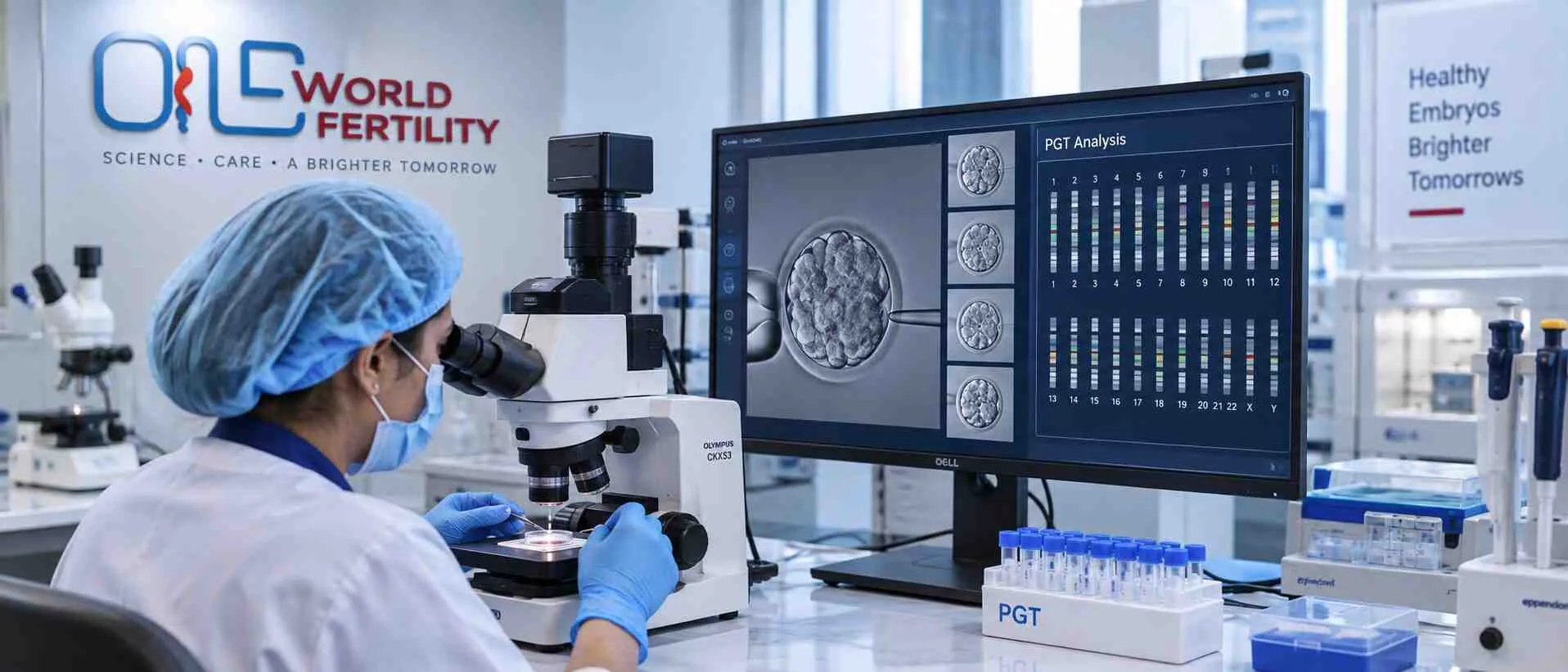

At One World Fertility, we use genetic testing of embryos together with IVF to assist you in selecting the most suitable embryo for transfer. We use preimplantation genetic testing (PGT) to screen for chromosomal defects or specific hereditary diseases in a small number of cells from each embryo.
PGT testing may be recommended if you are over 35, have had several miscarriages or unsuccessful IVF cycles, or have a known genetic problem. Our IVF with preimplantation genetic testing service includes genetic counselling, embryo biopsy, results review and frozen embryo transfer, with our experts assisting you through each step.
Why test? That’s because even an embryo that looks great under the microscope can nevertheless have a hidden chromosomal mistake that grading alone can’t discover.
What Is PGT Testing in IVF?
Preimplantation genetic testing (PGT) is a process done in the IVF laboratory to test a few cells from a blastocyst-stage embryo before transfer for chromosomal abnormalities or certain inherited genetic diseases. A blastocyst is a 5-7 day old embryo.
Preimplantation Genetic Testing Explained in Simple Terms
The full form of PGT is Preimplantation Genetic Testing. Preimplantation just means before implantation, which is the stage an embryo is in before it attaches to the lining of the uterus.
So, PGT testing in IVF happens before any pregnancy journey starts in the lab. You may also hear older names for the same thing, like PGS (screening) and PGD tests (diagnosis). Both of these are now part of PGT.
Embryo Grading vs Genetic Testing: What's the Difference?
Embryologists generally assess the embryo based on its appearance: its form, how many cells it has and how it is growing. Grading is helpful, but doesn't look at chromosomes.
Embryo genetic testing is more advanced, so it can tell you if the embryo has the proper number of chromosomes or a particular gene modification. Think of grading as evaluating a book by its cover, and PGT as reading a few chapters within. So, which patients benefit from looking beyond looks?
Who Needs Preimplantation Genetic Testing?
Not every patient undergoing IVF needs to have the embryos examined. Thinking: Should I do PGT testing? In these cases, it is often advised:
- Age 35 and older: The older the eggs, the more likely the embryos are to have chromosomal problems; thus, testing helps select a normal one.
- Recurrent miscarriage: PGT can identify chromosomal issues in the embryo that lead to several early pregnancy losses. Repeated implantation failure: If excellent-looking embryos repeatedly fail to implant, tests can determine if chromosomes are the cause.
- Known genetic carriers: If you or your partner are thalassemia carriers, sickle cell anaemia, or cystic fibrosis, PGT helps identify unaffected embryos.
- Balanced translocation or inversion: The parent is healthy, but can make embryos without or with extra bits of chromosomes.
- Previous affected pregnancy or child: Testing reduces the likelihood that the same genetic problem will affect your next baby.
That is why we do preimplantation genetic diagnosis: to minimise known dangers early on. The reason for testing also determines which PGT you need for your embryos.
Types of PGT Testing: PGT-A vs PGT-M vs PGT-SR
PGT is not one test. There are three main types of PGT and each of them looks for a different type of problem in the embryo. It is determined by your age, medical history and any genetic problems in your family.
What Does PGT-A Test For?
Preimplantation genetic testing for aneuploidy (PGT-A) screens an embryo for the correct number of chromosomes: 46, in 23 pairs. An embryo with missing or extra chromosomes is called aneuploid.
Such embryos generally don't implant or end in miscarriage. PGT-A embryo testing can also detect diseases such as Down syndrome (trisomy 21), Edwards syndrome (trisomy 18) and Patau syndrome (trisomy 13).
PGT-M and PGT-SR: Testing for Inherited and Structural Conditions
PGT-M checks for a specific change in a gene that is carried in your family. A customised test is created before the cycle begins to match your family’s exact mutation. It can also find a matching embryo for a sick sibling who needs a stem-cell transplant. That's the major difference between PGT-A and PGT-M. One looks at all chromosomes; the other targets one known gene.
What is PGT-SR testing? It is for parents who carry a translocation or inversion, which means sections of chromosomes have been rearranged. PGT-SR detects embryos with missing or extra parts. PGT-A can be added to either.
| Feature | PGT-A | PGT-M | PGT-SR |
|---|---|---|---|
| What it checks | Extra or missing chromosomes | One specific gene change | Missing or extra chromosome pieces |
| Ideal candidate | Age 35+, recurrent miscarriage, failed IVF | Carriers of a known genetic condition | A parent with a translocation or inversion |
| Example conditions | Down, Edwards, Patau, Turner syndrome | Thalassaemia, sickle cell anaemia, cystic fibrosis | Unbalanced translocations |
| Pre-test workup | Usually not needed | Yes: family genetic reports and a custom test | Yes: parental karyotype report |
Once you determine which test is right for you, here’s what the journey looks like at One World Fertility.
How Does PGT Testing Work at One World Fertility?
With PGT, you can still have an IVF treatment. You go through the same injections, scans and egg collection, with a few extra steps added before and after. Here's what the PGT process looks like with us.
Before Your Cycle: Counselling and Pre-PGT Workup
It all starts with a comfortable chat with our genetic counsellor. They discuss your medical and family history, recommend the right test, and explain what it can and cannot tell you. Some couples need a few initial reports.
For PGT-SR, that’s a karyotype, a simple blood test that maps your chromosomes. To create a custom PGT-M test, we need your family’s genetic results, and it may take a few weeks. That is why PGT must be scheduled before egg collection.
From Biopsy to Transfer: The PGT Testing Timeline
After fertilisation, we develop the embryos in our laboratory for 5-7 days until they reach the blastocyst stage. At this stage, our embryologist uses a fine laser to harvest 5-10 cells from the outer layer. These cells would make the placenta, not the infant.
The embryos are then safely stored and the cells sent for testing. Results can take about 1-2 weeks to return. After PGT testing, the embryo transfer normally takes place in the next cycle, when your uterine lining is ready.
| Stage | What Happens | Typical Duration |
|---|---|---|
| Counselling + workup | Counselling, consent, karyotype or family reports | 1–2 weeks (a few weeks for PGT-M) |
| Stimulation + egg collection | Daily injections, monitoring scans, egg collection | 10–14 days |
| Blastocyst culture + biopsy | Embryos grow, 5–10 cells removed, embryos frozen | Day 5–7 after egg collection |
| Lab analysis | Cells tested for chromosomal or genetic changes | 1–2 weeks |
| Uterine prep + transfer | Lining prepared, chosen embryo transferred | 2–4 weeks |
Discuss with our genetic counsellor whether PGT is appropriate for your IVF strategy. Your result comes in about two weeks after the biopsy, and it is rarely a straightforward pass or fail.
Understanding PGT Testing Results
Your PGT test results are sent to you as a short report for each embryo. At first, it may seem complicated, but every outcome falls into one of a few simple categories.
Euploid, Aneuploid and Mosaic Embryos Explained
- Euploid: The embryo has the normal number of chromosomes and is the best candidate for transfer.
- Aneuploid: The embryo is not transplanted because it is missing or has extra chromosomes.
- Mosaic: A mixture of normal and defective cells. After counselling, low-level mosaics can still be considered; however, high-level mosaics have a reduced success rate and a higher chance of miscarriage.
- No result: Sometimes the sample can't be read, and a re-biopsy may be proposed.
For PGT-M, embryos are categorised as untouched, carrier (healthy but carries the gene) or afflicted. These PGS results may be called older reports.
How Many Embryos Pass PGT Testing?
Egg age is the most important factor in the percentage of embryos that pass PGT testing. Some cycles, after 40, may not produce a normal embryo. Hard news, but it saves you the trouble of trying to make transfers that were unlikely to work.
| Age | Approx. Euploid Rate |
|---|---|
| Under 35 | ~55–65% |
| 35–37 | ~45–55% |
| 38–40 | ~30–45% |
| 41–42 | ~20–30% |
| Over 42 | ~10–15% |
Numbers are rough estimates; your doctor will tell you what they signify for you. A normal outcome is encouraging, but how far can you rely on it?
How Accurate Is PGT Testing?
Your PGT report helps decide which embryo is transferred, so it’s reasonable to worry about how much you can trust it. PGT testing is quite accurate today because next-generation sequencing (NGS) analyses the embryo's DNA in great detail. But no medical test is 100 per cent accurate.
Can PGT Detect Down Syndrome?
Yes. Down syndrome is caused by an extra copy of chromosome 21. Because this is a full chromosomal mistake, PGT-A can detect it quite reliably. However, "highly reliable" is not quite the same as "guaranteed.
Why a Normal Result Still Needs Confirmation in Pregnancy
PGT is a screening test, not a final diagnosis. The cells tested come from the layer that becomes the placenta, and sometimes they differ from the cells that become the baby.
PGT also can't find small fragments of missing DNA or new gene mutations. PGT testing can, in rare situations, be inaccurate. That's why ACOG recommends offering NIPT, CVS or amniocentesis during pregnancy, even if the result is normal.
Legal Disclaimer: PGT at One World Fertility is performed only for detection of chromosomal abnormalities and genetic conditions as per the PCPNDT Act and the ART (Regulation) Act 2021.
Embryo sex is never determined for selection or disclosure. Now that you understand what accuracy means and its boundaries, the true question is whether PGT is worth it to you.
Benefits and Limitations: Is PGT Testing Worth It?
For some couples, PGT can make a big difference; for others, very little. Knowing both sides means you can decide with your doctor instead of guessing.
PGT Testing Benefits: Who Gains the Most
The benefits of PGT testing are clearest when the risk is known. PGT-M and PGT-SR are well established for couples with a hereditary issue or a chromosomal rearrangement.
Women over 35 and those with repeated miscarriages or unsuccessful IVF cycles may benefit from PGT-A, which can reduce the chances of failed embryo transfers and miscarriage. For younger patients without that history, authorities like the ASRM and ACOG do not recommend it as routine. If you don't need it, we're being honest.
Risks of PGT Testing and Its Limitations
The risk to the embryo is quite low when the biopsy takes place at the blastocyst stage. The real merits and downsides of PGT are practical. Added cost, the likelihood that no embryo comes back normal, and mosaic results that demand careful consideration. PGT cannot repair abnormalities in the uterus or the uterine lining.
| Benefits | Limitations |
|---|---|
| May lower miscarriage risk | Added cost per embryo |
| Supports single embryo transfer | Possibility of no normal embryo |
| Helps prevent known inherited conditions | Mosaic results can be hard to interpret |
| May shorten time to pregnancy | Prenatal confirmation still advised |
For most families, the deciding factor is cost.
PGT Testing Cost at One World Fertility
You can make better plans if you know ahead of time how much the PGT test will cost. Before your cycle begins, One World Fertility will provide you with a clear, itemised estimate. PGT testing is normally priced per embryo tested. How much does the PGT test cost for you? That is subject to the following:
- Total number of embryos: the more blastocysts you test, the more it costs.
- Test type: PGT-M is more expensive, as a personalised test is created for your family first.
- Combined testing: the fee goes up when you add PGT-A to PGT-M or PGT-SR.
Your estimate will detail what's included in the quote, such as the biopsy and lab analysis, and what will be invoiced separately, such as embryo freezing and the frozen transfer.
You might also want to consider the expense vs. the emotional and financial toll of repeated failed moves. Price matters, but so does who's handling your embryos.
Why Choose One World Fertility for Embryo Genetic Testing
Choosing PGT is a major decision, and you need a team that makes it easier, not harder. At One World Fertility, Preimplantation Genetic Testing (PGT) is part of a full IVF process, developed to fit your history and your goals.
Your embryos will be looked after by skilled embryologists, growing them to the blastocyst stage, performing a delicate laser biopsy and freezing them safely whilst testing is performed. We use next-generation sequencing (NGS) to analyse the cells so you can get precise, reliable data. Before your cycle, your genetic counsellor will talk to you about which test is right for you.
Once the results are out, we will meet with you again to discuss what they indicate and assist you toward the right embryo for transfer. When you are ready, we are available to answer your questions and help you move forward with confidence. Book a consult with our fertility and genetics team.
Questions people ask about this treatment
10 answeredhere