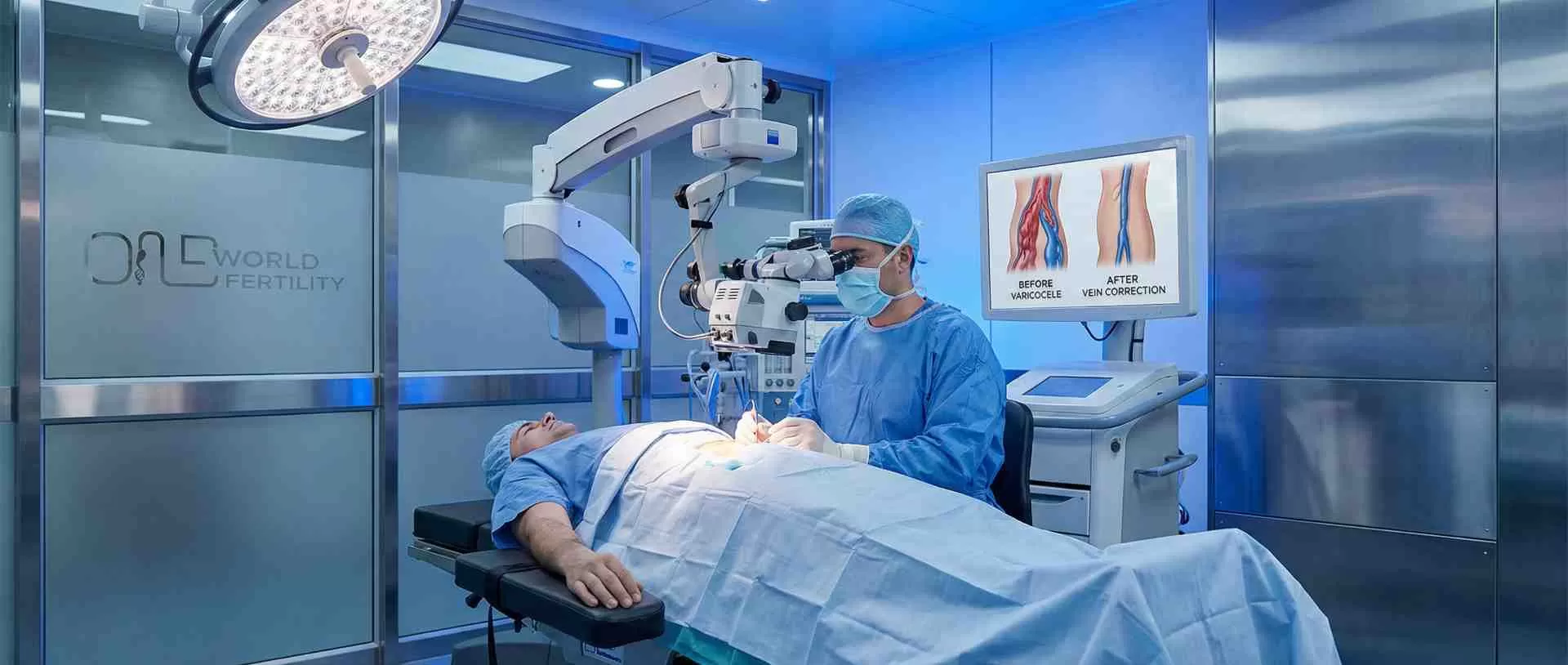



At One World Fertility, we perform TESA, Micro-TESE and PESA for men who need surgical sperm retrieval. All three procedures take place in our own operating theatre, with our andrology laboratory only a few steps away. That closeness matters. The sample we retrieve reaches our embryologist within minutes, still fresh, and we confirm what we find before you leave.
Many men come to us after a semen analysis has shown no sperm at all. It is a difficult report to read, and it does not always mean what people fear. Sperm can often still be found inside the testis or the epididymis and retrieved for use in IVF or ICSI.
Who Needs Surgical Sperm Retrieval?
Not every man with male factor infertility needs a retrieval procedure. We recommend it when there is no sperm in the ejaculate, or when the count is too low for the laboratory to use.
Most men we see have azoospermia, where repeated samples show no sperm at all. Others have severe oligospermia, where a few sperm appear but not enough for treatment to go ahead. We also treat men who cannot ejaculate on the day of the cycle, men whose semen travels backwards into the bladder, and men who had a vasectomy years ago and now want a child.
Blockage, earlier infection or surgery, genetic factors, and hormone problems underlie most of these findings. More on our male infertility page.
Does No Sperm in Semen Mean I Cannot Have My Own Child?
This is the first question almost every man asks us, and the answer is usually no. A semen analysis shows what has reached the ejaculate. It says nothing about what is happening inside the testis. Sperm production often continues at a level the sample never reflects, either because the passage out is blocked or because production is patchy rather than absent. We repeat the analysis on a second sample before drawing any conclusion, because one report is not enough to rule out your own biological child.
What Tests Are Done Before Sperm Retrieval?
We never change our approach based on a single report. We get a full picture of what is going on inside the testis and why the ejaculate is empty before we make any plans. Because a single sample can be wrong, the first step is to analyse the semen again. We check to see if there are no sperm at all or just too few to see clearly. We also look at the volume and pH, which often tell us where the problem is.
Alongside that, we run a small set of investigations that together tell us which procedure will work for you:
- Hormone profile covering FSH, LH and testosterone.
- Repeat semen analysis on a second sample.
- Scrotal examination with ultrasound.
- Genetic screening, including karyotype and Y-chromosome microdeletion.
- Review of your medical, surgical and treatment history.
Once these results are in, one question decides everything that follows.
How We Tell Obstructive from Non-Obstructive Azoospermia
The difference is important because it changes the whole process. In obstructive azoospermia, the testis normally makes sperm but can't get them out, so Hormone levels and testicular size are generally normal and sit within a range. This type of azoospermia doesn't block sperm flow, but it does lower or uneven production, and FSH levels often rise along with a smaller testicular volume. We reviewed the hormone profile, the ultrasound, and the test results together because none of these can be trusted on their own.
What Happens During a TESA Procedure?
TESA, or testicular sperm aspiration, is the most straightforward of the three procedures we offer. You come in on the morning of your partner's egg collection, or on a planned day if we are freezing the sample for later use.
The question men ask us most before this procedure is whether it will hurt. In practice, most describe it as pressure rather than pain. We give you local anaesthesia, sometimes with light sedation, and in a few cases a short general anaesthetic if you would rather be asleep. There is no incision. We pass a fine needle through the scrotal skin directly into the testis and draw out a small amount of tissue. If the first site gives us very little, we repeat the aspiration from another point in the same testis. The procedure is brief, and you stay in our day-care area afterwards rather than overnight.
Our embryologist examines the tissue while you are still with us, so we can tell you the same day whether we found motile sperm.
We recommend TESA when azoospermia is caused by a blockage rather than a failure of production, and for men whose earlier retrieval has already shown sperm are present.
When Is PESA Used for Obstructive Azoospermia?
PESA, or percutaneous epididymal sperm aspiration, is the procedure we use when we already know the passage out is blocked, and the testis itself is working normally. The epididymis sits just behind the testis and stores sperm before it moves on, so when the blockage lies further downstream, sperm collect there in good numbers. We reach for PESA in three situations in particular: men who had a vasectomy and now want a child, men born without the vas deferens, and men whose tubes have scarred after an earlier infection or surgery.
| Stage | What happens | How we support you |
|---|---|---|
| Before the procedure | Scrotal examination confirms the epididymis is accessible and the obstruction is clear | We review your reports with the andrologist and confirm the retrieval plan with both partners |
| Anaesthesia | Local anaesthesia with light sedation, no surgical incision | We keep you comfortable throughout and monitor you in the day-care area |
| Aspiration | A fine needle is passed through the scrotal skin into the epididymis and fluid is drawn | We aspirate from more than one site if the first sample is limited |
| Laboratory check | The fluid is examined for motile sperm while you are still in theatre | We confirm the result before the procedure ends so no second visit is needed |
| Discharge | Same-day discharge with simple aftercare instructions | We call you the next day to check how you are recovering |
Nothing in that sequence takes long. Most men are in and out within the morning, and the sample goes straight across to our andrology laboratory rather than being packed and moved. The result you are given before discharge is the result we work with.
Why We May Choose PESA Instead of TESA
Both methods work for blocking, so our team decides which one to use based on where they think they can find the best sample. When the epididymis is full and easy to access, PESA usually gives us sperm that can move around better because the sperm there are already fully grown. You don't have to come back another day if the epididymis is scarred or the aspiration comes back empty. We move on to the testicular aspiration at the same time.
What Is Micro-TESE and Who Is It For?
Micro-TESE, or microsurgical testicular sperm extraction, is the procedure we use when the testis is not producing sperm in normal numbers. This is non-obstructive azoospermia, and it behaves very differently from a blockage. There is no reservoir of sperm waiting to be drawn out. Production is patchy, confined to small pockets of tissue, and a needle passed blindly through the scrotum will usually miss them.
So we open the testis in our operating theatre and look. Under an operating microscope at high magnification, the seminiferous tubules that are producing sperm appear fuller and wider than those that are not. Our surgeon works along the tissue identifying these tubules one by one and removing only the small amounts that look promising. At the same time, the embryologist examines each piece as it comes across.
That care is what makes the procedure worthwhile, and also why we do not offer it first. Micro-TESE needs general anaesthesia, more time under the microscope, and longer recovery than a needle aspiration. When a blockage is the cause, TESA or PESA will find sperm faster and with less disturbance to the testis.
What We Do If No Sperm Is Found
Sometimes we search thoroughly and find nothing usable. We tell you on the day rather than leaving you waiting, and we sit down with both of you before you go home. Whether a second attempt is reasonable depends on what the tissue showed and what your hormone results looked like, and we will say plainly if we think another procedure would put you through more without changing the outcome. Donor sperm is one option we discuss when we reach that point. Counselling support is available to you at every stage.
What Is the Difference Between TESA, PESA and Micro-TESE?
Couples often arrive having read that one of these procedures is better than the others. It's fair to wonder, but the comparison doesn't work that way. None of the three is superior on its own terms. Each one is built for a different reason behind the empty semen sample, and the right choice follows the cause rather than a ranking. What we are really deciding is where sperm is most likely to be, and how much of the testis we need to disturb to reach it.
| Procedure | Where sperm is retrieved from | Who it suits | Anaesthesia and setting |
|---|---|---|---|
| TESA | Testicular tissue, drawn by needle | Men with obstructive azoospermia, and selected cases where earlier retrieval succeeded | Local anaesthesia with sedation, day-care theatre |
| PESA | Fluid from the epididymis | Men with confirmed obstruction, including post-vasectomy and absent vas | Local anaesthesia with sedation, day-care theatre |
| Micro-TESE | Individual seminiferous tubules, identified under an operating microscope | Men with non-obstructive azoospermia where sperm production is patchy | General anaesthesia, full operation theatre, longer procedure time |
Read across the rows, and the pattern is clear enough. Obstruction gives us a choice between two simple needle procedures, and the decision rests on which site looks more promising on the day. Failed production leaves only one route, and it asks more of you in return for a genuine chance of finding sperm that no needle would have reached.
How Is Retrieved Sperm Used in IVF and ICSI?
Your partner's egg collection is timed to coincide with the retrieval, so both parts of the cycle happen on the same morning.
The sample goes straight from theatre to our andrology laboratory, a short walk rather than a transfer. The embryologist assesses it at once: how many sperm are present, whether any are moving, and whether they can be used. Surgically retrieved sperm is rarely like an ejaculated sample. There is less of it, movement is sluggish or absent, and it has to be searched for.
This is why we always pair it with ICSI. The embryologist selects a single sperm and injects it directly into a mature egg, so fertilisation doesn't rely on the sperm reaching the egg. If you want to learn more about ICSI, you can read our detailed page.
Planning a Fresh or Frozen Retrieval Cycle
Retrieval does not always happen on the day of egg collection. Sometimes we retrieve and freeze first, then thaw when your partner's cycle is ready. We suggest this in three situations:
- When the outcome is uncertain, and we would rather know before stimulation begins.
- When you cannot both reliably be in the unit on the same day.
- When a Micro-TESE has already given us enough sperm for more than one cycle.
Where the diagnosis is clear and both of you can attend, a fresh cycle is simpler.
Can Sperm Be Frozen for Later IVF Cycles?
Yes, and if the retrieval gives us enough to work with, we usually do. We freeze and store anything not needed for the current cycle in our andrology laboratory under your name.
The reason is simple. A retrieval is a procedure, and no man should go through it twice if once will do. If the first cycle does not end in a pregnancy, or if you come back in a few years for a second child, we thaw what we already hold rather than returning you to theatre. Your partner's cycle can then be planned without waiting on a surgical date.
Does freezing weaken the sperm? Some loss on thawing is normal, but because ICSI needs only one sperm for each egg, a reduced count after thawing rarely changes what we can do with the sample. How much we can store depends on what the procedure yields, and after a Micro-TESE that is sometimes very little. We tell you plainly what we have put away, so you know from the outset whether a future cycle will need another retrieval.
How Long Does Recovery Take After Sperm Retrieval?
Recovery follows the same pattern as the procedures. A needle aspiration leaves only a puncture site, so TESA and PESA settle quickly, and most men are back at a desk within a short period. Micro-TESE involves an incision, so it requires more time and a slower return to activity.
Some discomfort in the first day or two is normal. We send you home with pain relief, rest, scrotal support (A specialised undergarment or belt designed to lift, hold, and provide gentle compression to the testicle sac) and no lifting.
A few things we ask you to ring us about: If the swelling or pain keeps getting worse, call us instead of waiting it out. The same goes for fevers and discharge from the wound. These are rare, but you should catch them early.
| Procedure | What recovery usually looks like | How we support you afterwards |
|---|---|---|
| TESA | Mild soreness and slight swelling for a short period, most men return to desk work quickly [timeline pending clinic confirmation] | We provide pain relief, aftercare instructions and a follow-up call |
| PESA | Similar to TESA, with less tissue handling and usually a settled recovery [timeline pending clinic confirmation] | We advise on scrotal support and rest, and review you if discomfort persists |
| Micro-TESE | Longer settling period because of the larger incision, with a gradual return to physical activity [timeline pending clinic confirmation] | We arrange a wound review, guide activity restrictions and stay available between visits |
Does the Procedure Affect Testosterone or Sexual Function?
Will retrieval change how you feel as a man afterwards? For most, no. TESA and PESA remove very little tissue and leave hormone production untouched. Micro-TESE takes more, so testosterone can dip for a period, though it usually recovers. Erections, desire and ejaculation are unaffected by all three, because none of them disturbs the nerves or blood supply involved. Where a hormone check is worth repeating later, we arrange it.
Why Couples Choose One World Fertility for Sperm Retrieval
What makes this work unique is how close it is. Our surgery room and andrology lab are in the same building, so a sample taken in the morning is quickly examined under the microscope by the embryologist.
That single fact shapes most of what follows:
- No one packs, moves, or hands the sample over to a third party.
- The andrologist and embryologist work together to plan each retrieval, not one after the other.
- If the first aspiration doesn't show anything, the next step is decided in the operating room while the lab is already reviewing it.
- The result is confirmed before you leave, so no second visit is needed to find out.
For men with a non-obstructive diagnosis, the day carries more weight, and the result is not always the one hoped for. Counselling support at One World Fertility is available to both partners from the first consultation onward, not only when results are difficult.
Questions people ask about this treatment
10 answeredhere