



Many women, while undergoing a fertility screening, are handed a request form with a short word written across it, and the meaning of this is rarely discussed at the counter. Saline infusion sonography (SSG) is a simple ultrasound evaluation in which a tiny amount of sterile saline is gently introduced into the uterus, so the cavity and the flow past the fallopian tubes may be clearly visualised on the screen. It acts as both a uterine cavity scan and a tubal patency test in the same session, and there is no X-ray or radiation at any time.
This page is about the SSG test in medical terms. If you are looking for what SSG stand for in medical terms, then you are on the right path. It explains what the SSG test looks for, why a doctor might recommend it, how to prepare for it, what happens during the session and how the results are read when it is done.
What Does SSG Mean in Medical Terms?
The word on a request form is often longer than the two or three letters it is. Medical names in this field are long, and departments cut them down for the simplicity of documents. The problem is that the same assessment can be located under more than one label. Much relies on where the scan was taken and how that centre reports it.
What Is the Full Form of SSG?
So, the full form of SSG in medical reports is Sono Salpingo Graphy, where “sono” is sound-based imaging and the word “salpingo” is the fallopian tube. Sonosalpingography is the name for a sonogram of the tubes, written jointly. Some centres write the entire form of SSG in medical ultrasound records; others write it as an SSG scan only.
How Does SIS Differ From SSG?
The meaning of SIS for the medical department is Saline Infusion Sonography, often known as saline infusion sonohysterography, abbreviated as the SHG test. The difference is a matter of focus: SSG follows the saline past the fallopian tubes, while SIS examines the lining of the uterine cavity.
Why is one assessment reported under three different abbreviations? Departments label it after the portion they were asked to look at, so patients wonder if SIS is the same as SSG. Once that is evident in the medical term sense, then a report saying saline sonogram makes sense too, and the SIS meaning in medical words for women follows easily.
Here are the most common abbreviations you will see on fertility request forms and reports. If you read them side-by-side, the differences are easy to keep in mind.
| Term Used |
Full Form |
What It Examines |
| SSG |
Sono Salpingo Graphy |
Fallopian tube flow |
| SIS |
Saline Infusion Sonography |
Uterine cavity lining |
| SHG |
Saline Infusion Sonohysterography |
Cavity shape and surface |
| HSG |
Hysterosalpingography |
Tubes, using dye |
| TVS |
Transvaginal Sonography |
Baseline pelvic view |
HSG is the only one in this list that uses X-ray and dye, not ultrasound and salt water. Everything else on the table relies on sound waves alone, which is why saline infusion sonography (SSG) is categorized separately from it.
Now that we have the nomenclature sorted, the following question is why this scan is ever recommended at all.
Why Is an SSG Scan Advised?
No doctor would suggest this scan without a reason. It’s often a question that an earlier scan or combination of symptoms left unanswered, and answered. This gap is filled by saline infusion sonography (SSG), which shows the cavity and tube flow combined. The following explains who is advised the scan and how it fits in a treatment plan.
Who Is Usually Recommended This Scan?
The largest category comprises couples under fertility testing, women with repeated pregnancy loss or unexplained pelvic problems. Who else might be advised to have this scan? Anyone with an unknown cavity from a previous routine scan.
If polyps are suspected or fibroids are pushed inward, or there are adhesions or an abnormal contour of the lining, a scan of the uterine cavity is brought forward. The same sitting can double as an SSG test if tubal flow is in question.The most common reasons to consider this fertility ultrasound test are the conditions below.
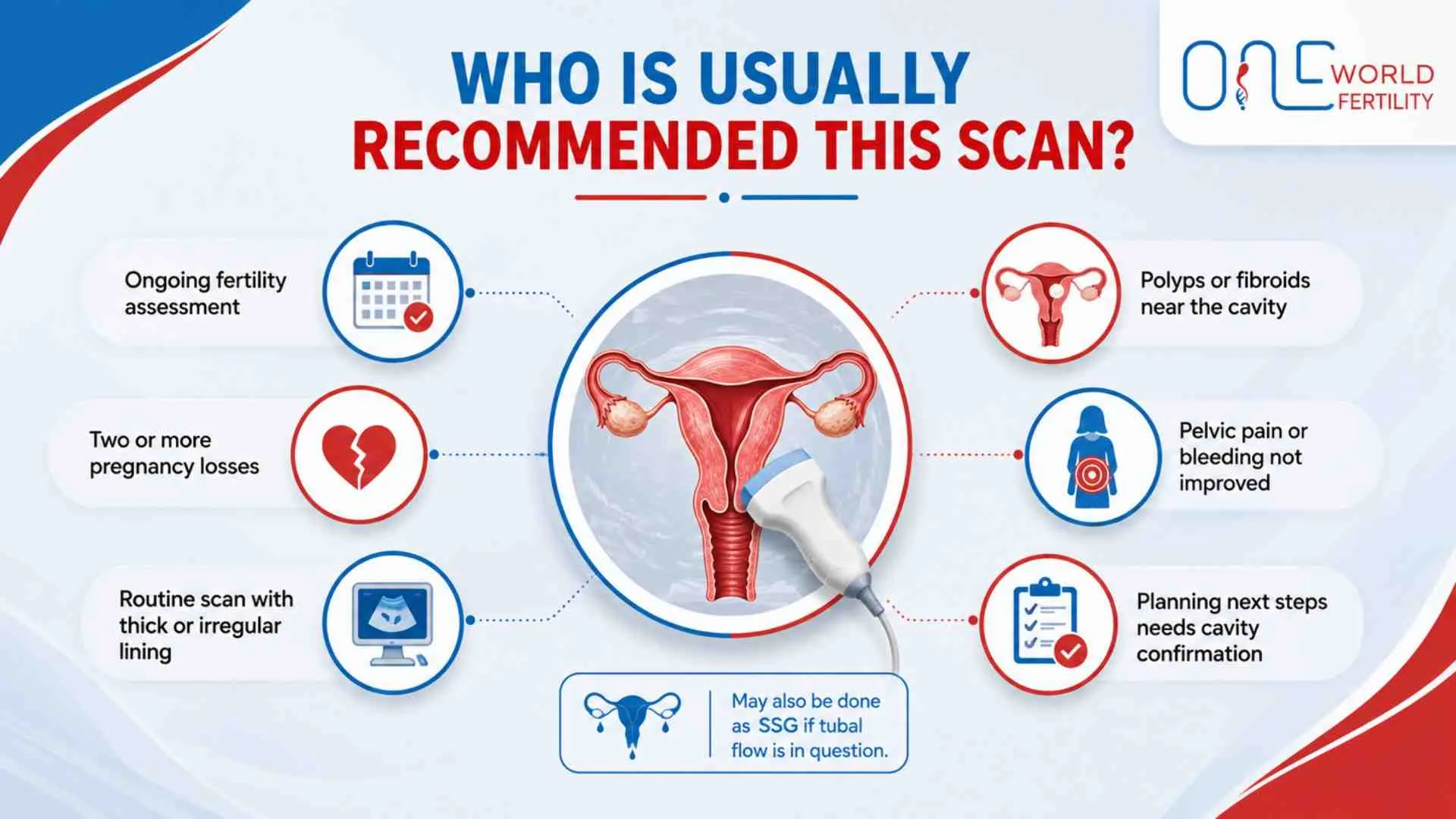
- An assessment that has been going on for several months without a clear response.
- Two or more pregnancy losses with no known reason.
- A routine scan showing a thicker or irregular line.
- Saline sonogram for uterine polyps and fibroids near the cavity.
- Pelvic pain or bleeding that failed to improve with previous management.
- Planning that needs confirmation of the cavity before the next phase.
How Does It Fit Into Fertility Planning?
The SSG test is normally early, after basic blood tests, and before a line of treatment is set. What does a clear cavity picture add before treatment planning? Now there is no guesswork since if a polyp or adhesion is found, it can be treated rather than being found later.
That’s why an SSG test before preparing for IVF or IUI is frequent, and when SSG is recommended before fertility therapy, the objective is information, not treatment itself.Once the scan is recommended, it’s about the logistics of the visit.
How Should Someone Prepare, and How Is the Scan Carried Out?
If you sort out the timetable and documentation beforehand, the appointment goes smoothly. Why is it worth paying attention to preparation for the SSG test? A timely scan is without a return visit and delivers a cleaner image of the cavity. This includes the preparation and the procedure itself. The instructions below describe this.
Which Day of the Cycle Is Preferred
Most centers will time the scan in the post-menstrual, pre-ovulatory period, after bleeding has ceased but before ovulation. By this time, the lining is thin; therefore, the cavity is very visible. If you would like to know which day of the cycle is ideal for the SSG test sessions, the specific date is from your treating doctor. Follow the date specified, not a general guideline.
What Should Be Arranged Before the Appointment
Preparing for the SSG test is easy and requires little effort. Bring your previous scan reports, medication record, a valid identification and a sanitary pad for after. As a rule, fasting is not required, and the need to take anything before the test is decided by the doctor treating you. In most situations, that’s all the preparation needed for an SSG test.
Please check these points before you leave your home. Each is one simple step that makes the day predictable.
| Preparation Point |
Why It Matters |
Typical Guidance |
| Cycle timing |
Clear cavity view |
Post-period window |
| Previous reports |
Comparison baseline |
Carry all copies |
| Infection screening |
Procedural safety |
As advised earlier |
| Bladder status |
Comfort during scan |
Follow clinic instruction |
| Companion support |
Travel home ease |
Optional but helpful |
None of these is long to arrange, but all save time at the centre. Once they are in place, the SSG method follows a specific pattern.
What Happens Step by Step During the Scan
The step-by-step technique of saline infusion sonography consists of positioning and a baseline transvaginal scan. What happens when the catheter is inserted? A speculum is inserted, the cervix is swabbed clean, a fine catheter is threaded through it, and sterile saline is slowly injected.
From start to finish, that’s how a saline sonogram is done. We watch the cavity and the flow past the tubes in real time.The identical sequence is shown in the table with rough timings next to it. It gives a good idea of how the minutes are used.
| Stage |
What Is Done |
Approximate Time |
| Preparation |
Positioning and cleaning |
A few minutes |
| Baseline scan |
Initial pelvic view |
Short |
| Thin tube inserted |
Brief |
Saline instillation |
| Catheter placement |
Thin tube inserted |
Brief |
| Saline instillation |
Cavity gently distended |
Short |
| Observation |
Cavity reviewed |
Main scan phase |
| Completion |
Catheter removed |
Brief |
So what is the real time for an SSG test? The scan itself is short, but the whole visit is longer when you include registration, changing and a short rest afterwards.Those few minutes of imaging dictate what the report can say, and what it cannot.
What Can the Scan Show, and What It Cannot
Some questions every imaging test leaves open, and others it answers well. In that list, where does saline infusion sonography (SSG) fit in? There is a clear view of the cavity and tube flow, but some results still need a different test. It's much easier to understand the report if you know both sides.
What Is Seen Inside the Uterine Cavity
As saline flows between the walls of the uterus, everything on the lining is seen against the fluid. A uterine cavity scan indicates polyps, submucosal fibroids, adhesions, a septum or an uneven contour, which is typically missed on a plain scan. That's why a saline sonogram for uterine polyps and fibroids delivers clear SSG test results and findings.
How Is Tubal Flow Assessed
The saline flows, and the sonologist looks for free spill past the tube ends. This is what a tubal patency test looks for. Can SSG detect blocked fallopian tubes with certainty? Not usually, as a spasm on the day can imitate a block; thus, an SSG test for blocked fallopian tubes reads as an indication, not an outcome.
Where Are the Limits of This Assessment
The scan follows a set flow, so that's all it can tell you about the interior health or operation of the tubes. It also cannot substitute for a direct view when suggested, which is the difference with hysteroscopy for assessment of the uterine cavity. An SSG test result taken in isolation is not very informative, as the treating clinician will always interpret the data with your history and other reports.
Below is what each more generally leads towards, not what it verifies.
- Smooth cavity outline suggests no growth pressing into the lining.
- Filling defect may be a polyp or fibroid requiring additional testing.
- Irregular contour may reflect bonds or a shape variation.
- Free spill on both sides indicates flow is unhindered.
- Only one side spill means more review needed on the other side.
- Small spill may be spasm, not real block.
These strengths and limitations are more clearly appreciated in relation to other available tests.
How Does SSG Compare With Other Fertility Tests
The tests look at the same area, but each asks a slightly different question about the uterus and tubes. Which one will the doctor choose first? It depends on what has to be checked, how detailed the answer needs to be, and what the centre has on site. Knowing how saline infusion sonography (SSG) fits in with the others makes the option easier to follow.
How Is It Different From an HSG?
The difference between SSG and HSG tests is what takes the scene. Is SSG a radioactive one? No. Saline infusion sonography (SSG) is an ultrasound test, so it is a tubal patency test without X-ray radiation. HSG employs X-ray and contrast dye. HyFoSy is even closer to saline infusion sonography with foam under ultrasound, with centres offering one or the other by set-up.
When Is a Direct View of the Cavity Considered
A hysteroscopy involves a tiny camera being inserted for a direct view. When uterine cavity scanning reveals something that requires confirming or fixing, it follows. This is the practical sense of SIS versus hysteroscopy for uterine cavity assessment: one leading to the other rather than competing with it.
Reading the four side by side, you know the option. Each has visual representation behind it as the main separating element.
| Assessment |
Imaging Used |
Main Focus |
Radiation Involved |
| SSG / SIS |
Ultrasound and saline |
Cavity and flow |
No |
| HSG |
X-ray and contrast |
Tubes and cavity |
Yes |
| HyFoSy |
Ultrasound and foam |
Tube flow |
No |
| Hysteroscopy |
Direct camera view |
Cavity surface |
No |
Comparisons help you choose, but the next question most women ask is what the appointment is like.
What to Expect During and After the Scan?
Knowing how the day generally goes takes away a lot of the worry. For most people, SSG scans have minimal symptoms that go away shortly. The next few hours include the scan itself, along with the points below. Together they outline the shape of a normal recovery and what exists outside of it.
How Much Discomfort Is Usually Felt
Will the SSG test be uncomfortable or painful? Most women report a cramping feeling similar to period discomfort, which is mostly noticed as the saline is being injected. After the SSG process, it subsides in a short period of time. Some feel very little, and some more, which is worth discussing with the team on the day.
What Does the Rest of the Day Look Like?
Light spotting and watery discharge for a day or so is usual, and most people resume routine exercise soon afterwards. When will things return to normal? Saline infusion sonography recovery time is usually hours rather than days after an SSG scan.
That said, there are limits to what to expect after SSG test appointments that are important to know, so please get in touch with your care team promptly if fever, excessive bleeding or pain that does not calm develops.
The table shows the common pattern against what each one asks for. It’s a quick reference for the scan date.
| Experience |
Usual Pattern |
Suggested Response |
| Mild cramping |
Settles quickly |
Rest, as advised |
| Light spotting |
A day or two |
Use a pad |
| Watery discharge |
Short-lived |
No action needed |
| Persistent pain |
Not expected |
Contact care team |
| Fever |
Not expected |
Contact care team |
The first three rows are to be expected and require no action but rest. The last two are not part of ordinary recovery and should be reported.A couple of easy routines make the rest of the day smoother.
- Take a sanitary pad for any spotting that might occur.
- Don’t plan anything strenuous. Keep the day light.
- Drink fluids normally and eat as you normally would.
- Follow your doctor’s advice.
- Keep the contact number for the center handy.
A lot of how the day feels depends on where the scan is done and how the appointment is managed.
Why Choose One World Fertility for an SSG Scan?
The scan is the same everywhere. The difference is how they do an appointment. What to look for in a center? Clear scheduling, a private area, and someone to discuss the findings following the presentation.
What Does the Scan Experience Look Like Here
The SSG scan appointment is arranged according to your cycle window, so the date is confirmed when your previous period is known. Before you get in you are sanitized and every process is explained as it happens. This is what an SSG test is at a fertility facility if someone is looking for a fertility ultrasonography test near me.
How Is the Report Shared and Explained
The sonologist who performed your scan will review your saline infusion sonography photos. What differentiates a report and an understanding? A conversation, because the SSG test report's meaning and conclusions are best understood when they are discussed thoroughly. That conversation is important when you're considering where to get a saline sonogram done.
A few things get corrected before you come.
- Scheduling according to your cycle window
- Private scan room sterile setup ready
- Earlier reports reviewed alongside the new visuals
- Report generated and shared
- Discussed findings with you.
To schedule an SSG scan or to discuss the next step, please get in touch with the One World care team.
Conclusion: Reading the Report and Planning the Next Step
Saline infusion sonography (SSG) answers two useful questions in one sitting, revealing the morphology of the uterine cavity and whether the saline passes smoothly beyond the tubes. But it does not stand alone. Your treating doctor considers the meaning and findings of the SSG test report along with your history, previous scans and any blood testing that has been done so far.
So what happens if the SSG is abnormal on report? It usually refers to a next step, rather than a final one, whether it be an additional look at the cavity or a modification in the planning of therapy. In any case, the next move is from a conversation, not a printout. At One World Fertility, that talk is included as part of the scan, not something apart.
Questions people ask about this treatment
10 answeredhere