

Have you been trying to get pregnant but not getting any answers? Sometimes the issue isn't what you can see; it's what's going on within. You're already one step closer to figuring out what's wrong if your doctor has suggested an HSG test. An HSG test, which stands for Hysterosalpingogram, is a simple and rapid fallopian tube dye test, also called a tube dye test or pregnancy HSG, that gives your fertility specialist a clear view of your uterus and tubes. So what HSG test does for you is provide answers that other tests simply cannot. It looks to see if your tubes are open or obstructed, which is very important for getting pregnant naturally.
We do everything we can to make this process as easy and stress-free as possible at One World Fertility. This includes setting up your HSG test appointment and explaining every result in straightforward, uncomplicated terms.No doubt. No guessing. Just simple answers that give you the courage to keep going on your quest to have a baby.
What Is HSG? Meaning, Full Form & Medical Definition
Don't worry if your doctor told you about an HSG test and you don't know what it is. You're not the only one. HSG is a quick imaging procedure that lets your doctor look inside your uterus and fallopian tubes without having to undergo any surgery. It shows if your tubes are open or obstructed, which is very important for getting pregnant naturally. Think of it as an X-ray map of your reproductive system.
At One World Fertility, we'll explain everything to you in simple terms with no complicated medical terms.
HSG Full Form - What Does HSG Stand For in Medical Terms?
What does HSG mean? HSG stands for Hysterosalpingogram, which is also known as Hysterosalpingography (yeah, it's a mouthful!). This is what it means in detail:
Hystero = Uterus (your womb)
Salpingo = Fallopian Tubes
Gram = Image
So, the hysterosalpingography medical term is just an X-ray picture of your uterus and tubes. That's all. It doesn't sound as scary as it is, does it?
What Is a Hysterosalpingogram Procedure at One World Fertility?
So what is a hysterosalpingogram procedure, anyway? Here's what occurs, step by step:
- A thin catheter is carefully put in: A little, flexible tube goes through your cervix and into your uterus. It sounds painful, but most women say it feels like moderate cramps.
- Contrast dye flows through your system: A unique HSG dye is progressively introduced into your body through the catheter. This dye goes through your uterus and into your fallopian tubes, lighting the way.
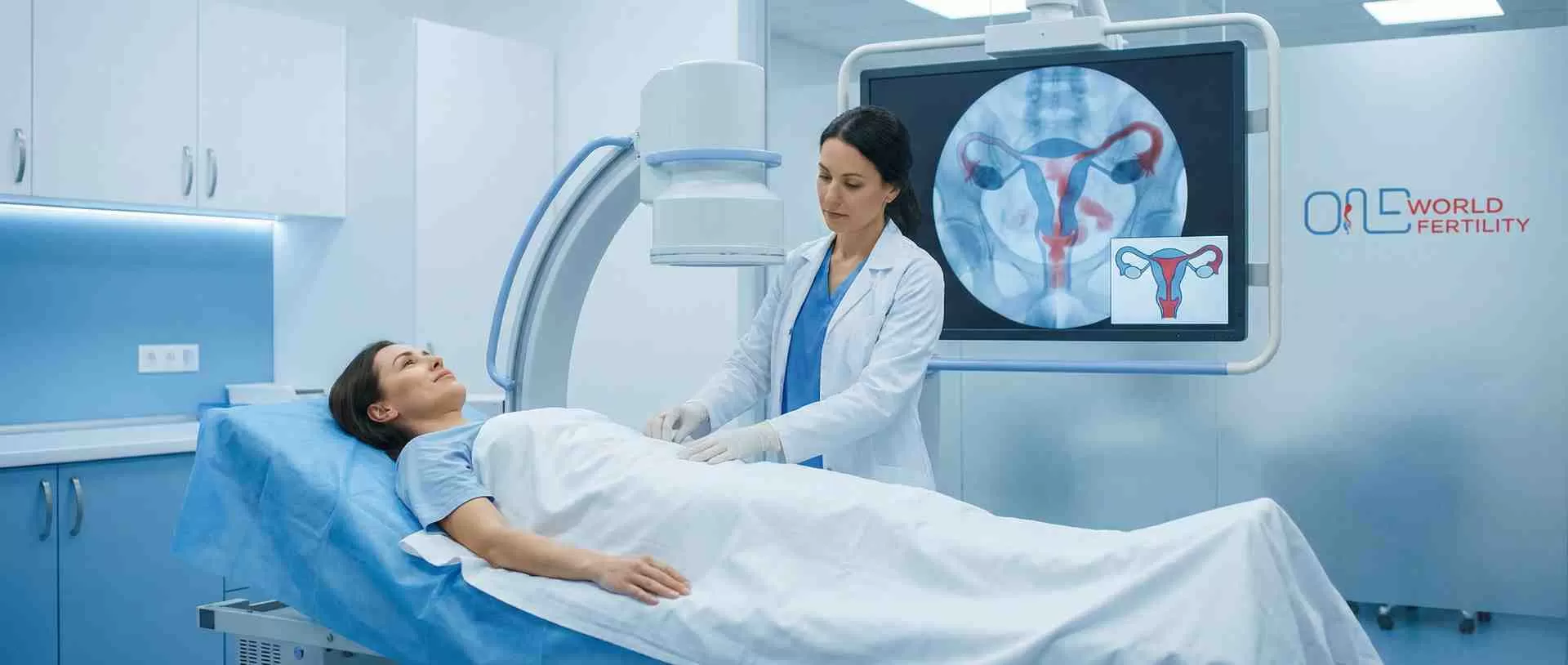
- Real-time X-ray imaging captures everything: A hysterosalpingogram X-ray (also known as an HSG X-ray or blocked fallopian tube X-ray) captures live images of the structures as the dye travels through them. This HSG tube test allows your doctor to identify exactly where issues are.
- Your doctor looks for blockages: The womb X-ray shows if the dye passes smoothly through both tubes or gets caught. If it does, then that means there is a blockage.
You may think of the dye as a highlighter on a map. The X-ray of the uterus indicates where the path is clear and where it is blocked.
Why Do Doctors Recommend an HSG Test? - Purpose & Uses
If your fertility doctor has told you to get an HSG test, you might be asking Why this test? What exactly will it show? Here's the honest answer: what the HSG test shows can make all the difference in understanding why pregnancy hasn't happened yet. This uterus test is one of the most essential fertility tests since it shows things that other tests can't. It's a fallopian tube test, also known as a tube test or tube test pregnancy assessment, that checks whether they are open, closed, or only partially blocked. What does the HSG test tell you?
- Whether your fallopian tubes are open or blocked: This is the main reason doctors order this tube test for pregnancy.
- The shape and structure of your uterus: Finding fibroids, polyps, scar tissue, or a uterine septum.
- Where a blockage is located: Your doctor knows exactly what treatment to suggest next.
- If there's a hydrosalpinx: a tube packed with fluid that can lower the chances of IVF working.
In short, this tube test for pregnancy gives your fertility experts at One World Fertility a full picture of your reproductive anatomy so they can make the best plan for you.
Top Benefits & Advantages of HSG Test
So, besides finding out what's wrong, what are the real benefits of the HSG test? This is why this dye test for fertility is generally the first thing people are told to do:
- Quick and precise - Results are accessible right after the operation
- No surgery - No cuts, no anaesthesia, and no need to go to the hospital
- Minimal recuperation time - Most women return to work the same day
- Can be therapeutic - The dye test itself may help clear up small blockages (more on this below!)
- Guides your next steps - The HSG test offers you the clearest way to go next, whether it's IUI, IVF, surgery, or natural pregnancy.
One of the advantages of the HSG test is that it can sometimes detect and correct minor problems with the tubes while also diagnosing them. At One World Fertility, we make sure you know what every result means for your reproductive journey. There's no uncertainty, only clarity.
Does HSG Test Improve or Increase Fertility?
We get this question all the time: Can the HSG test actually help me get pregnant? Yes, sometimes it can. Studies have shown that HSG can increase fertility in women with minor tubal blockages. The HSG dye travels into your tubes during the hysterosalpingogram, which is like a gentle flush that gets rid of mucus plugs or light adhesions that might be in the way. Because of this, a lot of women get pregnant spontaneously in the three to six months after the test.
So does HSG clear blocked tubes? It depends. Small clogs, like mucus plugs? Yes, HSG can clear blocked tubes. Severe blockages from conditions like endometriosis? You'll need further treatment. Think of it like cleaning out a clogged sink. Small blockage? The pressure clears it. Bigger issue? At least now you know what you're dealing with, and your doctor at One World Fertility can guide you on the next step. In the end, HSG gives you true answers, which are worth a lot, no matter what.
HSG Test Procedure at One World Fertility - Step-by-Step Guide
Do you want to know how the HSG is done? Knowing what happens during the HSG can make you feel better. The good news is that the HSG test procedure is quick and easy, and it can be done right in our imaging suite. You won't need to go to the hospital or stay overnight. Let's walk through how the HSG test is done at One World Fertility.
How Is HSG Done at One World Fertility
| Step |
What Happens |
Time Taken |
| Step 1 - Preparation |
You lie comfortably on the X-ray table, and the pelvic area is gently cleaned |
5 mins |
| Step 2 - Speculum Insertion |
A speculum is placed to access your cervix (just like a Pap smear) |
2 mins |
| Step 3 - HSG Catheter Insertion |
A thin HSG catheter is passed gently through your cervix into the uterus |
2-3 mins |
| Step 4 - Dye Injection |
The contrast HSG dye is slowly injected into your uterine cavity |
3-5 mins |
| Step 5 - X-Ray / Fluoroscopy Imaging |
Real-time fluoroscopy hysterosalpingogram images are captured as the dye flows |
5-10 mins |
| Step 6 - Spillage Observation |
The radiologist checks whether dye spills freely from both tube ends |
2-3 mins |
| Step 7 - Catheter Removal & Rest |
Catheter is removed, and you rest briefly before heading home |
5 mins |
| Total HSG Procedure Time |
15–30 Minutes |
HSG Instruments & Catheter Used in the Procedure
What tools are used during the test? The HSG process needs a few basic tools:
- Speculum - Like a regular pelvic exam, it helps access your cervix
- HSG catheter - A very thin, flexible tube passed gently through your cervix. This catheter for hysterography carries the dye inside
- Contrast dye - The special liquid that highlights your uterus and tubes
- Fluoroscopy X-ray machine - Takes real-time moving images as the dye flows
We use cutting-edge HSG radiology and fluoroscopy hysterosalpingogram equipment at One World Fertility to get the clearest pictures with the least amount of radiation. Everything is clean, disposable, and made to make you feel good.
How Long Does the HSG Test Take?
How long will you be there? The whole HSG procedure takes about 15 to 30 minutes, which includes getting ready, taking pictures, and a short break. Quick breakdown: Getting ready and getting in place: about 5 minutes Inserting the catheter and injecting the dye takes about 5 to 8 minutes. X-ray imaging takes about 5 to 10 minutes.
Rest and discharge: around five minutes What real imaging happens when X-rays are taken? Only 5 to 10 minutes. Most ladies leave after 30 to 40 minutes and return to their usual lives the same day.
Understanding Blocked Tubes - HSG Tubal Patency Testing at One World Fertility
Blocked fallopian tubes are the root of about 25–30% of all occurrences of female infertility. The HSG test is the primary tubal patency test and determines whether the tubes are open, slightly clogged, or completely blocked. What does "tubal patency" mean? In simple terms, your tubes are clear and open, allowing eggs to move freely from your ovaries to your uterus. If they are obstructed, it is almost impossible to get pregnant naturally.
How to Check If Your Fallopian Tubes Are Blocked
There are a few other ways to check if fallopian tubes are blocked, besides HSG:
| Test |
What It Is |
Advantage |
| HSG |
X-ray with contrast dye |
Gold standard, first-line test |
| Sono-HSG |
Ultrasound-based |
Radiation-free |
| Laparoscopy |
Surgical camera |
Direct visualization (most accurate) |
| Selective Salpingography |
Advanced HSG with catheter pressure |
Can open blockages during procedure |
If your HSG test shows a blockage, our specialists at One World Fertility can do Selective Salpingography right away. This could relieve the blockage without the need for further surgery. It's a single appointment for diagnosis and therapy.
Can HSG Unblock Tubes? The Tube Flushing Effect Explained
Yes, in some cases, the HSG procedure itself can unblock tubes through what's known as a fallopian tube flush. Many women seeking HSG to unblock their tubes are surprised to learn that the gentle pressure from the dye during the test can sometimes clear minor obstructions on its own. Here's a quick breakdown of when HSG can and cannot unblock tubes:
HSG Test Results - Normal vs Abnormal Report Explained
You've had your HSG test. Now comes the bit that everyone is worried about: What do my results mean? It doesn't have to be hard to understand your HSG report. At One World Fertility, we explain every HSG test result in plain, uncomplicated terms so you know precisely where you stand and what to do next. Let's look at the differences between a normal HSG and an abnormal hysterosalpingography result.
What Does a Normal HSG Report Look Like?
A normal HSG report is fantastic news since it signifies your reproductive system is healthy and open. Here's what a healthy normal HSG shows:
- The uterine cavity is smooth and triangular, with no fibroids, polyps, or other problems with the structure.
- Bilateral spilling means that dye flows freely through both fallopian tubes and spills out of the ends.
- There are no blockages or impediments, and the journey from the uterus to the tubes is clear.
- The uterus is the right shape and size, and there are no septa or other problems.
Your tubes are open (patent), and your uterus is structurally sound if you have a normal hysterosalpingogram. This means that eggs can move around easily, and natural conception or IUI are both good possibilities. What occurs next after a normal HSG test? Usually, your doctor at One World Fertility will suggest:
- Trying to become pregnant naturally for a few more cycles
- Proceed with IUI if other factors are present
- Looking into other probable fertility problems, such as ovulation, sperm quality, and so forth
Abnormal HSG Results - What Happens Next at One World Fertility?
An abnormal hysterosalpingography doesn't imply you can't have a kid; it only means we've figured out what's been stopping you from getting pregnant.
| Finding |
Recommended Next Step |
| One tube blocked |
Try IUI with the open tube or natural conception |
| Both tubes blocked |
Consider Selective Salpingography, surgery, or move to IVF |
| Hydrosalpinx |
Surgical removal/repair before IVF (improves success rates) |
| Uterine abnormality |
Hysteroscopy to correct polyps, fibroids, or septum |
| Minor blockage |
Tube may have cleared during HSG - try conceiving naturally |
We don't just give you results and send you home at One World Fertility. We sit down with you, explain what your HSG report means, answer every question, and create a personalized fertility plan based on your specific findings. Keep in mind that there are ways to fix problems, even if your results suggest blockages or other issues. We'll help you choose the best one.
HSG Test vs Other Fallopian Tube Tests - Which Is Right for You?
You might be asking yourself, "How do I know which tube test is right for me if there are more than one?" That's a good question. HSG is the most common test for tube patency, although it's not the only one. Your doctor at One World Fertility may suggest a different fallopian tube test based on your medical history, how sensitive you are to radiation, or other special concerns.
HSG vs SHG - What's the Difference?
Let's look at the choices one by one so you can see what makes each one different.
- HSG (Hysterosalpingogram) = Uses X-ray pictures with a contrast dye
- SHG/Sono-HSG (Sonosalpingography) = uses ultrasound images with air and saline bubbles
Both tests check to determine if your tubes are open, but HSG uses a little amount of radiation, while Sono-HSG does not use any radiation at all. A Sono-HSG test is also known as FemVue. At One World Fertility, we will recommend the best test for tube blockage for you, with no one-size-fits-all approach.
HSG Test vs SHG vs Laparoscopy - Which Fallopian Tube Test Is Best for You?
| Feature |
HSG Test |
Sono-HSG (SHG) |
Laparoscopy with Dye |
| Imaging Type |
X-Ray / Fluoroscopy |
Ultrasound |
Direct Visual (Camera) |
| Radiation |
Yes (Low dose) |
No |
No |
| Dye Used |
Contrast X-ray dye |
Saline + Air |
Methylene Blue Dye |
| Tube Patency Check |
Yes |
Yes |
Yes (Gold Standard) |
| Uterus Evaluation |
Yes (detailed) |
Yes |
Yes (detailed) |
| Procedure Time |
15–30 mins |
15–20 mins |
30–60 mins (Surgery) |
| Pain Level |
Mild–Moderate |
Mild |
Requires Anesthesia |
| Recovery |
Same Day |
Same Day |
1–2 Days |
| Best For |
Initial tube + uterus check |
Radiation-sensitive patients |
Confirmed blockage treatment |
Why Choose One World Fertility for Your HSG Test?
Are you looking for an HSG exam near me or wondering where to obtain the best HSG imaging? You are in the right place. We know that fertility testing can be hard to deal with. That's why we've made HSG radiology services as easy and stress-free as we can. What sets us apart?
- Advanced fluoroscopy hysterosalpingogram technology - images that are very clear and uses very little radiation.
- Results the same day - no waiting weeks for responses
- Experienced specialists - our HSG radiology team has done thousands of treatments.
- Kind care - we walk you through every step, answer all your questions, and help you the whole time
- Scheduling is easy - it's simple to make an HSG appointment that fits with your cycle
Looking for "HSG test schedule near me"? We can help.We care about your journey to having a baby. We're here for you every step of the journey, from your initial HSG imaging appointment to comprehending your results and making plans for what to do next.Are you ready to get answers? Make an appointment for your HSG test at One World Fertility today.
Questions people ask about this treatment
10 answeredhere