



A "normal delivery" is when your baby comes out through the birth canal without any surgery. It's also known as natural delivery, vaginal birth, or vaginal delivery. They all mean the same beautiful thing. Giving your body the chance to bring your baby into the world naturally is what "normal delivery" really means. A lot of women choose this because they usually get better faster, get to hold their babies right away, and get to have the awesome experience of giving birth the way nature meant it to be.
We know how exciting and scary it can be. Having a natural birth can be very powerful if you get the right help and support, though. Remember that your body was made to do this. Whether you're still thinking about your choices or you can already picture that moment, knowing how it works is the first step toward feeling ready and confident.
What Is Normal Delivery?
The simple truth is that a normal delivery is when your baby comes into the world through your vagina (birth canal) without any surgery. That's it. Contractions help your cervix (the opening of your uterus) open up, and your baby makes their way out.
When you have a normal vaginal birth, you have to trust the process. What does it mean to have a vaginal delivery or a vaginal birth? It means the same beautiful thing: your body and baby working together, the way nature intended.
Normal Delivery vs C-Section: What's the Difference?
It's pretty easy to tell the difference between a regular birth and a cesarean:
- Normal delivery means that your baby comes out normally through the birth canal. There was no surgery or cutting. Natural things for you, your body, and your baby to do.
- A C-section, also called a cesarean birth, is surgery in which your doctor cuts your belly and uterus to get your baby out. It takes place in an operating room and is sometimes medically important.
| Normal Delivery (Vaginal Birth) |
C-Section (Cesarean Delivery) |
| Baby comes through birth canal naturally |
Surgical procedure with incision in belly |
| Faster recovery, shorter hospital stay |
Longer recovery time needed |
| No surgery involved |
Done in operating room |
| Immediate skin-to-skin bonding |
May have slight delay for bonding |
| Can be spontaneous, assisted, or induced |
Planned or emergency |
| Typically 1-2 days in hospital |
Usually 3-4 days in hospital |
Why Choose Natural Childbirth?
So many women have chosen to have a normal birth when they could. Here's why. They tell us that they feel better faster, can go home sooner, and can hug and bond with their baby right away. One more thing is that there are no risks or healing times for surgery. And to be honest? Birthing a baby naturally makes you feel very strong. It makes you feel so strong and like you've done something great.
Whether you give birth normally or through a C-section, the most important thing is that you and your baby are healthy and well cared for. Your path is unique, and your body is beautiful no matter what.
What Is a Normal Birth Delivery Called?
You may have heard the same thing called different names, and it can be pretty confusing! Let's make that clear. There are many names for the expected baby delivery, but they all mean the same beautiful process. Normal birth, vaginal birth, natural delivery, and normal vaginal delivery are the words you'll hear most often. Whether your doctor talks about a "vaginal delivery" or your friend a "natural birth," they both mean the same thing: the baby comes out of the birth canal without surgery.
Common Names for Normal Delivery
Your doctor, midwife, or other moms may tell you this: The medical term for what happened is "normal childbirth" or "spontaneous vaginal delivery."
- Vaginal birth is just a word for the way your baby comes out (through the vagina).
- "Natural delivery" or "natural birth" means that the birth took place without any medical help.
- Physiological birth is a fancy word for "your body did what it was supposed to do."
Why So Many Names?
There are different words used by healthcare providers and governments, but they all mean the same thing. This term "natural childbirth" is liked by some because it promotes the body's natural ability. Some people say "vaginal delivery" as the clear medical term. Also, everyone knows what "normal delivery" means.
No matter what you call it: your body bringing your baby into the world the way nature meant. And really? Absolutely fantastic, no matter what words we use to describe it!
Types of Delivery During Pregnancy
Basically, there are two main ways to give birth: vaginal delivery (through the birth canal) or cesarean delivery (surgery). But did you know that there are different ways to have a vaginal birth within the types of birth that are possible during pregnancy? Let's break it down.
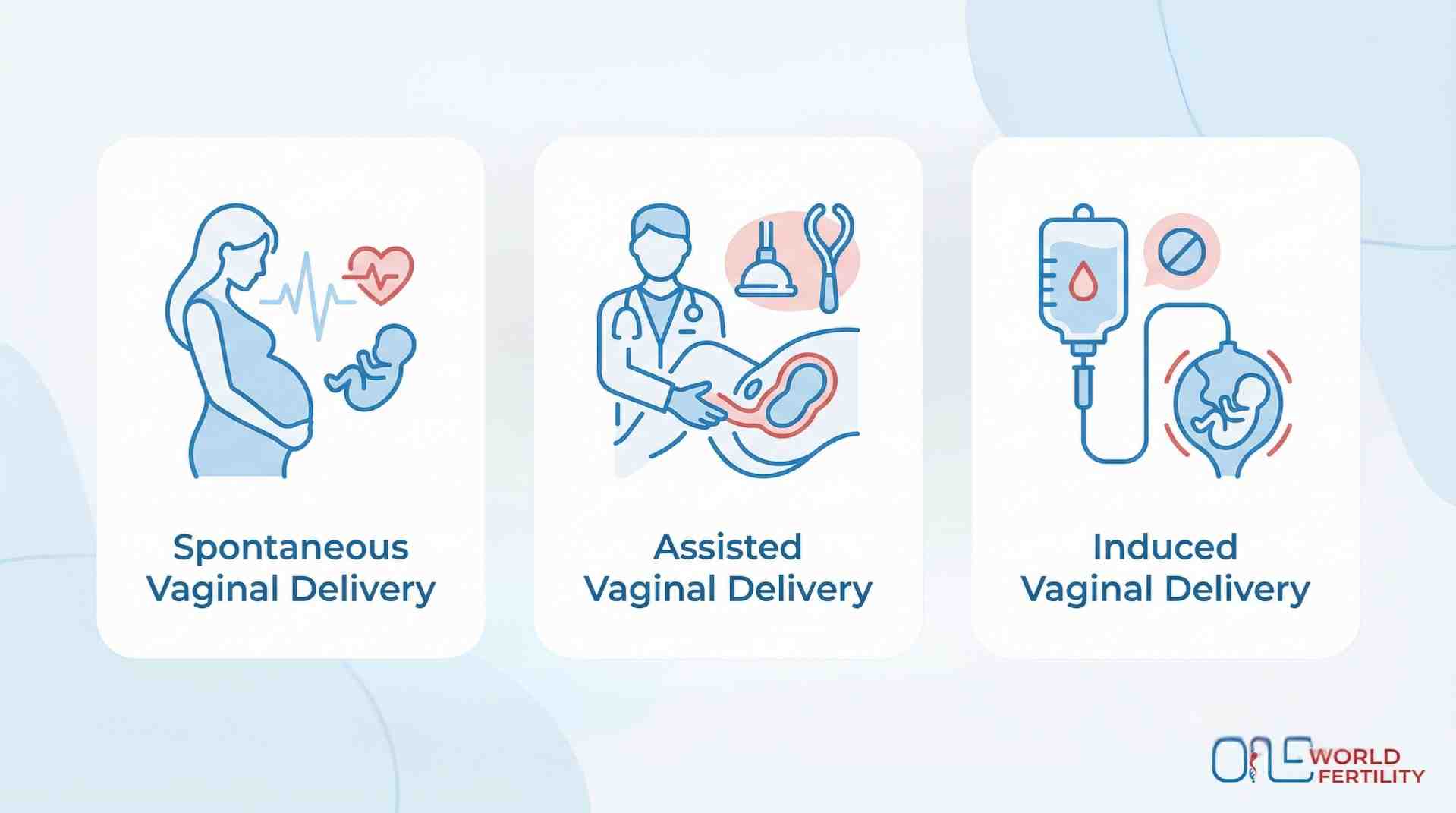
3 Different Types of Vaginal Deliveries
1. Spontaneous Vaginal Delivery: This is a typical natural birth: your body goes into labour on its own, and you don't need any help to have the baby, as you and your child do what comes easily. This is the most common way for a woman to give birth naturally.
2. Assisted Vaginal Delivery: At the finish line, sometimes you need a little help! During pushing, your doctor will use tools or a vacuum to help gently deliver your baby. You'll still give birth naturally; you'll just have extra help if you need it.
3. Induced Vaginal Delivery: With induction, your doctor uses medicine to help you start labor instead of waiting for it to happen on its own. But once labor starts, it's still a normal vaginal birth- the baby still comes out through the birth canal.
In the end? All three are legal ways to give birth vaginally. No matter if your body can do it all by itself or needs some help, the most important thing is that you and your baby are safe and cared for.
Normal Delivery Week: When Does It Usually Happen?
The question "Normal delivery in which week should I expect my baby?" is one that a lot of parents-to-be ask. We completely understand that you can't wait to meet your child! Let's talk about what to expect during a typical birth week.
When Is the Right Time for Normal Delivery?
Between 37 and 42 weeks of pregnancy, most women give birth. That being said, most doctors agree that 39 to 40 weeks is the best time for your baby to come. Your baby has had enough time to develop fully and is ready to live outside of your womb. This is called a "full-term" pregnancy.
So, how many weeks into the pregnancy is a normal delivery? Most of the time, the number is around 40 weeks, which is about 9 months. The first day of your last period is used to determine this.
Understanding Full-Term Pregnancy
Here's a simple breakdown of pregnancy timing:
| Pregnancy Stage |
Weeks |
What It Means |
| Early Term |
37-38 weeks |
Baby can be born safely, but 39+ is better |
| Full Term |
39-40 weeks |
The ideal normal delivery week- baby is fully ready! |
| Late Term |
41 weeks |
Still normal, just keeping things cozy a bit longer Post Term |
| Post Term |
42+ weeks |
Doctor may recommend induction |
When Will Your Baby Actually Arrive?
There is an "official" answer of 40 weeks for "How many weeks until delivery?", but only about 5% of babies come on time! Between 38 and 41 weeks, most babies pick their own birthday. The right time will be chosen by your body and your baby together.
Your health, the baby's growth, and how your pregnancy is going will all affect how many weeks you should wait to give birth. The doctor will keep an eye on things and let you know if the baby needs to come early or if you can wait a little longer.
Do not forget that each pregnancy is different! Whether your baby comes at 37 weeks or 41 weeks, the most important thing is that you and your partner are both healthy and ready for that beautiful moment when you meet.
How Long Does Labor and Delivery Take During Pregnancy?
Every woman who is about to give birth wants to know, "How long will I be with child?" Let's talk about when to expect to give birth and what to expect during labour and delivery.
How Long Does the Process of Childbirth Take?
Truth be told, giving birth is different for everyone. The main thing that determines when you give birth is whether this is your first child or not. Your body holds on!
Average Labor Duration: What to Expect
| Stage of Labour |
First-Time Moms |
Second-Time Moms |
| Early Labor |
8-12 hours |
4-8 hours |
| Active Labor |
4-8 hours |
2-5 hours |
| Pushing Stage |
1-3 hours |
15 min - 1 hour |
| Total Average |
12-24 hours |
6-12 hours |
Why the Difference?
- If you are a first-time mom, your body is still getting used to giving birth. It takes longer to do everything because it's all new!
- If you're a second-time mom, your body knows what to do because it's been through this before.
Your body knows how to do labour and delivery faster most of the time.
Keep in mind that these are only averages! Some moms give birth in 4 hours, while others take 30 hours or more. Both are fine. Trust your body, not the clock. You can do this!
Normal Delivery Process Step by Step
Want to know what the normal delivery process looks like? Let us go over the steps of a normal birth together so you know what to expect!
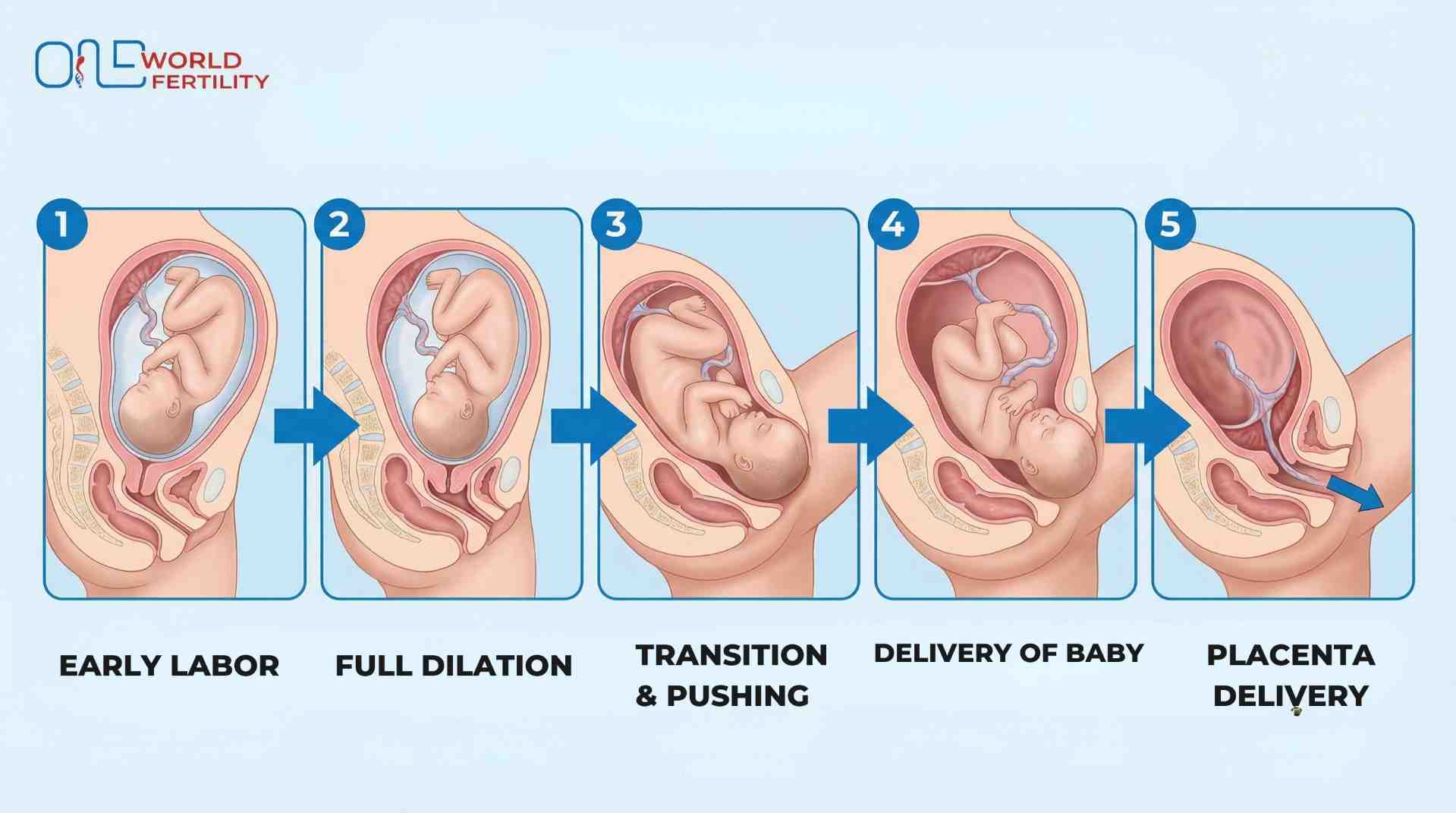
The Normal Delivery Procedure: How It Happens
The stages of labor happen naturally one after the other. Here is a simple explanation of how a vaginal birth works:
Stage 1: Early Labor
In this way, the steps of a normal birth start! As your cervix opens, you'll feel contractions that feel like period cramps and get harder over time. For first-time moms, this is the part of labor that lasts the longest. Don't worry; your body can handle this.
Stage 2: Active Labor
They happen every three to five minutes and are stronger now. When your cervix reaches 10 centimetres open, it's fully open. It's time to go to the hospital. That's a beautiful birthing process!
Stage 3: Transition
The hardest part of giving birth, but it only lasts a short time! You'll feel like you need to push through it. Almost there!
Stage 4: Pushing & Birth
That's it! You push to get the baby to come out when your contractions happen. During a normal birth, the baby's head comes out first, then the rest of the body.
Stage 5: Delivering the Placenta
About 5 to 30 minutes after birth, a few light contractions help the placenta come out. This last part of a normal birth is quick, and you won't even notice because you'll be holding your baby.
Remember that each woman's way of giving birth is different. Believe in your body and your team. You're better than you think!
Is Normal Delivery Painful?
Let's be honest: does giving birth usually hurt? It's possible, yes. But here's the thing: the pain of giving birth is normal and can be handled. There are lots of ways to get through it. Let's get real.
How Painful Is Normal Delivery?
The truth about how much pain a normal birth really is changes from person to person. For some women, it feels like heavy period cramps, and for others, it's like strong pressure. Your cervix opens, and your uterus closes to push the baby out. This is what causes the normal pain of labor. The good news is that it comes in waves with breaks in between the bad news! Plus, your body makes chemicals that ease pain to help you deal.
How it feels:
- Early labor easy to handle, like menstrual cramps
- More intense and needs focus is active work.
- Pushing and transitioning worst pain, shortest phase
What Are the Pain Management Options for Normal Delivery?
You don't need to put up with it! To deal with normal delivery pain and labor pain during a normal birth, try these methods:
Natural Ways to Treat Pain:
- Breathing routines and ways to relax can help you deal with normal labor pain.
- Moving around and switching places while you're giving birth.
- Take a warm bath or shower to slow cramps.
- Birthing balls and settings for active labor.
Medical Pain Management Options:
- Epidural: Most popular choice-numbs you from the waist down while you stay awake during a normal birth
- IV pain medications: Take the edge off labor pain without complete numbness
- Nitrous oxide (laughing gas): Helps you relax during contractions
- Spinal block: Quick-acting pain relief for delivery
Remember that it's fine to use both natural and medical ways together. When you're giving birth normally, there is no "right way" to deal with how much pain you feel. Pick what makes YOU feel strong and makes you feel like you can handle the birth.
What Are the Signs and Symptoms of Normal Delivery?
When labor is starting, your body sends some unmistakable messages. Here are the key symptoms of normal delivery to look out for:
| Sign/Symptom |
What It Means |
| Regular Contractions |
Getting stronger, longer, and closer together-true labor is starting! |
| Water Breaking |
Gush or trickle of fluid-your amniotic sac has ruptured |
| Bloody Show |
Pinkish mucus discharge-labor could start within hours or days |
| Lower Back Pain |
Constant ache-baby's moving into position |
| Pelvic Pressure |
Feeling baby pushing down-getting ready for birth! |
| Nesting Instinct |
Sudden energy burst-labor often follows within 24-48 hours |
When Should You Go to the Hospital?
One thing is to know the signs and symptoms of a normal birth; it's another thing to know when to go to the hospital.
When you should go to the hospital:
- There is a rule called 5-1-1 that says contractions occur 5 minutes apart, lasting 1 minute each, for at least an hour.
- Your water breaks (even if you don't have cramps).
- You're losing a lot.
- You feel like the baby is moving less.
- Trust your gut when you feel like something is wrong.
First, call your doctor if
- You're not sure if it's real work.
- Contractions happen randomly and hurt.
- You spot any symptoms that worry you.
At One World Fertility, We're Here for You
You should feel like family when you get care around your due date. Our skilled and loving doctors at One World Fertility want to help you every step of the way as you become a parent. We know that every birth is different. That's why we want your whole birth experience to be as safe, comfortable, and positive as possible, from the first contraction to the time you hold your baby.
Are you ready for care from professionals you can trust? Talk to One World Fertility right away. We will be here for you every step of the way!
Real Labor vs False Labor
Is it the real deal? Contractions during real labor get harder and closer together over time. On the other hand, contractions during false labor (Braxton Hicks) stay irregular and often stop when you move.
Don't forget: The normal labor and birth symptoms are a little different for each woman. If you're not sure about something, trust your body and don't be afraid to call your doctor. It's always best to check when you're not sure!
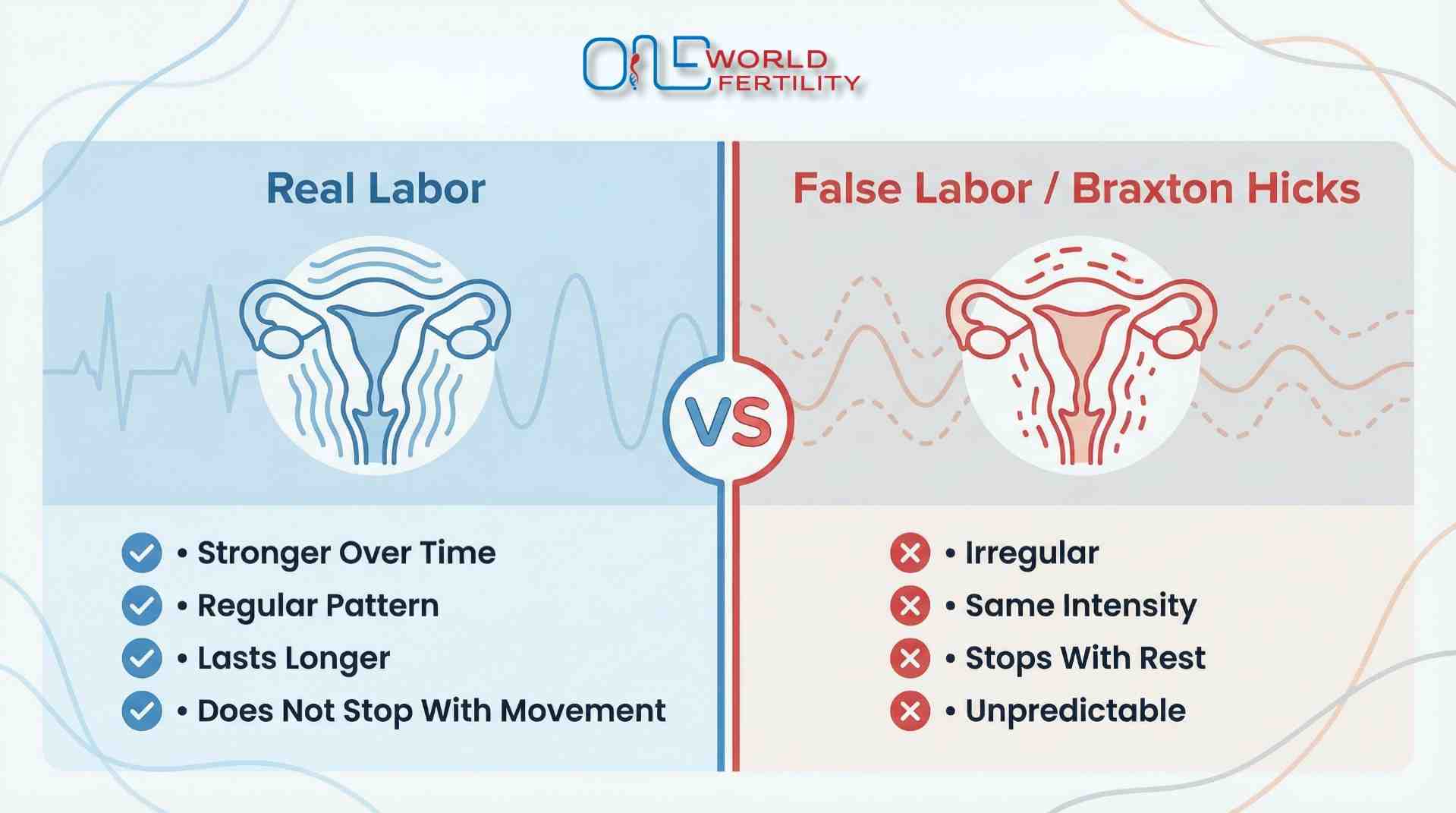
| Real Labor Contractions |
False Labor (Braxton Hicks) |
| Get progressively stronger over time |
Stay the same intensity |
| Get closer together (regular pattern) |
Remain irregular and unpredictable |
| Last longer as labor progresses |
Duration stays about the same |
| Don't stop when you rest or move |
Often stop when you change position or walk |
Normal Delivery Tips for First-Time Moms
Getting ready for your first normal birth? We understand that you're both excited and maybe a little scared! Here are some useful tips for a normal birth that will help you feel ready and confident.
1. Before labor: Getting ready for a normal delivery while pregnant. Take a class on childbirth. Knowing how it works will help you feel less scared and teach you how to breathe and how to prepare yourself for labor.
2. Stay active: Light exercises like prenatal yoga or walking will help your body stay strong so that you can have a normal birth.
3. Practice Breathing & Relaxation: Start now to work on your breathing and relaxation. During birth, deep breathing can really help.
4. Make plans for your birth: Think about what you want (pain relief, a support person, a particular setting), and let your healthcare team know. Prepare your hospital bag ahead of time. If you're 36 weeks along, you won't have to rush when labor starts!
During Labor: Normal Delivery Tips That Help
1. Stay Home in Early Labor - Until your contractions become regular and strong, you'll feel better at home.
2. Keep Moving - Move around and use a birthing ball. Moving around speeds up labor and eases the pain.
3. Use Water Therapy - When you're having contractions, a warm shower or bath really helps!
4. Focus on One Contraction at a Time - Don't think about the hours ahead. Take a deep breath during this one contraction, and then take a break.
5. Ask for Pain Relief if You Need It - There is no reward for pain! Epidurals, IV drugs, or anything else that makes you feel better.
6. Lean on Your Support Person - Let them take your hand, massage you, and cheer you up.
How Long After Normal Delivery Can You Have Sex?
Let's talk about something many new moms wonder but hesitate to ask-when is it safe to resume intimacy? Here's the honest answer about sex after normal delivery recovery and normal childbirth healing.
The Medical Guideline: Wait at Least 6 Weeks
Most doctors recommend waiting at least 6 weeks after normal delivery before having sex. This gives your body proper time for normal childbirth healing.
Why 6 weeks?
- Your cervix needs to close to prevent infection
- Your uterus is healing and shrinking back
- Any vaginal tears or stitches need to heal completely
- Vaginal bleeding (lochia) should have stopped
- Risk of infection is much lower
Your 6-Week Checkup Matters
At your postpartum visit, your doctor will check if everything has healed properly and give you the green light. But here's the important part: medical clearance doesn't mean you have to feel ready. It just means it's physically safe when you are ready.
Why Choose One World Fertility for Your Normal Delivery?
The birth of your child is one of the most precious times in your life, and you deserve expert care that is infused with genuine kindness.
With years of experience, our doctors at One World Fertility are with you from the first contraction to the moment you hug your baby. We combine medical expertise with genuine support to create a safe and warm environment for your normal birth.
What we give you:
- 24/7 access to skilled, caring doctors
- birth plans that are unique to you and respect your wants
- Modern services in a warm and welcoming space
- Natural, safe help during childbirth
- Complete care after giving birth
You are more than a patient; you are family. Let us be a part of your lovely birth story. Are you ready for a normal service you can trust? Talk to One World Fertility right away. We're here to love and help you welcome your little one!
Questions people ask about this treatment
8 answeredhere