

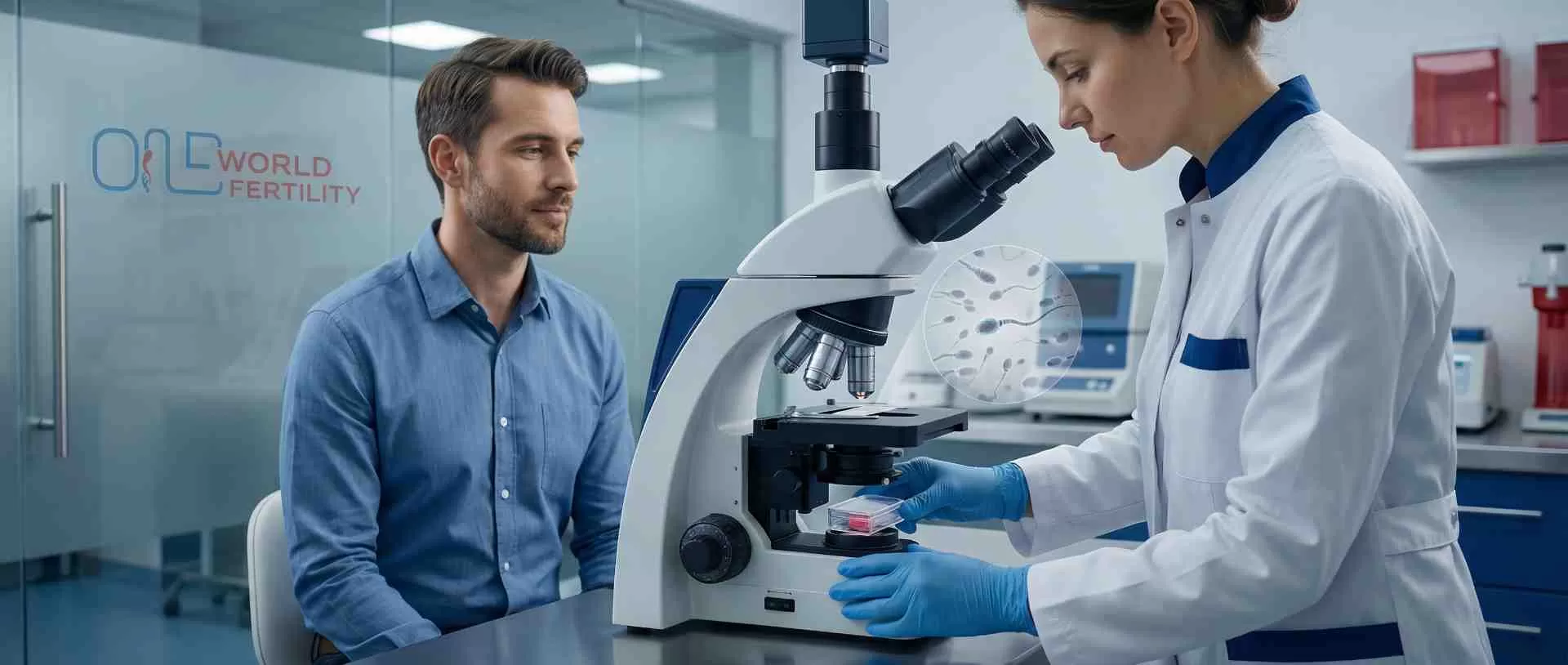

Thinking about starting a family or wondering about your fertility? A semen analysis can tell you what you need to know about male reproductive health. We make the sperm analysis test easy and comfortable at One World. Using WHO-approved methods, our cutting-edge sperm analysis facility checks the number of sperm, their mobility, and their shape to provide you with precise results. Our lab sperm analysis gives you clear information about your reproductive health, whether you require a male fertility test to evaluate your health, find out whether you're infertile, confirm that your vasectomy worked, or plan fertility therapy.
We understand that giving a sample for a spermogram can be uncomfortable, so we've set up a quiet, comfortable place to collect them. Fast findings, expert analysis, complete privacy, and a team that knows what you're going through. To us, your sperm quality check isn't simply a test; it's a step toward making the family you want.
What is Semen Analysis? Understanding the Sperm Fertility Test
What is a semen analysis, then? You could say it's a full health check-up for your sperm and seminal fluid. This lab test looks at everything that influences your fertility, such as the number of sperm you have (how many), the quality of the sperm (how well they travel and their form), and the qualities of the fluid that supports them (volume, pH, and how quickly it liquefies). When looking at male infertility testing, the main diagnostic tool is a microscope used by skilled embryologists or andrologists who follow WHO laboratory manual criteria.
Why is this sperm test so important? Because it gives you important, real information about your male reproductive health and ability to have children. Not guesswork, but real data that you can use.
What is Semen?
So what exactly is semen? It's that whitish-grey fluid that comes out during ejaculation, but here's what most people don't realise: it's way more than just sperm. Seminal fluid is like a whole support system. That's what's inside it:
- Sperm cells (2-5%) – Those tadpole-shaped guys produced in your testicles. They take roughly 72 days to fully grow, and they're the ones that carry your DNA to fertilise an egg.
- Gland fluids (95–98%) – Your seminal vesicles, prostate, and other glands make this protected liquid that sperm use as fuel, keep them safe, and move around. Sperm would not have made it through the trip without it.
- Nutrients and energy: Proteins, vitamins, minerals, and natural sugars that keep sperm alive and moving. Think of it as their survival kit.
| Component |
Amount |
Role |
| Sperm |
2-5% |
Carries DNA to fertilize egg |
| Seminal Vesicle Fluid |
65-70% |
Provides energy (fructose) |
| Prostatic Fluid |
25-30% |
Helps sperm movement and survival |
| Gland Secretions |
Very small |
Lubricates, balances pH |
| Nutrients |
Throughout |
Fuel and protection for sperm |
Here's why this matters for you: We check to see if all of these parts of semen are working right when we do seminal fluid analysis. Low sound? Need some nutrients? Not the right pH balance? These clues help us figure out exactly what's going on with your fertility, and more importantly, how to fix it.
Why Do You Need a Sperm Analysis Test?
Are you confused about whether you really need a sperm analysis test? Men's fertility is as important as women's, but it's not given as much attention. Getting a male pregnancy test early saves time, keeps your partner from having to go through painful testing that isn't necessary, and gives you clear answers quickly.
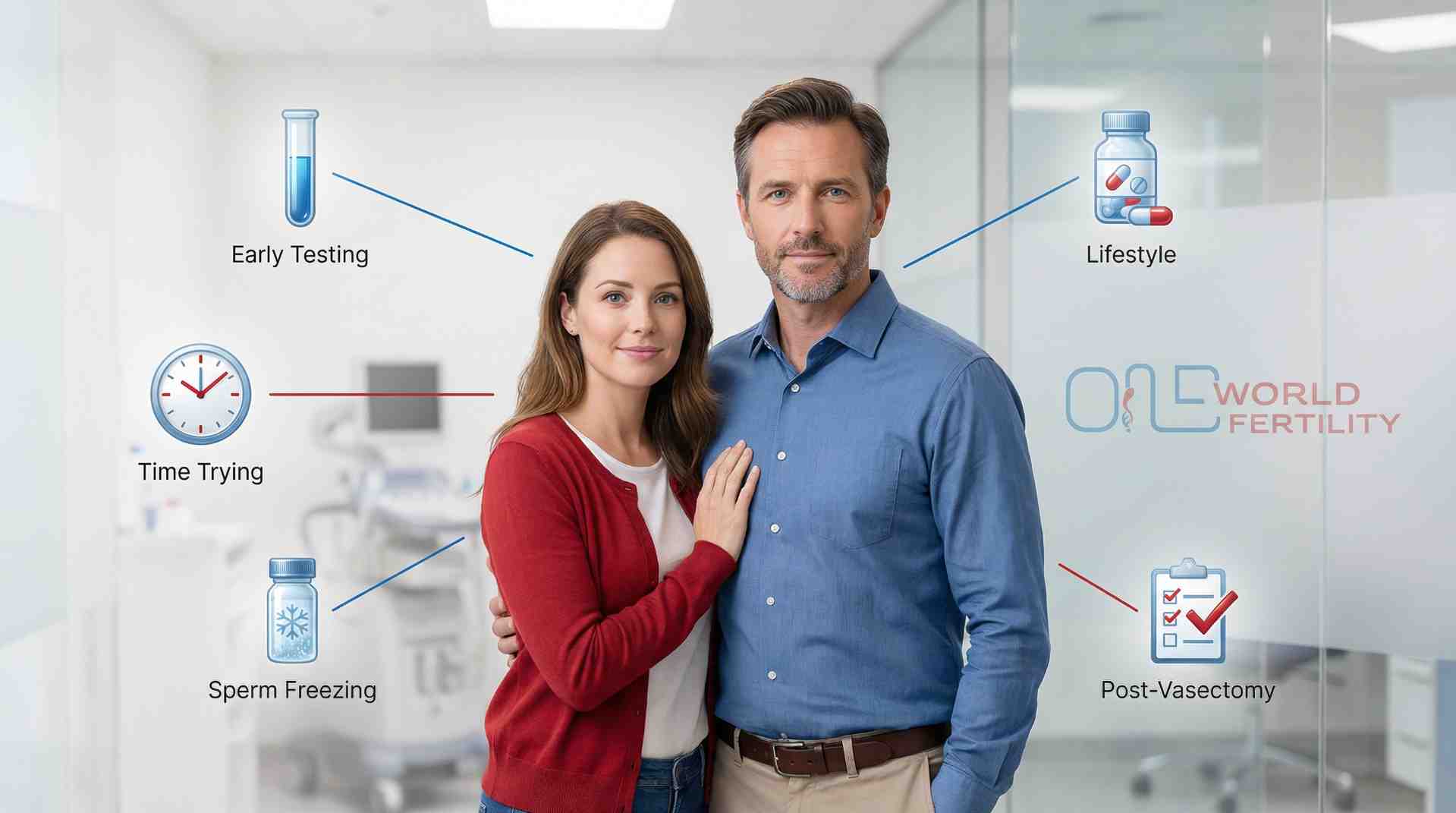
You might want to get a sperm health test if:
- You haven't been able to get pregnant for 6 to 12 months.
- You want to try IVF or IUI for getting children and need some basic knowledge.
- You had a vasectomy and need to have your sperm analysis to make sure it worked.
- You have long-term health problems, take medicines, or smoke or drink alcohol, all of which can affect your ability to get pregnant.
- You have been touched by poisons, radiation, heat, or had cancer treatment.
- You're thinking about freezing your sperm or donating it.
Now here's the deal: Male infertility testing is quick, painless, and provides a lot of helpful information. One easy sperm analysis test can tell you if the problem is with the number of sperm, their movement, their shape, or none of these things at all. When should you get a sperm test? Better early than late. Early testing keeps people from wondering for months and helps them make better decisions about care for both partners.
What Does Sperm Analysis Test For?
Our laboratory sperm analysis checks the key factors that affect your fertility. We look at the number of sperm, how they move, their form, and the fluid that moves them. We learn something special about your reproductive health from each test parameter.
| Parameter |
What We Measure |
Normal Range | What It Means |
| Semen Volume |
Amount of fluid |
≥1.4 ml | Low may mean blockage or incomplete sample |
| Sperm Concentration |
Sperm per ml |
≥16 million/ml | Production levels |
| Total Sperm Count |
Total sperm |
≥39 million | Overall output |
| Total Motility |
% moving sperm |
≥42% | Movement ability |
| Progressive Motility |
Forward-swimmers |
≥30% | Key for natural conception |
| Morphology |
Normal shapes |
≥4% | Affects egg penetration |
| Vitality |
Live sperm |
≥54% | Alive vs. dead |
| Liquefaction |
Time to liquefy |
≤60 min | Affects sperm mobility |
| pH Level |
Acidity balance |
7.2-8.0 | Infection/gland health |
What do you need to know about these numbers? The sperm concentration test tells you how many sperm you're making. The sperm mobility test checks how well the sperm can move, whether they can swim forward. That's what it takes to get to an egg. The sperm morphology test checks the form of the sperm to see if they can correctly enter an egg. Being still doesn't always mean you're dead.
The viability test for sperm distinguishes between living and dead sperm. We can still use them for ICSI even if they're living but not moving. Seminal fluid pH and liquefaction show if there are infections or problems with the glands. Each finding points us toward specific solutions.
Understanding Sperm Motility Grading
Not all sperm mobility is helpful. We check how your sperm move, since only certain types can reach an egg and fertilise it.
- Progressive Motility (≥30%) - The swimmers These sperm swim straight ahead with a goal in mind. They're the only ones who can naturally travel to fertilise an egg. This is the most important number.
- Non-Progressive Motility: The wigglers They're moving tails that wiggle and circles that move around, but they're not getting anywhere. They help you move about, but they can't get to an egg on their own.
- Immotile (less than 58%): Not moving Still as a rock. Still, some may still be alive (we test that separately), and if they are, ICSI can put them right into eggs.
What's the point of this? Progressive vs. non-progressive motility tells us whether you can get pregnant naturally or if you require help like IUI or IVF. It's not just about moving; it's about moving in a way that works. Your motility classification tells you what kind of treatment is best for you.
How is Semen Analysis Performed?
Have you ever thought about what really happens to your sample after you give it? It takes roughly one to two hours to do a semen analysis. Let's go over how a sperm test works in our lab, step by step.
Step-by-Step: How Does a Sperm Test Work?
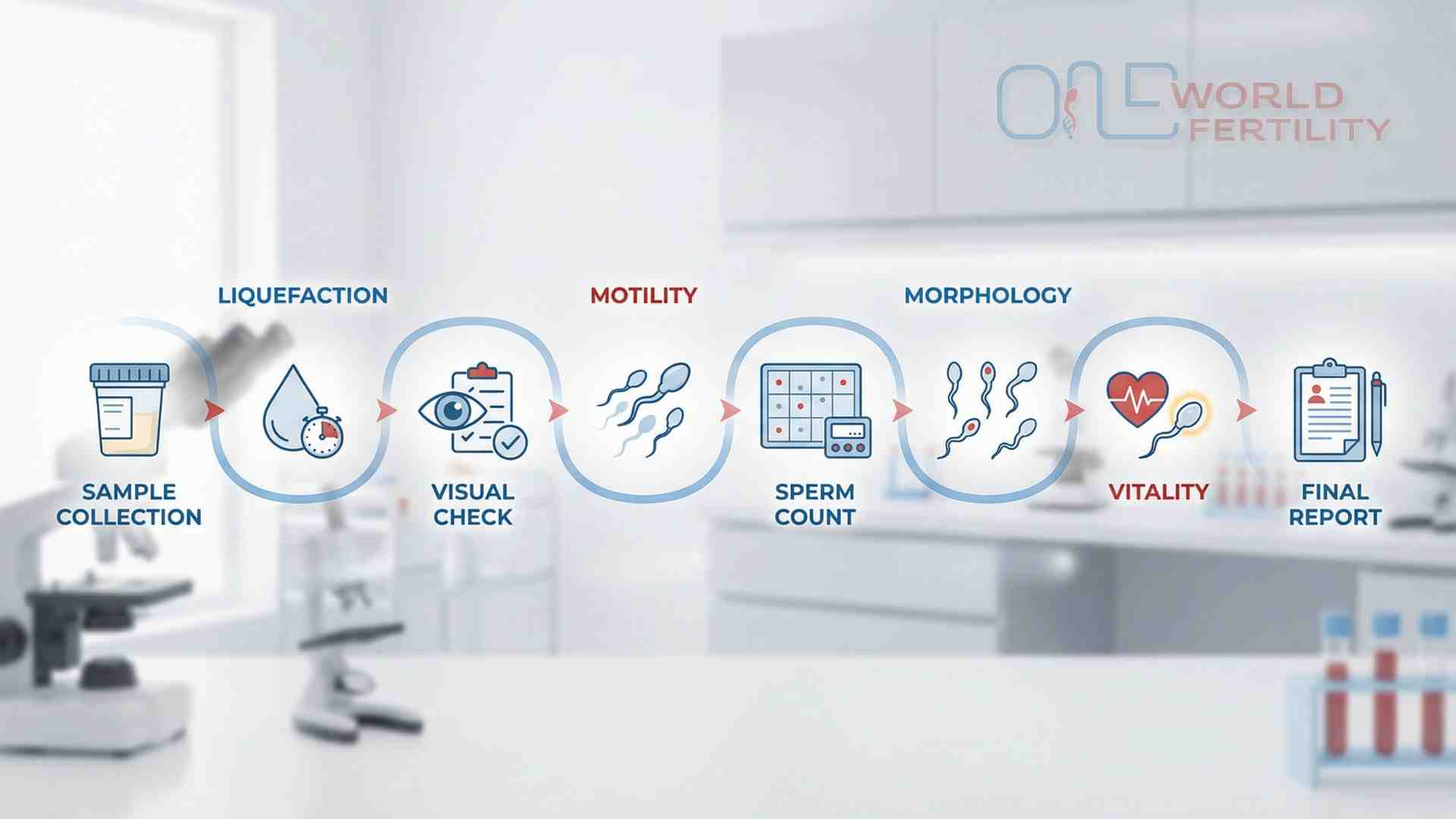
In basic terms, this is the step-by-step process for analysing sperm:
Step 1: Getting the Sample - We write down your information, when you will collect your things, and how long you will not drink (preferably 2 to 7 days). The time of day impacts the number of sperm.
Step 2: Liquefaction (30 to 60 minutes) - Fresh semen is viscous and gel-like. We let it sit at room temperature until it naturally turns into a liquid. You can't adequately evaluate it until this happens.
Step 3: Visual Check - We check thickness, colour, and appearance, as well as volume and pH.
Step 4: Motility Assessment - We put a drop under the microscope and look right away to see how many sperm are moving and how well they swim.
Step 5: Sperm Count - We count the number of sperm in each millilitre using either a counting chamber or a computerised CASA system.
Step 6: Shape Evaluation - We make a stained slide and look at 200 sperm at extreme magnification to see if they are formed regularly or strangely.
Step 7: Vitality Test (if needed) - If motility is poor, we check which non-motile sperm are still alive and which are not. Alive, but not moving? ICSI can still function.
Step 8: Report - We put everything together, compare with WHO standards, and provide your results with recommendations. How long? The entire sperm testing procedure takes 1-2 hours in the lab. You get results within 24-48 hours.
What Equipment Do We Use in Sperm Analysis?
Are you curious about the technology? Here's our semen analysis equipment:
- Microscopes let you see sperm motility and form in great detail.
- CASA Systems are computerised analysers that measure sperm without bias and with fewer mistakes made by people.
- Counting Chambers for counting sperm concentrations by hand Incubators keep samples at body temperature (37°C) during testing.
- Staining Kits are special dyes that allow us to clearly examine the architecture of sperm.
- pH Test Strips: Check how acidic something is What is important is that you have the right equipment.
Modern CASA technology gives us results that are more accurate and consistent than hand counting. For example, it can tell us exactly how fast someone swims and how they move.
Types of Semen Analysis - What Level Do You Need?
Not all sperm tests are the same. These are the several kinds of semen analysis:
| Test Type |
What's Checked |
Best For |
| Basic |
Volume, count, motility, morphology, pH |
Initial screening |
| Comprehensive WHO |
Basic + vitality, WBC, detailed assessment |
Complete evaluation |
| Advanced |
Comprehensive + strict criteria, detailed grading |
Pre-IVF, unexplained infertility |
| CASA |
Automated precision measurements |
Objective, accurate analysis |
| DNA Fragmentation |
Genetic integrity testing |
Miscarriage, IVF failures |
| Post-Vasectomy |
Zero sperm confirmation |
Vasectomy verification |
What kind do you need? Begin with a full examination and only add specialist testing if the situation requires it.
What Happens After Abnormal Sperm Test Results?

It's totally normal to have a lot of questions about an abnormal report. Does this mean you can't have kids? Do I need to get therapy right away? The truth is that abnormal sperm test results don't tell the whole story on their own. That's why we focus on the proper next steps after looking at the semen. If you need to retake the test, we will help you do so. We will also help you find treatable causes and make sure you understand all of your options, from basic lifestyle modifications to more advanced male infertility treatments. We don't just give you figures in a report; we help you understand what they really mean.
How to Improve Sperm Quality? Tips for Better Sperm Health
Want to learn how to naturally make your sperm better? You have more control than you realise, which is good news. It takes 72 days for sperm to be made, and it makes adjustments to your lifestyle that make your sperm better, which will show results in around three months. This is the comprehensive guide to naturally increasing your sperm count:
| Category |
Do This |
Avoid This |
| Diet |
Berries, leafy greens, nuts, fish, tomatoes |
Excessive caffeine (>300mg/day) |
| Nutrition |
zinc, selenium, omega-3s, 8-10 glasses water |
Processed foods |
| Weight & Exercise |
BMI 18.5-25, moderate exercise 30 min 5x/week |
weekObesity, excessive endurance training |
| Sleep & Stress |
7-8 hours sleep, yoga, meditation, stress management |
Chronic stress, poor sleep |
| Harmful Habits |
Quit completely |
Smoking, excessive alcohol, recreational drugs |
| Temperature & Clothing |
Loose, breathable underwear |
Hot baths, saunas, tight clothing, laptops on lap |
| Environment |
Clean, safe workspace |
Pesticides, chemicals, heavy metals, toxins |
Why Choose Our Semen Analysis Lab
Want to know where to get a sperm test? Picking the right sperm test lab is important for getting accurate results. When you're looking for a sperm test near me, our lab is the best choice because: We're a WHO-approved lab that has to follow strict 2021 rules. For accurate research, our embryologists use cutting-edge CASA technology and extensive experience. The results will be precise and complete the same day or 24 hours later. You can be sure of complete comfort and privacy at our private sperm test centre.With every test, you can talk to our fertility specialist for free about the results and your choices.
We offer on-site expert testing, such as DNA fragmentation and antibodies, at clear prices. Picking the right sperm test centre is very important. If you want to find the best semen analysis lab, it needs to offer accuracy, safety, and expert advice. Let's find out what you need to know.
Questions people ask about this treatment
10 answeredhere