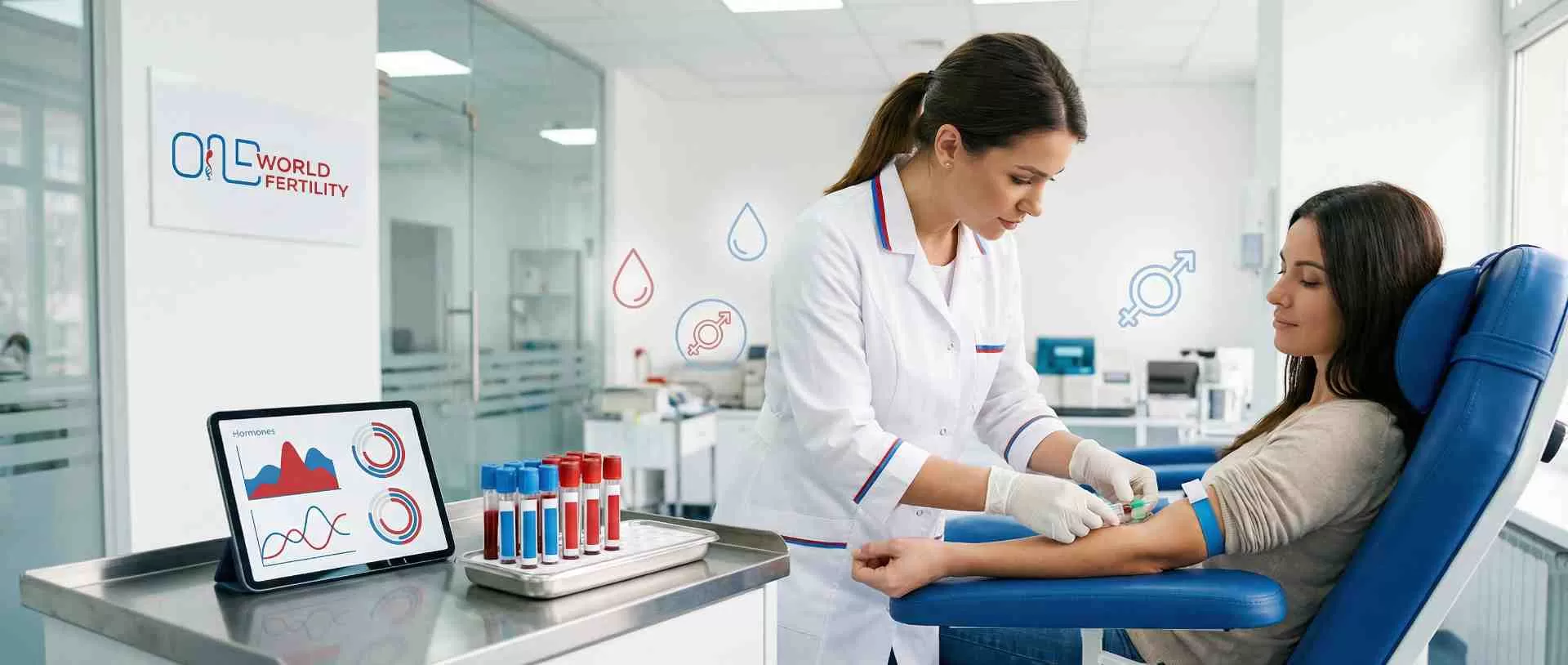



You may have asked yourself this more times than you can count: "How many eggs do I really have left?" It's the question that comes to mind when you're alone and thinking about your future and whether or not time is on your side. You don't have to wonder anymore; here's the good news. Ovarian reserve testing is like a fertility check-up that informs you how many eggs you have left. What does ovarian reserve mean in simple terms? It's the number of eggs you still have in your ovaries. Not in five years, not in the future, but today.
This guide explains ovarian reserve testing in a way that makes sense. We'll talk about the egg reserve tests you need, what the results indicate for you, and what you can do next. This reproductive health test will provide you with the information you need to make choices that fit YOUR life and YOUR schedule. Are you ready to stop guessing and start knowing? Let's go through this step by step.
What Is Ovarian Reserve Testing?
Remember that question you started with, "how many eggs do I have left?" That's what ovarian reserve testing tells you. The meaning of ovarian reserve is only the number of eggs you have right now. Your current egg reserve levels. This is what this fertility reserve test looks at. Here's the truth: you were born with all the eggs you'll ever have, about one to two million of them. By the time you have your first period, you only have about 300,000 left. And every month, you naturally lose roughly 1,000 eggs, whether you want to get pregnant or not.
But here's what you need to know: Quality is not the same as quantity. You might have a lot of eggs, but if you're older, fewer of them might be viable, which means fewer of them will actually lead to a safe pregnancy. On the other hand, someone younger with fewer eggs might have better quality eggs overall.Your reproductive potential assessment looks at both how many you have and how likely they are to operate. That's everything you need to know about your fertility.
Why Ovarian Reserve Testing Matters for Your Fertility
You know what the test assesses, but why does it matter for you? This fertility reserve evaluation keeps you from making one of the biggest decisions of your life by guessing. If you meet any of the following criteria, you should strongly consider getting tested:

- You want kids "someday", but that someday keeps moving.
- You've been trying for 6+ months without success.
- You want to know if freezing your eggs is a good idea for you, but you're not sure.
- Your sister or mom went through menopause early.
- You have endometriosis, PCOS, or prior ovarian surgery.
- Medical treatment is coming up that could impact your fertility.
What knowing your ovarian reserve actually does:
Gives you a genuine schedule for fertility: Good levels of egg reserve? You've got some time to plan your fertility. Not as high as expected? It's time to move faster, whether that means trying now, preserving eggs, or getting ready for IVF.
Shapes your treatment: Your results affect everything from figuring out how likely you are to get pregnant to how well your treatment works. A higher ovarian reserve suggests that the drug will work better. Different methods and tailored protocols are needed for lower reserves.
Stops the cycle of worry: You won't have to worry about your ability to have children anymore. You obtain information about your fertility timeline and specific steps to take next.
This isn't meant to scare you; it's meant to provide you with the information you need to make your own choices. Isn't knowledge power?
Types of Ovarian Reserve Tests: Comprehensive Assessment Methods
You know you need to get your ovarian reserve test, but what does that mean? Don't worry; it doesn't sound as bad as it is. We employ a few different tests that fit together like puzzle pieces to give us a full picture of your fertility. Let's go through each one so you know what to anticipate.
AMH Test (Anti-Müllerian Hormone Test)
The AMH test is the most important part of this. AMH (anti-müllerian hormone) is made by the small cells in your ovaries. It tells us how many eggs you have stored. Test for a higher AMH level? More follicles mean a greater ovarian reserve. The best part? You can do this ovarian reserve AMH test on any day of your cycle. It's just a simple blood sample. No need for exact timing.
How long do AMH results take? Most of the time, it takes 3 to 7 days. We test your blood anti-mullerian hormone levels in ng/mL, which are your AMH measurement units. Then we compare your AMH score to the typical level for your age. Does AMH change during your cycle? Nope! AMH, on the other hand, stays the same throughout your cycle. That's why when to test AMH levels is flexible.
| Age Range |
Normal AMH Level (ng/mL) |
What This Means |
Ovarian Reserve Status |
| Under 30 |
2.0 - 6.8 |
Excellent potential |
Normal to high reserve |
| 30-34 |
1.5 - 5.5 |
Good potential |
Normal reserve |
| 35-39 |
1.0 - 4.5 |
Moderate potential |
Normal to slightly low |
| 40-44 |
0.5 - 2.5 |
Reduced potential |
Decreased reserve |
| 45+ |
< 0.5 |
Very low potential |
Severely diminished |
This chart of AMH levels by age shows how normal AMH levels drop naturally with age. It's important to know where YOUR number is on this chart of anti-mullerian hormone levels.
FSH Test (Follicle-Stimulating Hormone Test)
FSH is like an alarm clock for your ovaries. It tells you how hard your brain has to "yell" to wake them up on the FSH test for fertility. That means your ovaries need to sound bigger alarms, which means you have less egg reserve. When should I take this test? The tricky part is that you HAVE to do this cycle day 3 blood test on the third day of your period. This baseline FSH test finds out where your hormones are at the start.
We want the FSH level on day 3 to be normal and less than 10 mIU/mL. Between 10 and 15 means declining reserve. Above 15 typically indicates diminished reserve. Interesting fact: on what day does FSH reach its peak concentration? Around day 14, right before ovulation. But we test on day 3 to get your baseline before that surge.
Estradiol Test (E2 Test)
This estradiol test on day 3 is important because strong estrogen might make your FSH levels look normal when they aren't. Isn't that sneaky? On day 3, we want your baseline estradiol levels to be between 50 and 80 pg/mL. If your estrogen fertility test shows E2 levels above 80, it could be hiding a greater FSH level, which would make your reserve look better than it really is. That's why we never trust FSH by itself. The estradiol test fertility reading makes sure that FSH is accurate in your E2 fertility testing.
Antral Follicle Count (AFC) Test
This antral follicle count ultrasound literally counts the follicles in your ovaries right now. It's your physical headcount; each follicle might house an egg. How do you do it? An ultrasound of the vagina to count eggs. The technician counts the follicles in both ovaries using a little wand. Lasts 10 to 15 minutes. How many follicles should there be? A normal antral follicle count is normally between 6 and 16+; however, it might be higher or lower depending on the person's age. What does AFC mean in IVF? It's the greatest way to tell how well your medicine will work. A higher AFC means more eggs retrieved.
| Age Group |
Average AFC (Both Ovaries) |
Reserve Status |
IVF Response |
| 25-30 |
15-30 follicles |
Excellent |
High response |
| 31-35 |
10-20 follicles |
Good |
Normal to high |
| 36-40 |
8-15 follicles |
Moderate |
Normal |
| 41-45 |
5-10 follicles |
Decreased |
Low to normal |
| 46+ |
< 5 follicles |
Severely low |
Poor response |
This breakdown explains what a normal antral follicle count usually looks like for someone your age.
Do you need both AMH and AFC? Yes. AMH measures hormones, while AFC counts follicles. We feel sure when they agree. We look into it more when they don't.
Inhibin B Test
This inhibin B ovarian reserve test is a backup that isn't usually needed but is useful when AMH and FSH don't match up or we need further proof. Sometimes it gets added to your cycle day 3 testing panel. Inhibin B fertility testing is like a tiebreaker that offers us one more piece of information to help us figure out how many eggs you have left.
How Is Ovarian Reserve Testing Done? Step-by-Step Process
Knowing the tests, let's discuss what happened. It's easier than you think. Blood tests Testing ovarian reserve with blood is simple:
Blood Test Procedures
Egg count blood test scheduling: Choose any day of your cycle for AMH, but FSH and Estradiol require cycle day 3 (the third day of your period). What to expect: Regular blood draw. The needle stuck for 2 minutes. Eat breakfast before coming, no fasting needed. This is how to test ovarian reserve with blood work, and honestly, it's the easiest part.
When to test AMH levels and get results: AMH comes back in 3-7 days. FSH and E2 are faster, usually 1-3 days. So, how to check the egg reserve? You'll know within a week.
Ultrasound Examination Process
Your egg count ultrasound is scheduled on days 2-5 of your cycle when follicles are easiest to see. What happens during the transvaginal ultrasound for egg count: A pap smear-like lie-back. Softly insert a tampon-sized ultrasound wand. Moving it around, the tech counts follicles on both ovaries. Egg count is checked with an antral follicle count ultrasound. Its feel: Light, unpleasant pressure, not excruciating. The wand is greased and warmed.
Duration: 10-15 minutes. Just 5-7 minutes. That's it. The whole follicle assessment procedure and ovarian reserve screening test can usually happen within one cycle. Quick, straightforward, and you'll have your complete answers soon.
Understanding Your Ovarian Reserve Test Results
You got your results. What now? Let's talk about what those figures really imply for you and your journey to get pregnant.
Normal Ovarian Reserve: What It Means
Got findings that say "normal ovarian reserve"? That's great news. But let's be clear about what "normal" really means. One number doesn't mean "normal" for everyone. Your good egg reserve at 32 looks different than at 38. We look at your figures and compare them to the average ovarian reserve by age for women, not for women who are 25.
What this means for you:
- If you try regularly, you have a good chance of getting pregnant naturally.
- You have some flexibility in your time (but not forever).
- IVF would likely get a normal response if needed.
- Your body has choices each cycle since you have a healthy number of follicles.
Next steps: If you're ready, go ahead and try. Want to wait? You probably have 1 or 2 years, but don't wait 5 years. Normal savings by age now doesn't mean the same thing in a few years. If you're putting off freezing your eggs, consider doing so now.
Low Ovarian Reserve & Diminished Ovarian Reserve
Nobody wants to hear "low ovarian reserve" or "reduced ovarian reserve." Let's be honest about what this really implies.What does it mean to have decreased ovarian reserve (DOR)? It's when you have a lot fewer eggs than you should for your age. When more than one test indicates low ovarian reserve, the DOR fertility meaning arises.
Signs of diminished ovarian reserve:
- Irregular or shorter cycles
- Lighter periods
- Poor response to fertility meds (if you've tried IVF)
- Sometimes, there are no symptoms, and you feel completely normal
Diminished Ovarian Reserve Diagnostic Criteria
| Test Type |
Normal |
Diminished |
Severely Diminished |
| AMH (ng/mL) |
1.0 - 4.0 |
0.5 - 1.0 |
< 0.5 |
| Day 3 FSH (mIU/mL) |
3.0 - 10.0 |
10.0 - 15.0 |
> 15.0 |
| Day 3 E2 (pg/mL) |
< 50 |
50 - 80 |
> 80 |
| AFC (total) |
> 10 |
5 - 10 |
< 5 |
What causes low ovarian reserve?
- Age (especially after 35)
- Genetics/family history of early menopause
- Endometriosis
- Prior ovarian surgery
- Autoimmune conditions
- Chemotherapy/radiation
- Smoking Sometimes, it's just unknown
"Can I still get pregnant with a low egg count?" Yes, but it's tougher to do. When your ovarian reserve goes down, you have fewer eggs, not none. A lot of women who are 35 or older and have poor egg counts or a shrinking ovarian reserve nevertheless get pregnant. It just takes longer or needs medical aid.
High Ovarian Reserve
High numbers are nice, right? Not always. Let's talk about what having a strong ovarian reserve really means. What it means to have high AMH levels and a high AFC count: You have a lot of follicles, more than most people do. In some cases, it's just good genes. It often means you have polycystic ovary syndrome (PCOS).
The link between PCOS and ovarian reserve:
- Irregular or missing periods
- Many small follicles on ultrasound
- Trouble ovulating regularly
- Higher risk during fertility treatment
High reserve doesn't automatically mean easier fertility. It only means you need to take care of them in a different way, whether you are trying naturally or through IVF.
Who Needs Ovarian Reserve Testing?
You don't have to be having trouble becoming pregnant to get this ovarian reserve screening test. The best thing to do? Get tested before you need to. Who should think about getting a fertility test? Got PCOS, endometriosis, irregular cycles, or prior ovarian surgery? You are a candidate. If you are getting cancer treatment or have had a bad IVF, you should definitely test. If you're wondering if you should test your ovarian reserve, the answer is yes. This testing before pregnancy turns fear into real facts.
| Your Situation |
Tests You Need |
When |
Why |
| Age 30-35+, planning pregnancy |
AMH + AFC |
Before trying |
Know your timeline |
| Thinking about egg freezing |
AMH + AFC + FSH |
Before deciding |
See if you're a good candidate |
| Trying 6-12+ months, no pregnancy |
Complete panel |
Now |
Find out what's happening |
| Had ovarian surgery |
Complete panel |
3-6 months after |
See what's left |
| Starting chemo/radiation |
AMH + AFC |
Before treatment |
Plan fertility preservation |
| Irregular or missing periods |
Complete panel |
ASAP |
Check ovarian function |
| IVF didn't work well |
AMH + AFC recheck |
Before trying again |
Adjust your plan |
Why Choose One World Fertility for Ovarian Reserve Testing
We understand that getting your ovarian reserve checked can be stressful and even intimidating. You want more than simply statistics on a lab report. You want to know what your future holds, whether your dream of starting a family is realistic, and what you should do next. That's why we're here. We don't only do tests and give you the results at One World Fertility. We will sit down with you and go over what each number means for your position. Then we will develop a plan that works for your life, not just a textbook example.
We're with you every step of the journey, no matter what your findings show: a lot of reserve, less than expected, or somewhere in between. We use the most up-to-date tests and really care about our customers. You won't ever feel rushed. You won't ever feel like simply another patient. We address all your concerns, talk through your worries, and help you move forward with confidence and clarity. Because you deserve skilled help with your reproductive journey that is also kind. That's what we do best.
Questions people ask about this treatment
10 answeredhere