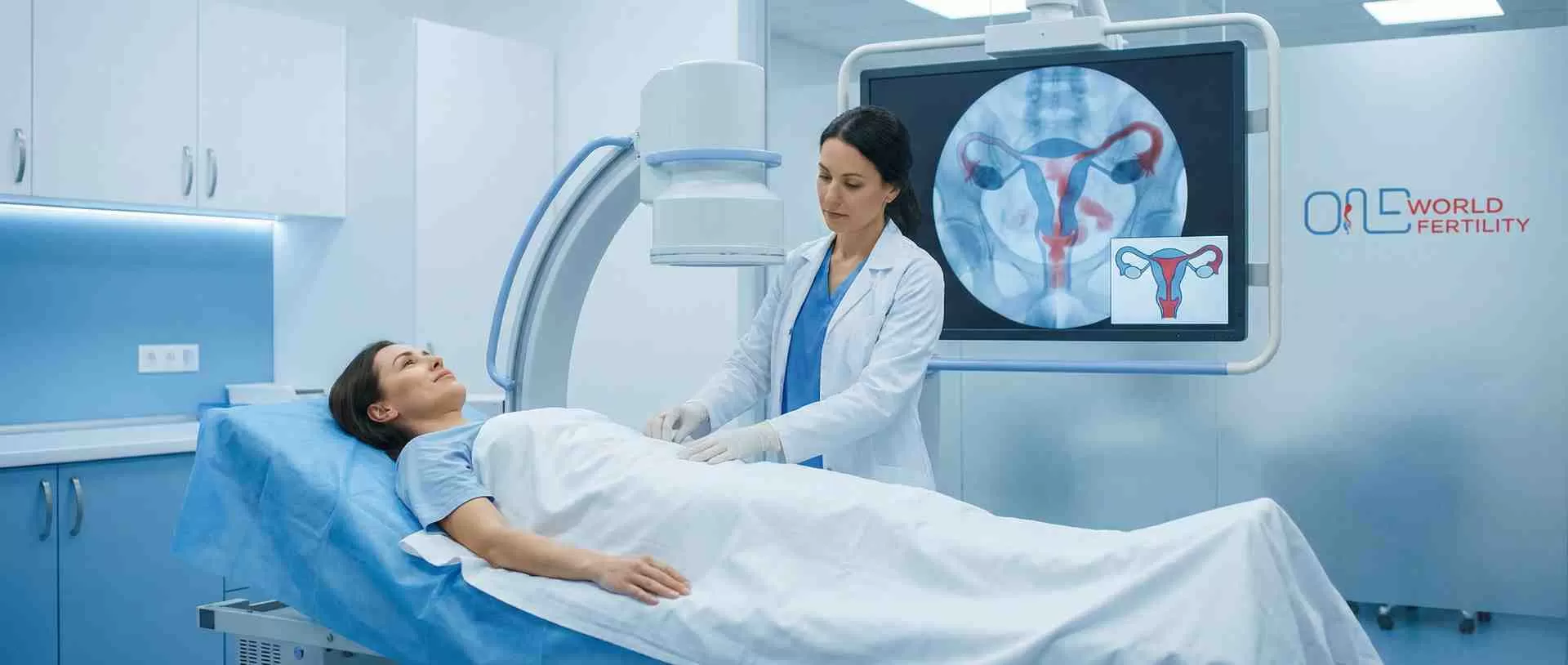



It can be hard to start a fertility journey, but the first and most empowering thing you can do is learn about your body. Our fertility ultrasound and follicle scan services at One World Fertility are meant to provide you with clear, correct answers from the start. Our follicular monitoring team keeps a close eye on every stage of your cycle, from your first baseline fertility scan and follicular test to real-time follicle ultrasound readings and follicular study for pregnancy that indicate when your body is ready. This is true whether you are trying to get pregnant naturally, getting ready for IUI, or starting an IVF cycle.
Our experienced fertility professionals review each ultrasound follicular study results and explain what it implies for your specific situation. There is no medical jargon or uncertainty, just honest advice and a clear next step. Knowing your body is the first step toward getting pregnant. Make an appointment for your fertility scan with One World Fertility today.
What Is a Fertility Ultrasound? Understanding Your Fertility Scan
A fertility ultrasound is a simple, mild scan that doesn't hurt and lets our experts examine your uterus, ovaries, and pelvic organs closely. This gives us a full picture of your reproductive health. It is like a map of your body's ability to have children. Your fertility scan is always the first step before we suggest any therapy, such as IVF, IUI, or ovulation support. It gives us all the information we need to make the best plan just for you. No guessing, just clear.
What Does a Fertility Ultrasound Check?
In just 15 minutes, your fertility ultrasound scan checks more than you would think. This is what our experts look at:
- Uterine shape & lining - Checking the shape and lining of your uterus to make sure it is healthy and suitable for implantation.
- Ovarian volume - knowing how big and healthy your ovaries are.
- Antral follicle count (AFC) - a way to guess how many eggs you have left.
- Fibroids and polyps - looking for anything that could make it harder to get pregnant or implant.
- PCOS signs - seeing several tiny follicles or hormonal patterns early on.
- Health of the fallopian tubes - including how to check if fallopian tubes are blocked and identifying signs of a normal fallopian tube HSG result, alerting us to any obstructions or fluid that may need a closer look.
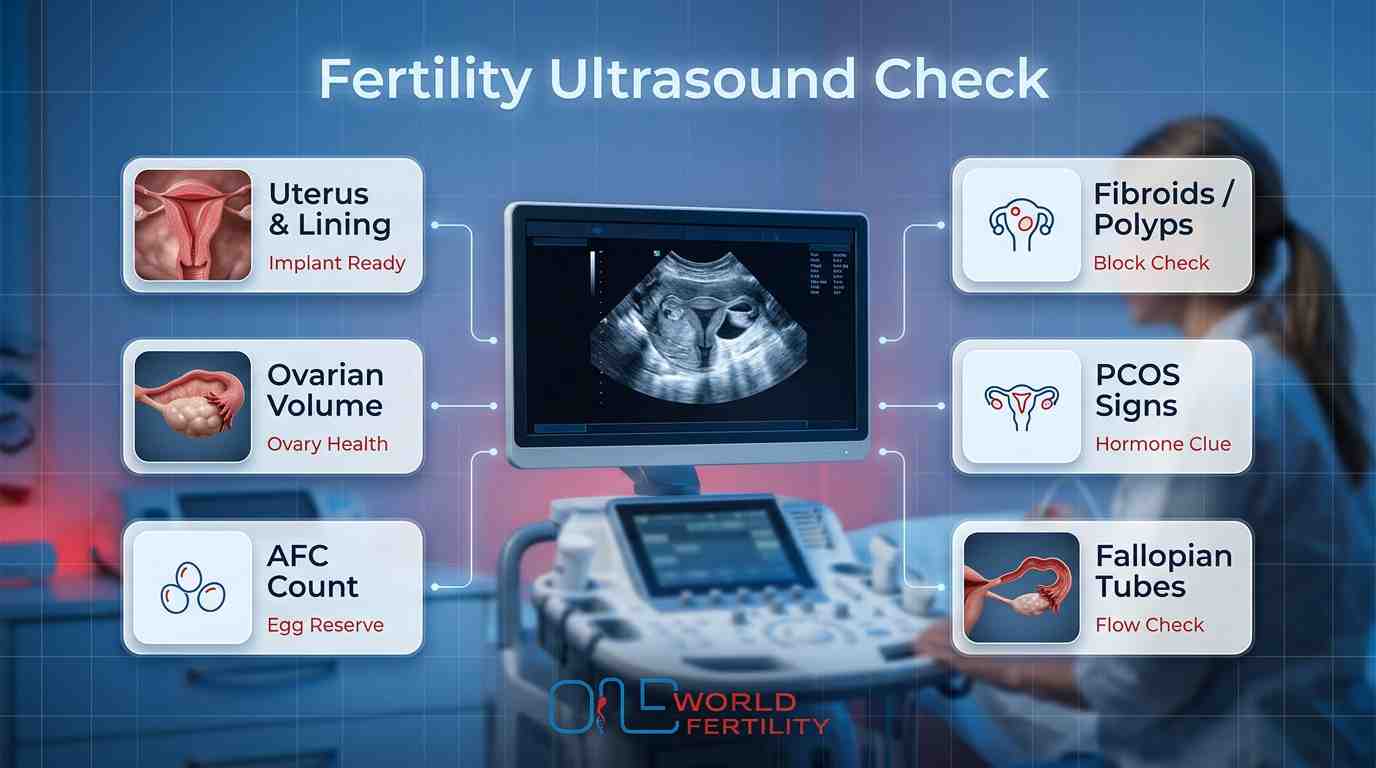
At One World Fertility, every single discovery from your fertility ultrasound affects the treatment plan we make for you. We take every detail into account when it comes to your journey to becoming a parent.
Types of Fertility Ultrasound Scans at One World Fertility
Not every step of your journey needs the same scan. That's why we offer a wide range of fertility ultrasound scans tailored to where you are in your cycle and your therapy. Every scan has a clear purpose, and every result is explained personally by your specialist, for example, from your first baseline fertility ultrasound that maps your reproductive health, to a follicular study ultrasound that tracks your eggs in real time, to a 3D uterine scan or Doppler ultrasound that supports implantation.
Fertility Ultrasound Scans Types & Their Purpose
| Scan Type |
When Done |
What It Checks |
Best Used For |
| Baseline Fertility Ultrasound |
Day 2–3 of cycle |
Ovarian reserve, AFC, uterine health |
IVF/IUI cycle start, first assessment |
| Follicular Study Ultrasound |
Day 6 onwards |
Follicle growth, endometrial thickness |
Ovulation tracking, IUI, IVF monitoring |
| Transvaginal Ultrasound (TVS) |
Any stage |
High-resolution ovarian/uterine detail |
Primary scan method for all follicle checks |
| 3D Uterine Ultrasound |
Pre-IVF |
Uterine cavity shape, anomalies |
Recurrent miscarriage, IVF preparation |
| Doppler Ultrasound |
Pre-implantation |
Blood flow to endometrium & ovaries |
Implantation support, IVF cycles |
What Is a Follicle Scan & How Does Follicular Monitoring Work?
Have you ever thought about why some individuals try for months without knowing when they are most fertile? A follicular scan alters everything there.
So, what is a follicle ultrasound? A follicular study is a series of gentle, non-invasive ultrasound scans that look at little, fluid-filled sacs in your ovaries called follicles. Each follicle holds an immature egg. Our experts at One World Fertility use follicular monitoring to identify your exact fertile window by measuring the size and number of your follicles and the thickness of your uterine lining on certain cycle days.
This is not an estimate or a prediction; it is a real-time answer. Your follicle tracking scan is like a personal egg tracker. It not only tells us if you are ovulating, but also when.
What Does a Follicle Look Like on Ultrasound?
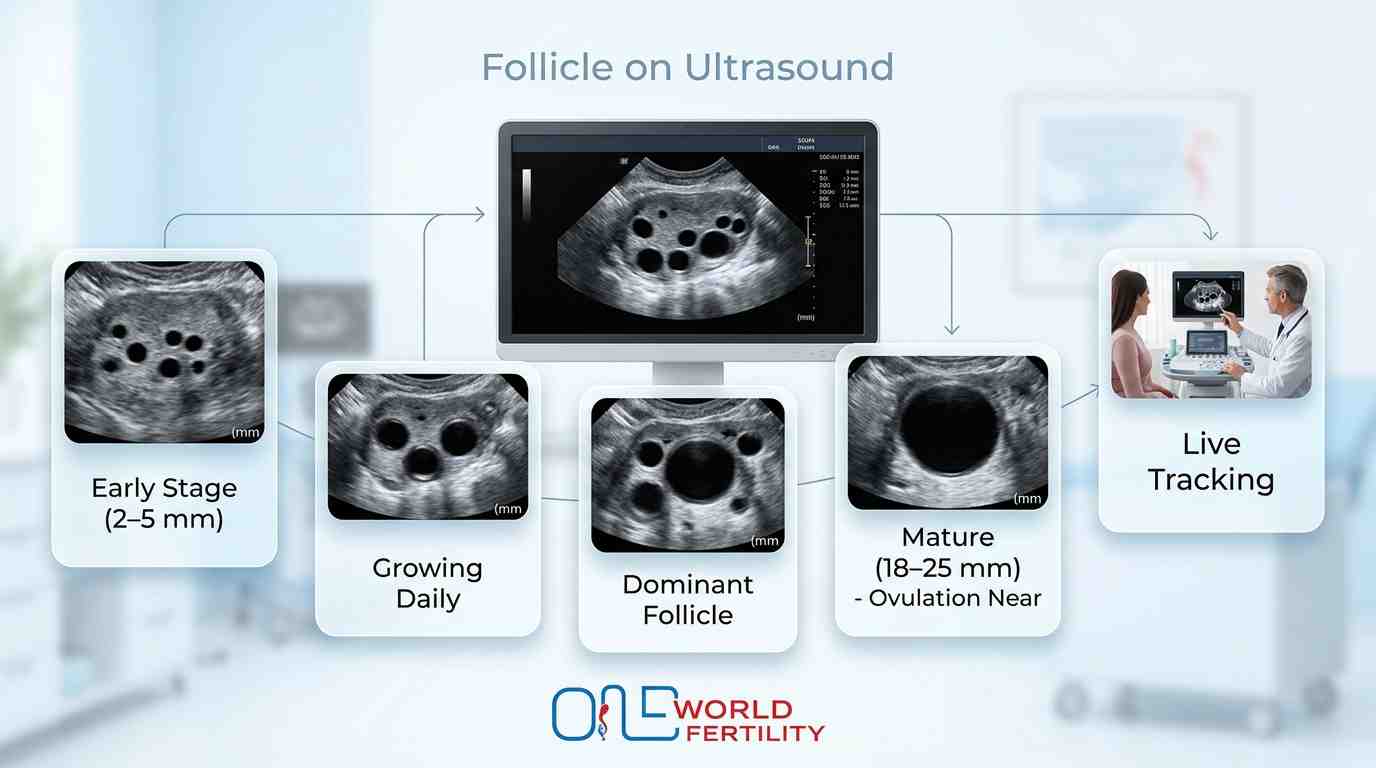
So, what do we see on the screen during your follicular ultrasound? This is what your doctor sees:
- Small, black circles: follicles look like small, spherical sacs filled with fluid inside your ovary.
- Size at the start: 2–5 mm: They are little and quiet at the start of your cycle.
- Growing 1–2 mm every day: may be seen at every follicle monitoring ultrasound session.
- Dominant follicle on ultrasound: one follicle stands out because it is much bigger and darker than the others.
- Mature follicle at 18-25 mm: a sign that ovulation is coming soon.
- Clear on screen: Your professional shows you the pictures and discusses each measurement in real time.
Can You See Ovulation on Ultrasound?
So, can ultrasound detect ovulation? Short answer: Yes, of course. Seeing it confirmed on screen is one of the most comforting things that may happen during a reproductive journey.
| What We See on Scan |
What It Means |
| Dominant follicle collapses |
Egg has been successfully released |
| Free fluid appears nearby |
Confirms follicle has ruptured naturally |
| Corpus luteum forms |
Body is now supporting potential implantation |
| Endometrial lining thickens | Uterus is preparing for a fertilised egg |
| Follow-up follicle after ovulation ultrasound |
Full ovulation confirmation - no guesswork |
And many patients also ask, can you see follicles on ultrasound after ovulation? Yes, once ovulation occurs, your specialist can still see the collapsed follicle, the corpus luteum, and free fluid on the scan. This is why One World Fertility's follicular monitoring is more than just keeping track; it shows you for sure that your body has done what it needed to do.
Why Are Fertility Ultrasound & Follicular Monitoring Essential?
Most people use apps or home kits to track ovulation, but these only provide imprecise estimates. You can be missing your fertile window cycle after cycle without even understanding what's going on within your ovaries. That's where ovarian stimulation monitoring, follicular phase ultrasound and follicular phase tracking come in, changing everything.
At One World Fertility, we combine your antral follicle count scan with real-time egg development tracking to give you a precise, personalised picture of your cycle, whether you need clomiphene monitoring, letrozole scan support, or simply an accurate ovarian reserve assessment before starting treatment. Just clear answers and a plan built entirely around you.
Who Actually Needs a Follicle Monitoring Scan?
Honestly? More people than you might think. Whether you have been trying for a while or are only just beginning to explore your options, a follicular study sonography session can provide answers no home kit or app ever could. Here are the people we see most often at One World Fertility and why keeping a close eye on ovarian stimulation monitoring and oocyte retrieval timing makes a big difference for each of them:
Who Needs a Fertility Ultrasound or Follicle Scan?
| Who You Are |
Why You Need It |
Recommended Scan |
| Trying naturally, unsure of ovulation |
Find your precise fertile window |
Timed intercourse ultrasound |
| PCOS diagnosis |
Track irregular ovulation safely |
Anovulatory cycle detection scan |
| On Clomid or Letrozole |
Monitor follicle response, prevent OHSS |
Clomiphene / letrozole monitoring scan |
| Irregular or absent periods |
Detect follicular phase disruption |
Follicular study sonography |
| Starting IUI |
Time insemination to exact ovulation |
LH surge monitoring + follicle scan |
| Beginning IVF |
Track stimulated follicles pre-retrieval |
Daily ovarian stimulation monitoring |
| Recurrent miscarriages |
Assess uterine health & egg quality |
Ovarian reserve scan + 3D ultrasound |
| Unexplained infertility |
Uncover hidden cycle issues |
Complete conception ultrasound |
| Premature ovarian failure |
Evaluate remaining egg reserve |
AFC assessment + baseline scan |
If you saw yourself in any of those rows, a single ovarian reserve test at One World Fertility could provide you with the clarity you've been looking for on your quest.
Your Step-by-Step Fertility Ultrasound & Follicle Scan Journey
Do you not know what really happens during your follicular monitoring scans? This is your full, honest guide, from your first fertility ultrasound appointment to the moment you know for sure that you are ovulating. No surprises, no medical jargon, just clear steps all the way through.
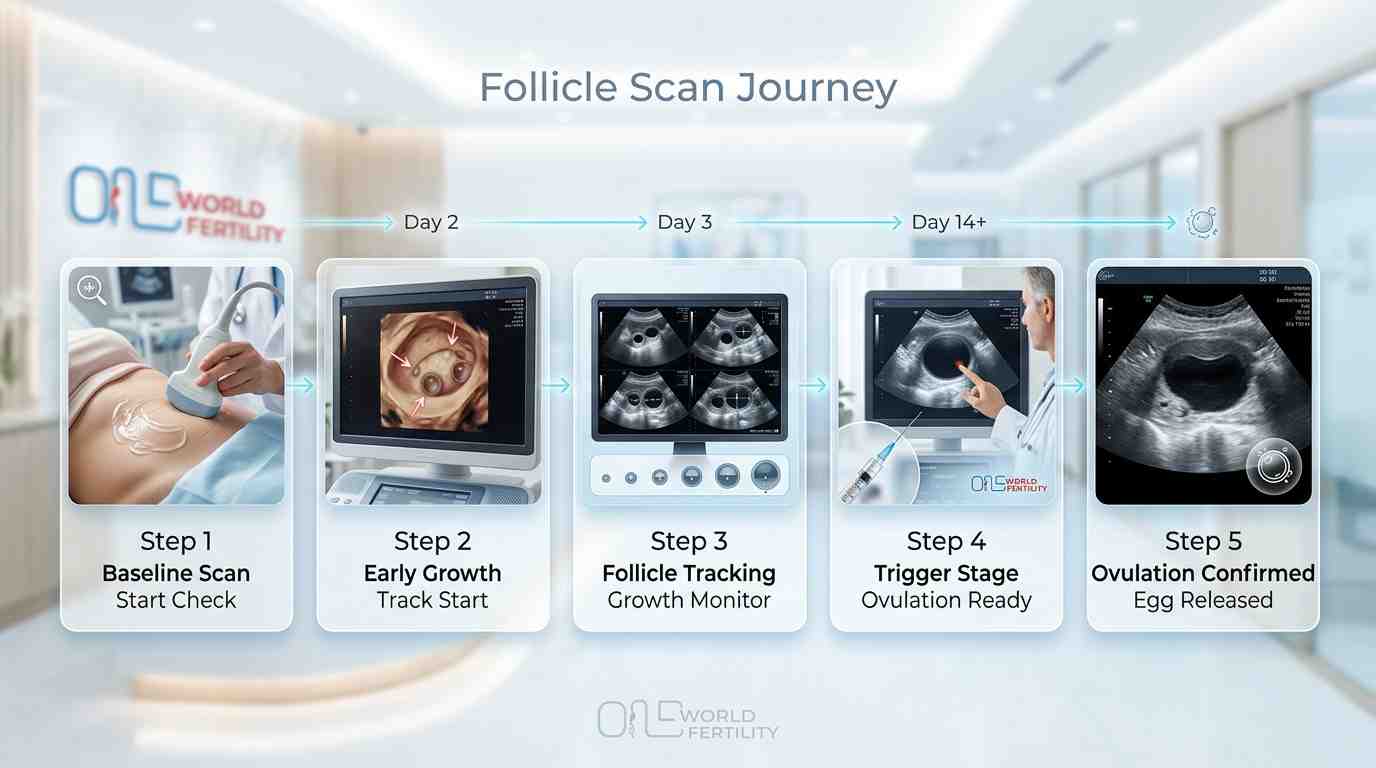
Step 1: Baseline Fertility Ultrasound (Days 2–3 of Your Cycle)
This is where your trip begins, and it begins slowly. On the second or third day of your period, your expert does a full baseline fertility scan to get a complete picture of your reproductive health. Your antral follicle count provides a lot of information about your egg supply and ovarian reserve. We check how many resting follicles are in your ovaries. We also check the size of your ovaries, the shape and condition of your uterus, and look for anything that could get in the way of your therapy, such as cysts, fibroids, or polyps.
Before you start your quest, this fertility ultrasound can help you make a map of your own fertility. We can't move forward unless we know exactly where you are starting from.
Step 2: First Follicle Monitoring Scan (Days 6-8)
Your ovaries have started working by Day 6 to 8, and so have we. Your specialist performs your first follicle-monitoring ultrasound to identify which follicles have begun to grow and carefully quantify their size. This is the initial ultrasound of follicle size that we can use as a standard for comparing all future images. We also check the thickness of your endometrial lining early on to ensure it is beginning to thicken. This is a good sign that your uterus is already getting ready for possible implantation.
This USG follicular study scan also helps us see how well your ovaries are reacting to fertility drugs like Clomid, Letrozole, or FSH injections. If they aren't responding well, we may need to change the dose.
Step 3: Serial Follicular Study Scans (Day 9–12)
This is when true follicular tracking and ultrasound follicle monitoring truly begin. We repeat your follicular scans every 2 to 3 days so we can see your follicles expand in real time. We check the follicle size on ultrasound and how fast they are growing each time we meet. They should grow 1 to 3 mm every day. On Day 12, we expect to observe one follicle on ultrasound that is bigger than the others. This is usually between 14 and 17 mm, which is your day 12 follicle size checkpoint.
We also examine whether your endometrial lining is forming a healthy trilaminar endometrium pattern. This is the unique three-layer look that tells us your uterus is making the best environment for an embryo to implant.
Step 4: Pre-Ovulatory Trigger Scan (Day 13–14)
This is the most significant follicle check ultrasound of your whole cycle. We check the endometrial thickness for implantation when your mature follicle is 18-25 mm on ultrasonography. Then we give you the HCG trigger injection to finish the maturation of the egg. Within 34 to 36 hours, ovulation happens. This scan also locks in the exact time of your oocyte retrieval for individuals who are being monitored during an IVF cycle.
Step 5: Post-Ovulation Confirmation Scan
The final scan, and often the most reassuring one. Your follicle ultrasound after ovulation confirms three things: the follicle has collapsed, a corpus luteum has formed, and free fluid is visible nearby. Together on your follicle rupture ultrasound, this is definitive proof that your egg was released successfully, and your body has begun the progesterone rise needed to support embryo implantation.
At One World Fertility, an experienced fertility doctor personally reviews and explains every scan to you. They do this in a clear, compassionate way and with your next step fully planned out.
What Your Fertility Ultrasound Report Shows by Cycle Day
Have you ever glanced at the findings of your follicular study and had no idea what the numbers meant? You're not the only one, which is why we made this straightforward tutorial. An ultrasound reading of each follicle size shows you where your body is in its cycle. This is what the statistics really mean in simple terms:
Follicle Size by Cycle Day (Natural Cycle)
| Cycle Day |
Expected Follicle Size |
Status |
What It Means |
| Day 2–3 |
2–5 mm |
Antral / Resting |
Baseline fertility scan - your starting poin |
| Day 6–8 |
6–10 mm |
Early Development |
First follicle monitoring scan begins |
| Day 9–10 |
10–13 mm |
Active Growth |
Serial follicular study tracking begins |
| Day 12 |
14–17 mm |
Near Mature |
Critical day 12 follicle size checkpoint |
| Day 13–14 |
18–25 mm |
Mature / Dominant |
Mature follicle on ultrasound - ovulation imminent |
| Post Day 14 |
Collapsed / Corpus Luteum |
Ovulation Confirmed |
Follicle rupture confirmed - egg successfully released |
How to Read Your Follicular Scan Normal Report
Getting your follicle monitoring report or follicular monitoring report can be a lot to take in, especially if it has a lot of medical terminology and data. But once you understand what each number means, it offers a very clear tale about your cycle. We never give you a report and send you home at One World Fertility. Your specialist will personally analyse and explain each follicular study result to you. Understanding your own body should never be confusing. Here's a brief explanation of what each part of your fertility ultrasound scan report implies for you:
Follicular Scan Normal Report: Parameters & What They Mean
| Report Parameter |
Normal Range |
What It Means for You |
| Antral Follicle Count (AFC) |
6–10 per ovary |
Reflects your egg supply and ovarian reserve |
| Dominant Follicle Size |
18–25 mm |
Your egg is mature and ready - ovulation or trigger time |
| Endometrial Thickness |
7–12 mm (trilaminar) |
Your uterine lining is ready to receive an embryo |
| Ovarian Volume |
6–10 cm³ |
Your ovaries are functioning within a healthy range |
| Corpus Luteum |
Present post-ovulation |
Confirms your egg has been successfully released |
| Free Fluid (Pouch of Douglas) |
Small amount visible |
Additional confirmation that ovulation has occurred |
| Multiple Small Follicles (MSF)I |
If present |
Could indicate PCOS - your specialist will guide next steps |
Fertility Ultrasound for Natural Conception, IUI & IVF
A lot of people don't know this, but follicular monitoring doesn't look the same for everyone. The scan procedure is made to fit your body and treatment needs, whether you are trying to get pregnant naturally, getting ready for IUI, or going through an IVF cycle. The goal is always the same: to get the timing just right. But every path has a different way of getting there.
Follicular Monitoring: Natural Cycle vs. IUI vs. IVF
| Parameter |
Natural Cycle |
IUI Cycle |
IVF Cycle |
| Initial Fertility Scan |
Baseline pelvic ultrasound |
Baseline fertility ultrasound |
Comprehensive scan + AFC |
| Monitoring Start |
Day 2–3 |
Day 2–3 |
Day 2 (post-suppression) |
| Scan Frequency |
Every 2–3 days |
Every 2–3 days |
Every 1–2 days |
| Target Follicle Size |
18–25 mm (1 dominant) |
18–22 mm (1–2 follicles) |
18–20 mm (multiple) |
| Trigger Injection |
Optional (HCG/LH) |
Commonly used |
Always administered |
| Primary Goal |
Time intercourse perfectly |
Time insemination to ovulation |
Precise egg retrieval timing |
Transvaginal vs. Transabdominal: Which Fertility Ultrasound Gives Better Results?
When it comes to your follicle scan, not all ultrasound methods are equal, and the difference in clarity actually matters quite a lot. We mostly employ transvaginal follicle scan (TVS) as our gold standard at One World Fertility. Here's why. TVS gives far clearer, more detailed pictures than an abdominal scan by gently moving a little probe closer to your ovaries. It finds tiny follicles under 10 mm with far more accuracy, giving your doctor the exact measurements they need to make treatment decisions with confidence.
That being said, patients who want a fully external scan or just a quick look at their pelvic organs can always get a transabdominal pelvic ultrasound. Both procedures are fully safe, don't use radiation, and don't hurt you in any way. Your comfort is always the most important thing.
Before, During & After Your Fertility Scan: Exactly What to Expect
First fertility ultrasound coming up and feeling a little nervous? Totally understandable. This is a full, honest guide to the whole experience, so you'll know what to expect when you go in and feel better when you leave.
Before Your Fertility Scan
Getting ready is very easy. This is all you need to do:
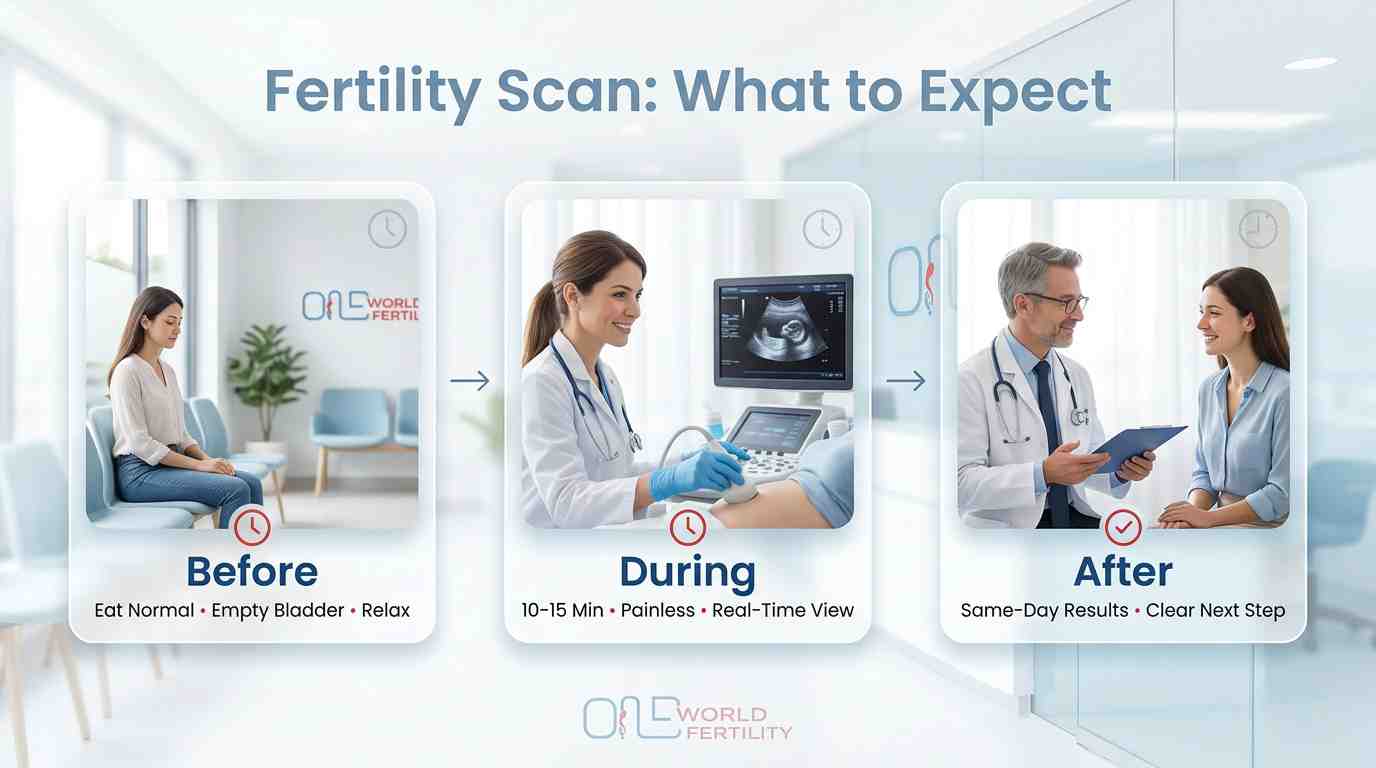
- No fasting required - eat and drink normally before your appointment
- Empty your bladder - before a transvaginal follicle scan for the clearest images
- Note your cycle day - knowing where you are in your cycle helps your specialist enormously
- Wear comfortable, loose clothing - you will be more relaxed and at ease
- Bring any previous scan reports or test results - even from another clinic, they all help build your picture
During & After Your Follicle Scan
That's really all there is to it. You don't need to do anything particular to get ready for your fertility ultrasound. Your follicle monitoring ultrasound takes just 10 to 15 minutes and is painless for most patients. A little transvaginal probe lets your doctor see your ovaries and uterus clearly and in real time. They can see every follicle and every endometrial lining reading right there on the screen. We want you to understand what you're seeing, not just wait for a report, so please ask questions throughout.
And when it's over, you'll always know what to do next. Your follicular study findings are given to you the same day, and your fertility specialist goes over them with you and explains them properly, not just giving you a confused sheet of figures. You always leave with perfect clarity, whether your next step is another follicle check, your trigger injection, or getting ahead with IUI or IVF.
Why Choose One World Fertility for Your Fertility Ultrasound & Follicle Scan?
Because you deserve more than just a piece of paper with a scan and a number on it. An experienced doctor at One World Fertility reads every fertility ultrasound. They know your name, your history, and your treatment plan. We explain the results of every follicle scan to you in a way that is simple, kind, and free of confusing medical terms. Our cutting-edge technology provides the most accurate follicular monitoring possible, and every finding goes straight into your IVF or IUI strategy without any gaps.
We know that every USG follicular study appointment is for someone with real hope, real fear, and a deeply personal dream. That's why we never hurry through a scan, never give you a report that doesn't make sense, and never let you leave without knowing what to do next. That type of care is what your trip needs. We are here to help.
Make an appointment for a follicle scan, a fertility ultrasound, or talk to a doctor.
Questions people ask about this treatment
10 answeredhere