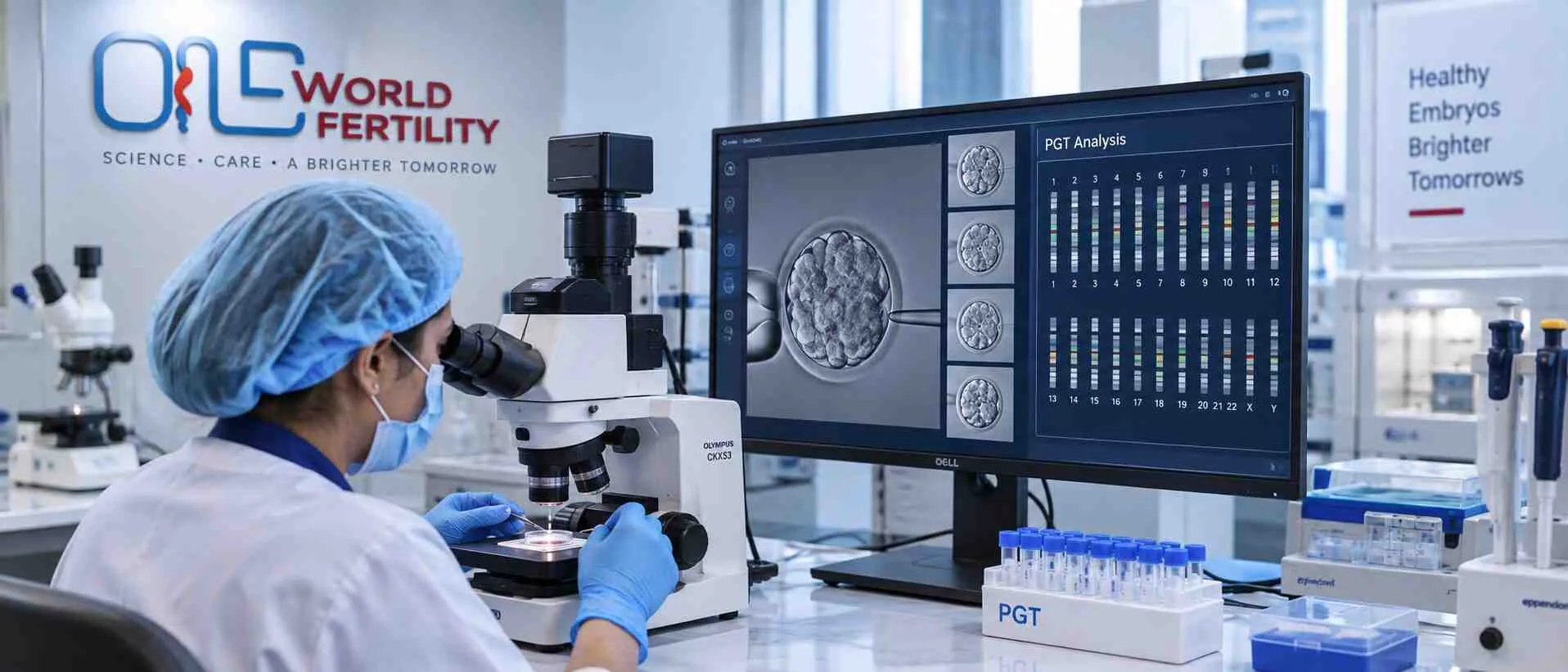



At One World Fertility, we help you protect your possibility of becoming a mother with our egg freezing service, on a timeframe that works for you. Some women freeze eggs before cancer treatment or surgery that could damage their ovaries. Others choose it because the timing isn't perfect yet, whether for their profession, studies, or meeting the right partner.
Either way, egg freezing is an established method of fertility preservation. Find out who it’s for, when the best time to freeze is, how it works, how safe and successful it is, and what storage and cost require here.
The timing is tricky: your eggs age with you, but once they are frozen, they are exactly as old as the day you froze them. With the support of the skilled fertility doctors and embryology team at One World Fertility, and care that respects your decisions every step of the way.
What Is Egg Freezing and How Does It Preserve Fertility?
Egg freezing, or oocyte cryopreservation, is a fertility preservation treatment that involves the collection of a woman’s mature eggs, freezing and storage by vitrification so they can be later thawed and used for pregnancy through IVF.
Oocyte is a medical term for an egg, so egg cryopreservation and oocyte freezing are the same thing. Only fully developed eggs, called MII eggs, are frozen, as these are the ones ready to be fertilised later. And you don’t need a partner or sperm to freeze your eggs.
Vitrification: How Eggs Stay Safe in Deep Freeze
Eggs have a high water content, and slow freezing can generate ice crystals that harm them. Today’s egg freezing uses a technique called vitrification, which freezes the egg in seconds, converting it into glass with no ice at all.
For most frozen eggs, thawing with this method is survivable. How it works is the same for everybody, but why you're freezing is where your personal journey begins.
Why Do Women Freeze Their Eggs? Medical and Future-Planning Reasons
Every woman's reason is personal, but most fall into two groups. Some have to freeze their fertility after medical treatment; others just desire more time.
Medical Egg Freezing Before Cancer Treatment or Surgery
Medical egg freezing is recommended in situations where a health condition or treatment could harm your ovaries. Common reasons are:
- Chemotherapy or pelvic radiation that can damage or kill eggs
- Ovarian surgery or severe endometriosis, which may reduce your egg reserve
- A family history of early menopause, which can be a sign that eggs run out earlier
- Genetic concerns, such as Turner syndrome or a BRCA mutation
Timing is critical for fertility preservation for cancer patients. That's why egg freezing before cancer treatment is often done rapidly, usually without delaying your care. Your fertility specialist can also coordinate with your oncologist to arrange for the ideal timing.
Elective Egg Freezing for Your Future Family Plans
Elective egg freezing is for women who want children in the future, but not yet. Maybe you're building a career, finishing your education, waiting for the right partner, or getting your finances in order. This is a practical option, not a last option.
So today, many women in their late 20s or early 30s are freezing their eggs to keep their choices open. Freezing your eggs while they're young means you get to save eggs for future use, leaving the option of a future pregnancy open until the moment feels appropriate.
| Feature | Medical Egg Freezing | Elective Egg Freezing |
|---|---|---|
| Who it's for | Women facing cancer treatment, ovarian surgery or fertility-affecting conditions | Healthy women who want to delay pregnancy |
| How soon to start | As soon as possible, often within days | When you're ready, ideally before 35 |
| Main goal | Protect fertility before it's harmed | Keep motherhood open for later |
| Main benefit | A chance of biological children after treatment | More freedom to plan your family |
| Insurance chances | May be partly covered, depending on your policy | Usually not covered |
Whatever the cause, there is one thing that has more of an impact on your performance than everything else, and that is your age.
What Is the Best Age to Freeze Your Eggs?
The ideal age to freeze eggs is often in the late 20s to early 30s, preferably before 35, when the eggs are more abundant and more likely to be chromosomally normal, providing you with the most potential for a future pregnancy.
Freezing Eggs at 30, 35 or 37: How Age Changes Results
Egg quantity and quality reduce as age advances, and the decline is faster from around 35 to 37. If you freeze eggs at 35, you will probably need more eggs than at 30 to have the same likelihood of success. If you freeze eggs at 37, that number increases again.
But why so many? Not every egg develops, survives thawing, fertilises, or develops into a healthy embryo. The more good eggs you bank, the better your chances.
Still on hold about freezing your eggs? A simple AMH blood test reveals your egg reserve and lets your doctor give you a personal answer.
Can You Freeze Your Eggs After 40?
Yes, it can be done, but the results are fewer. But you get 40 fewer eggs per cycle, and they are more abnormal. So many women need to do numerous cycles. In India, the egg freezing age limit is set by law.
Under the ART (Regulation) Act 2021, women can freeze their eggs between the ages of 21 and 50. There's no single point when it's too late, but the later you start, the harder it gets. Your doctor may also discuss embryo freezing or donor eggs with you.
| Age at Freezing | Suggested Mature Eggs | Likely Cycles | Est. Chance of at Least One Live Birth |
|---|---|---|---|
| Under 35 | ~10–15 | Usually 1 | About 60–70% |
| 35–37 | ~15–20 | 1–2 | About 50–65% |
| 38–40 | ~20 or more | 2 or more | About 35–50% |
| Over 40 | Case by case | Multiple | Around 10–25% |
When you know your target, here’s how we get you there.
How Does Egg Freezing Work at One World Fertility?
Egg freezing is identical to the early steps of IVF, but stops after your eggs are safely frozen. This is how the egg freezing procedure works with us, from your initial test until storage.
First, we examine your ovarian reserve with an AMH blood test, an antral follicle count (AFC) scan and other standard blood tests. That sort of gives you a rough idea of how many eggs you have left. Your specialist then reviews your results and the number of eggs they expect you to gather. Under the ART Act, you must sign a consent form before treatment can begin.
From Injections to Retrieval: Inside the Egg Freezing Cycle
At the beginning of the egg freezing stage, hormones are injected every day for 10–12 days. This medicine for freezing eggs helps several eggs grow at the same time, and their progress is checked on a regular basis.
Once the eggs are ready, you get a trigger shot. 36 hours later, the egg retrieval is done under anaesthesia in 20-30 minutes. It's a minor procedure, and you go home the same day. Within hours, your mature eggs are frozen. Your egg freezing timeline at a glance:
- Testing and Counselling: A Few Days
- Hormone shots and scans: 10-12 days
- Trigger shot and egg retrieval: 1-2 days
- Freezing and storage: same day as collection
The entire egg freezing procedure usually takes about 2-3 weeks. Book an AMH test to discover how many eggs you could freeze. If You Are Diagnosed With Cancer Random-start stimulation can be started on any day of your cycle.
Protocols with letrozole can keep hormone levels low for oestrogen-sensitive malignancies. We also work directly with your doctor to keep your cancer care on time.
Are you in cancer treatment? Call us for an emergency consult. The next thing that most women ask is, "What will the injections and retrieval feel like?"
Does Egg Freezing Hurt? Side Effects, Risks and Recovery
Egg freezing is easier for most women than they think. Some discomfort is expected, but major issues are unusual. Most side effects of egg freezing come from the hormone injections. You may have bloating, and your tenderness may feel more emotional than usual.
The retrieval is pleasant because you're sedated, so egg freezing doesn't hurt like many women think it does. Some cramping afterwards is usual. Most women are back to their normal routine within a day or two.
Risks of Egg Freezing and How We Keep You Safe
The risks of egg freezing are unimportant. The most important is ovarian hyperstimulation syndrome (OHSS), in which the ovaries grow up. Very rarely, there may be bleeding, infection or ovarian twisting.
We reduce the risk of OHSS with the proper dose and the proper trigger shot. Babies born from frozen eggs also do not have a higher likelihood of birth abnormalities; therefore, egg freezing is safe for you and your future baby. You know it's safe, but the next concern is how well it works and how long your eggs can wait.
How Successful Is Egg Freezing?
Egg freezing provides you with a real chance of producing a child later on, although the results can vary from woman to woman. Knowing what shapes them helps you set the right expectations. What Affects Your Egg Freezing Success Rate? Three things shape your egg freezing success rate, and your age is the biggest of them.
- Your age at freezing: Eggs frozen in your late 20s or early 30s tend to be healthier, so they're more likely to become a baby one day.
- The number of eggs you store: Some eggs won't survive thawing or fertilise, which is normal. Having more in storage simply gives you more chances.
- The lab behind your eggs: Freezing and thawing need real skill. A good lab handles each egg with care, so more of them make it through.
Women have the best results with frozen eggs if they are frozen before the age of 35, even years later. While egg preservation does boost your future chances, it cannot guarantee a pregnancy.
Thus, the above table correlates egg numbers with your odds of a live birth. Egg freezing improves your future chances, but it can't guarantee a pregnancy.
Egg Freezing Storage: How Long Can Frozen Eggs Last?
Frozen eggs are stored in liquid nitrogen at roughly -196C and do not age or lose quality. For egg freezing storage in India, the ART Act sets clear rules: Storage life: 10 years and above Longer storage: only in some medical instances, with approval Age for use: maximum 50 years When you are ready, your eggs are thawed and fertilised with ICSI.
The frozen eggs are subsequently used in IVF, which is the same process as a typical IVF cycle. Some women also ask whether freezing embryos or some other approach would be better for them.
Egg Freezing vs Embryo Freezing and Other Fertility Preservation Methods
Egg freezing isn’t the only strategy to protect your fertility. It really depends on your situation and whether you have a partner, and what the best decision is. The key difference between egg freezing and embryo freezing is the addition of sperm. Eggs freeze by themselves, so you don’t have to find a partner or donor, and your future choices are still yours.
Embryos are eggs that have been fertilised. They don’t die so easily when they thaw, and they indicate how many eggs have been fertilised, but they are linked to that sperm source.
So while thinking about egg freezing vs embryo freezing, consider your relationship and future goals. One of several options for preserving fertility, freezing ovarian tissue may help women who absolutely cannot wait to begin cancer treatment. Whichever route you select, planning the cost keeps surprises at a distance.
How Much Does Egg Freezing Cost at One World Fertility?
Egg freezing cost at One World Fertility covers in three parts: the procedure and lab price, the stimulation medications (based on your age and ovarian reserve), and an annual storage fee. In India, an average cycle costs roughly ₹ 1.5- 3 lakh in all.
Egg Freezing Cost Breakdown: Procedure, Medicines and Storage
Here’s what egg freezing will cost you:
- Procedure and lab charge: This is pretty much set and includes egg collection and freezing.
- Medications: Largest variable. Your dose will vary from woman to woman based on your age and egg reserve.
- Storage: After the initial storage term, an annual egg-freezing storage fee keeps your eggs frozen and safe.
We’ll confirm the exact cost of your egg freezing after your AMH test, once we know your expected dose. Also, consider the additional costs of using your eggs: thawing, ICSI, and embryo transfer.
| Cost Component | What It Covers | Typical Range in India (₹) |
|---|---|---|
| Consultation + tests | Specialist visit, AMH test, AFC scan, blood tests | ₹10,000–30,000 |
| Stimulation medication | Daily hormone injections for about 10–12 days | ₹50,000–1,50,000 |
| Retrieval + vitrification | Egg collection under sedation and lab freezing | ₹50,000–1,60,000 |
| Annual storage | Keeping eggs frozen after the included period | ₹10,000–30,000 per year |
Indicative ranges for India: You will receive your specific quote after your assessment.
Does Insurance Cover Egg Freezing in India?
Elective egg freezing is not covered by most health insurance policies in India. If you are freezing eggs for a medical purpose, like before cancer treatment, your coverage may cover some of the cost; therefore, it is worth checking with your insurer.
Our specialists can help you navigate your options for egg freezing insurance questions or a payment plan, including EMI where available. Cost is important, but so is the lab where your eggs will sit for years.
Why Choose One World Fertility for Egg Freezing?
Choosing where to freeze your eggs means choosing who will look after them for years. As a dedicated fertility preservation clinic, One World Fertility puts that care at the centre of everything we do. Your eggs are frozen in our embryology lab using vitrification, then kept in secure liquid nitrogen storage with round-the-clock temperature monitoring and alarms.
If you are being treated for cancer, we offer fast-track appointments so your treatment is not delayed. Throughout our service, our specialists and counsellors explain every step of the egg freezing process, from your initial AMH test to storage, so you always know what’s happening and why.
Whatever your reasons for protecting your fertility, whether medical or planning, we can help you do it with confidence.Book your consultation for egg freezing today.
Questions people ask about this treatment
10 answeredhere