
What Hormonal Changes Occur During the Eleventh Week of IVF Pregnancy?
 Written by
One World Fertility
Sep 25, 2026 12 min read
Written by
One World Fertility
Sep 25, 2026 12 min read
11 weeks pregnant after IVF? Learn how hCG, progesterone and estrogen change, what your symptoms mean, your baby's size and when to book the NT scan
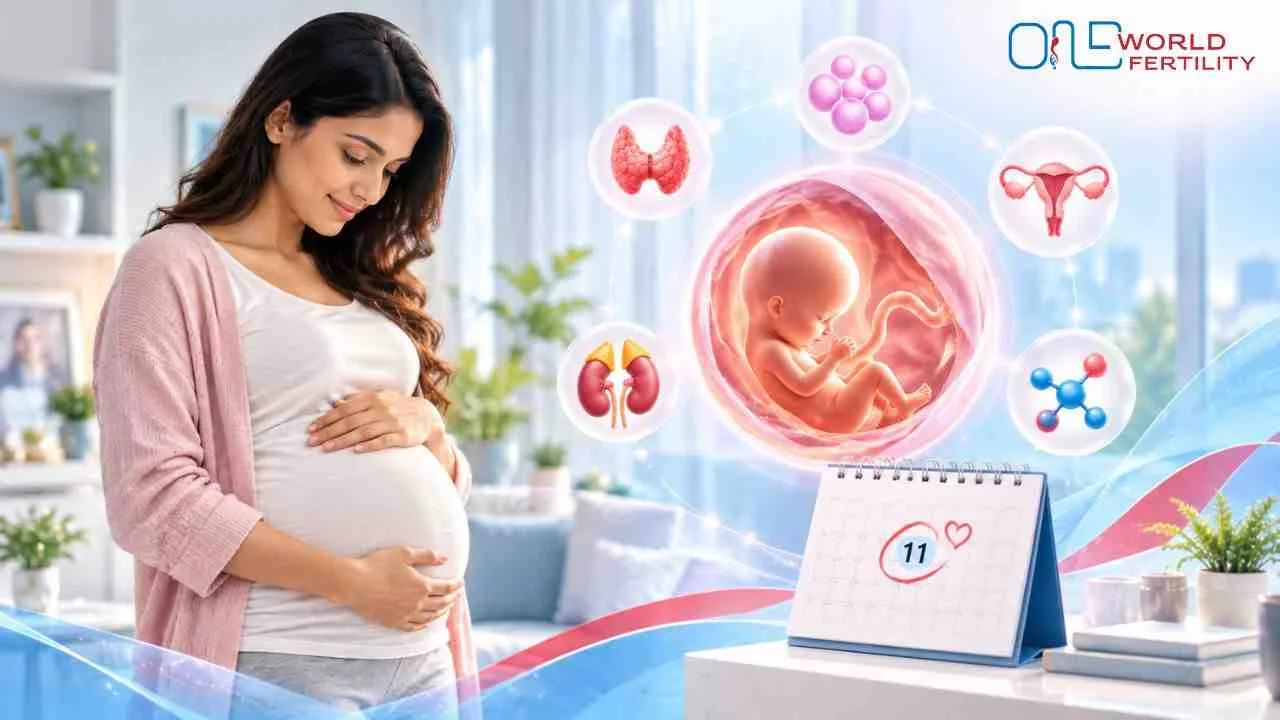
Some changes in pregnancy show up on a screen, but this week's biggest change happens inside your hormones. At 11 weeks pregnant after IVF, the placenta takes over the work your medicines did for weeks, and the hormonal changes at 11 weeks pregnant start to show in how you feel. Can the placenta really manage on its own? Yes. It now makes enough progesterone to keep your pregnancy steady.
But progesterone isn't working alone. Another hormone, one most women never hear about, starts rising this week and may explain your returning appetite. Can you guess which one? Keep reading to find out what your symptoms mean, your baby's size, the NT scan, and more. Because your symptoms fading isn't your body letting go. It's your body taking over.
What Happens at 11 Weeks Pregnant After IVF?
Look how far you've come. From transfer day to the first flicker on the scan, every week has brought you here. And this week, three big changes are happening inside you.
Your hCG has peaked and is slowly coming down. Your placenta is now looking after your pregnancy hormones. And your little one is growing faster every day. That's what happens at 11 weeks pregnant after IVF.
Where Are You in Your IVF Pregnancy at 11 Weeks?
If you had a Day 5 transfer, it's been about 8 weeks since that special day. After a Day 3 transfer, it's a few more days. Counted the same way as in our Week 10 guide, your 11 weeks pregnant IVF milestone is here.
And here's something to smile about. Only one week of your first trimester is left, and your NT scan window opens now.
You might wonder: is anything different because this pregnancy began with IVF? Not much anymore. Your body is doing the work on its own now. For most women who are IVF 11 weeks pregnant, the care ahead follows the usual pregnancy path.
Those changes start with your hormones, so let's start there.
Which Hormones Change at 11 Weeks Pregnant After IVF?
This week, your hormones start working as a team, with the placenta leading the way. Each one links to something you feel, from fading nausea to a returning appetite. Remember the hormone we promised? Meet hPL. It's the one making you hungry again. Here's how the five key hormones during 11 weeks of pregnancy fit together.
| Hormone | Its Job | What's Happening at Week 11 | What You May Notice |
|---|---|---|---|
| hCG | Kept early pregnancy going and signalled the ovaries | Past its peak, starting to fall slowly | Nausea may start to ease |
| Progesterone | Keeps the uterine lining stable and the uterus relaxed | Now made mostly by the placenta, still rising | Bloating, constipation and sleepiness may linger |
| Estrogen | Boosts blood flow, uterine growth and baby's organ development | Rising steadily from the placenta | Skin changes, stuffy nose, more discharge |
| hPL (human placental lactogen) | Shifts your metabolism to feed your baby | Beginning to climb | Appetite returns |
| Thyroid hormones | Support your baby's brain until their own thyroid works | Briefly nudged by high hCG | Usually nothing; checked in blood tests |
Not all IVF pregnancy hormone changes move at the same speed. And the one turning around this week is hCG.
How Do hCG Levels Change at 11 Weeks of Pregnancy?
hCG was the first hormone to announce your pregnancy, and for weeks it kept climbing. Doctors see it peak between weeks 8 and 11, then slowly settle in the second trimester. So a falling hCG now is expected. It's often why your nausea starts to ease.
Should you test it at home? No. hCG levels during IVF pregnancy vary widely now, and your scan tells you far more.
When Does the Placenta Take Over Progesterone and Estrogen?
The handover you read about in Week 10 is nearly complete by weeks 11 to 12. Progesterone during IVF pregnancy once came from your medicines. Now the placenta makes it, so if your support has stopped, your own levels keep rising.
Estrogen climbs every week too. It helps your baby's organs grow and explains any new skin changes or discharge.
But if your body makes the same hormones either way, why did IVF need so much support?
Are IVF Pregnancy Hormones Different From Natural Pregnancy Hormones?
In a natural pregnancy, a small structure in the ovary called the corpus luteum makes progesterone in the early weeks. In IVF, your medicines often do that job instead. That's the main difference in pregnancy hormones after IVF, and by week 11 , the placenta has taken over.
Do Fresh and Frozen IVF Cycles Affect Pregnancy Hormones Differently?
Yes, in the early weeks. How much help you needed depended on your cycle type:
- Fresh cycle: Your ovaries made some progesterone after egg collection, so your body shared the work from the start.
- Natural frozen cycle: You ovulated before the transfer, so a corpus luteum helped alongside your medicines.
- Programmed frozen cycle: There's no corpus luteum, so your medicines did all the work. That's why estradiol after frozen embryo transfer, along with progesterone, may continue closer to 12 weeks.
What Symptoms Are Normal When You Are 11 Weeks Pregnant With IVF?
Now that you know what your hormones are doing, your body starts to make sense. Some of your 11-week IVF pregnancy symptoms are fading, while a few new ones may be showing up. Each one has a hormone behind it.
| Symptom | Hormone Behind It | Week 11 Trend |
|---|---|---|
| Nausea | hCG | Often easing |
| Breast tenderness | Estrogen, progesterone | Softening for many women |
| Tiredness | Progesterone, hCG | Slowly lifting |
| Bloating and constipation | Progesterone | May continue |
| Heartburn | Progesterone | Can start or get stronger |
| Darker skin, faint belly line | Estrogen | Starting to appear |
| Stuffy nose, bleeding gums | Estrogen, higher blood volume | Common; mention it at your next check-up |
Seeing them side by side helps. And the symptom easing first is often the one you've been waiting for.
Is It Normal for Symptoms to Ease at 11 Weeks?
Yes, and you should expect it. As hCG levels drop after their peak, nausea often gets better. Your energy may slowly come back, and your breasts may feel softer.
You saw in Week 7 how symptoms can come and go. This week, the easing often feels steadier.
Does less nausea mean fewer hormones? No. Your progesterone and estrogen are still rising. Your body has simply adjusted. So if you've noticed your symptoms going away at 11 weeks pregnant, your hormones are telling a calmer story.
Why Do New Symptoms Appear as Nausea Fades?
Estrogen and your growing blood volume are behind the new arrivals. You may notice darker skin, a stuffy nose, bleeding gums or more discharge. Clear or milky discharge with no smell is normal. These IVF 11-week-pregnant symptoms can feel odd, but they show your body is doing its job.
Some signs, though, need a call to your clinic straight away:
- Red bleeding or passing clots
- Severe or one-sided cramping
- A fever
- Vomiting that stops you from keeping fluids down for 24 hours
- A sudden loss of all symptoms, together with pain or bleeding
While your symptoms settle, your baby is doing the opposite: speeding up.
How Large Is a Fetus at 11 Weeks After IVF?
Last week, your baby was the size of a strawberry. Now, your little one measures about 4.1 cm from crown to rump and weighs around 7 grams. That's roughly the size of a fig.
If you've been curious about your 11-week-pregnant baby's size, here's a sweet detail. The head is still about half of your baby's body length. The body will catch up soon, but for now, the brain is growing fastest of all.
Can You See Your Baby's Face and Fingers Yet?
Almost. Your baby's face looks more like a little person's each day. The ears are moving into their final place on the sides of the head, and the irises are beginning to form behind closed eyelids.
The hands are busy, too. Your baby can now open and close them into tiny fists. And on the scalp, the first hair follicles are starting to appear.
Which Organs Is Your Baby Building Inside the Womb Now?
Remember the hormones we talked about? This is where they go to work. Estrogen boosts the blood flow that feeds your baby, and your thyroid hormones support the growing brain. So baby development at 11 weeks leans on your body every single day.
Here's what's happening inside the womb at 11 weeks pregnant:
- The intestines are moving from the umbilical cord into your baby's belly.
- The diaphragm is forming, and tiny hiccups may begin.
- Bones are starting to harden.
- Your baby is swallowing amniotic fluid, practising for feeding later.
- The skin is still thin enough to show tiny blood vessels underneath.
This week, a scan can show you much of this.
Should You Book Your NT Scan at 11 Weeks After IVF?
Many IVF moms look forward to this scan. Your baby is bigger now, and the screen shows far more than a flicker.
When Is the NT Scan Done After IVF?
Fetal medicine guidelines time the NT scan between 11 weeks and 13 weeks and 6 days, when your baby measures 45 to 84 mm. At 11 weeks, some babies are still just under that length. So an NT scan at 11 weeks is possible, but many clinics book it for week 12 to be sure.
Does the NT Scan Hurt, and What Does It Check?
No, it doesn't hurt. The scan is usually done over your tummy and takes about 20 to 30 minutes. If your baby is lying low or at a tricky angle, your sonographer may switch to an internal scan. Here's what your doctor checks:
| On Your Scan | What the Doctor Measures | Why It Matters |
|---|---|---|
| Crown-rump length | Baby's length from head to bottom | Confirms dates and scan timing |
| Nuchal translucency | Fluid at the back of the neck | Screens for chromosomal conditions |
| Nasal bone | Whether it's visible | Adds accuracy to screening |
| Heartbeat | Rate and rhythm | Should be strong, around 150–170 bpm |
| Early anatomy | Skull, stomach, limbs, cord | Spots major concerns early |
Your scan results are then combined with a blood test, known as the double marker in India, for a clearer picture. Had PGT-A on your embryo? As we shared in Week 10, this screening is still worth doing.
So, what should you expect at 11 weeks pregnant after IVF? A closer look at your growing baby, and more reassurance with every measurement.
The scan shows you how your baby is growing. But it also answers the one question every IVF mom carries into that room: how safe is my pregnancy now?
Is 11 Weeks Pregnant Safe From Miscarriage After IVF?
This is the number you've been waiting for. Large studies show the risk of miscarriage drops to about 1–2% once a healthy heartbeat is seen at this stage. That's even lower than at Week 10.
So, is 11 weeks pregnant safe from miscarriage? For most women with a normal scan, the answer is a very reassuring yes. And with every week you move forward, the odds get even better.
Does an IVF Pregnancy Carry More Risk at 11 Weeks?
Not in most cases. Once your baby is growing well, being 11 weeks pregnant after IVF carries much the same risk as a natural pregnancy; your age and health history still matter, which is why your doctor keeps checking in.
Numbers don't always calm the heart. As we talked about in Week 10, it can be hard to believe good news after IVF. This week, symptoms that are going away may make that question louder. It's okay to feel this way. It shows how important this pregnancy is to you.
Are You Ready to Share Your News Yet?
There's no rule. Some couples tell family after the NT scan, and others wait until the second trimester. Choose the moment that feels right for both of you.
Your baby is safer than ever now. And there's one simple thing you can do every day to support that growth. It's on your plate.
Can Food Support Your Hormones and Baby at 11 Weeks?
Food can't change your hormone levels during the first trimester of an IVF pregnancy. But it gives your body and your baby the building blocks those hormones need to do their work.
Why Is Your Appetite Coming Back at 11 Weeks?
You may have noticed it already. Meals don't feel like a battle anymore. That's because hCG is falling, and hPL, the hormone you met earlier, is rising. It shifts your metabolism so more energy reaches your baby.
You don't need a special diet. Small, balanced meals with the right nutrients are enough.
Do You Need Extra Iodine and Iron Now?
Both are important this week. Iodine helps your thyroid make proteins that your baby's brain needs, and iron helps your blood volume grow. This is how your plate ties in with what your body needs:
| Your Body's Need | Nutrient | Easy Sources |
|---|---|---|
| Thyroid hormones and baby's brain | Iodine | Iodised salt, milk, curd, eggs |
| Rising blood volume | Iron + vitamin C | Spinach, rajma, lentils with lemon |
| Hardening bones | Calcium + vitamin D | Paneer, curd, milk, morning sunlight |
| Brain growth | Omega-3 (DHA) | Walnuts, chia seeds, well-cooked salmon |
| Steady blood sugar as hPL rises | Protein + fibre | Dal, eggs, sprouts, whole grains |
Keep taking your prenatal vitamins, and add short, easy walks when you feel up to it. The foods to avoid haven't changed from earlier weeks: raw fish, unpasteurised dairy, high-mercury fish, alcohol and caffeine over 200 mg a day.
Every meal, every walk and every vitamin adds up. And when you step back, you'll see just how much this one week has built.
Conclusion
Week 11 is a week of handovers. hCG is coming down, your placenta now makes the progesterone and estrogen you need, and your fig-sized baby is growing fast.
So if you're 11 weeks pregnant after IVF and feeling a little less pregnant, remember what's really going on. Your body hasn't stepped back. It has stepped up. For now, keep it simple.
Follow your doctor's medication plan, book your NT scan, and keep taking your prenatal vitamins.
Our Week 10 blog shows where this handover began. And when you're ready, our Week 12 guide will walk you to the end of your first trimester. From here, your pregnancy grows on its own strength.
One World Fertility is proud to have been there from the start.