
Surrogacy in India as per Law: Legal Rules, Eligibility, Cost & Complete Treatment Process
 Written by
One World Fertility
Sep 8, 2026 66 min read 51 sections
Written by
One World Fertility
Sep 8, 2026 66 min read 51 sections

Complete guide to surrogacy in India: legal requirements, eligibility criteria, costs ₹15-25 lakhs, step-by-step process & latest regulations under 2021 Act
If you're reading this, you've probably been through a lot. You might have been trying to get pregnant, dealing with health problems, or looking for information about surrogacy in India. You're not the only one. Many couples in India are going through the same things, and surrogacy is often a ray of hope when other options seem impossible.
But the truth is that surrogacy in India isn't what it used to be. The Surrogacy (Regulation) Act, 2021 changed a lot when it went into effect on January 25, 2022. This law made commercial surrogacy illegal and set severe eligibility standards that many couples don't fully understand. And if that wasn't enough, the government made more changes in February 2024, especially about how donor gametes can be utilized. This has left a lot of people who want to be parents confused about what they can and can't do.
It can be hard to understand surrogacy law in India, like trying to find your way through a maze without being able to see. One mistake, such as not having the right paperwork, not meeting the eligibility requirements, or not knowing legal costs, might put your dream of becoming a parent on hold for months or even years.
That's exactly why we made this whole guide. We'll explain everything you need to know, including who can legally pursue surrogacy in India, what documents you'll need, the whole treatment process from start to finish, realistic cost expectations, timelines, legal challenges, and most importantly, how to do everything according to Indian law without getting into any trouble. At the end of this guide, you'll have a clear plan for how to make smart choices about your surrogacy journey.
Understanding Surrogacy Law in India
It's important to know the laws about surrogacy before you even think about starting the process. The law in India about surrogacy is complicated, has a lot of rules, and has changed a lot in the last few years. Let's go over exactly what the law says about what kinds of surrogacy are legal and what kinds are not - because not knowing these rules could cause you years of delays and serious legal trouble.
What is the Surrogacy (Regulation) Act, 2021?
The Surrogacy (Regulation) Act, 2021 became law on January 25, 2022. It completely changed the way surrogacy works in India. Before this Act, there weren't many rules about surrogacy. This allowed for abuse and unethical behavior, and India was called a "global baby factory" because of how well commercial surrogacy did without proper control.
What did change? The government passed this law with three main goals in mind:
- First, commercial surrogacy should be totally banned, and only altruistic surrogacy should be allowed. This means that surrogate mothers should not be paid anything other than their medical bills and insurance coverage. This isn't a small change; it's a major one that quickly got rid of the whole commercial surrogacy industry.
- Second, to protect women from being exploited, especially poor women who were often forced to become surrogates for money. The law says that women shouldn't have to become surrogate mothers because they are poor, and it wants to make sure that people do it out of kindness, not desperation.
- Third, to protect the rights of children born through surrogacy and make sure they have the same legal rights as blood children from the time they are born. No child born through surrogacy can be left behind or denied their rights.
To make sure these rules were followed, the Act set up two important oversight bodies:
- At the central level, the National Surrogacy Board is in charge of policy and administration across the whole country.
- At the state and union territory level, there are State Surrogacy Boards that are in charge of rules and approvals.
These boards aren't just for paperwork; they have absolute power:
- India's surrogacy centres should be regulated and watched over.
- Give prospective parents and surrogate mothers certificates that they are eligible.
- Look into reports and violations.
- Make sure that the law is strictly followed.
- Clinics that break the rules should have their registrations revoked or suspended.
- Approve every surrogacy plan before it goes forward.
It's essential to understand this Act because trying to do surrogacy without following the law can get you up to 10 years in jail and a fine of up to 10 lakhs. You have to follow the rules no matter what; it's not flexible.
Types of Surrogacy Under Indian Law
Something very important you need to know right away is that India does not allow all kinds of surrogacy. The law is extremely clear about what you can and can't do. Let's break it down.
Altruistic Surrogacy (Only Form Allowed)
This is the only legal way to be a surrogate in India. What does it mean to be "altruistic"? In other words, the surrogate mother can't get any money or other financial help besides what she needs to pay for her medical care, insurance, and basic living expenditures while she's pregnant. She carries your baby because she cares and wants to help, not to make money. Think of it as an act of kindness that a close family member or friend usually does. The intended parents can pay for her hospital bills, healthy food, pregnancy clothes, travel for doctor visits, and health insurance for 36 months, but they can't pay her a "fee" or "compensation" for being a surrogate.
Gestational Surrogacy (No Genetic Link of Surrogate to Child)
This is also allowed, and in fact, it is the best way to do it medically. In gestational surrogacy, the intended parents' egg and sperm (or donor gametes if medically confirmed) are used to make the embryo. Then, using IVF, the embryo is put into the surrogate's uterus. The most important thing to remember is that the surrogate has no genetic connection to the kid; she's only carrying the baby. The child is all yours biologically (or from the donor you chose). This stops any legal problems or emotional problems that could come up if the surrogate were related to the child.
Prohibited:
Commercial Surrogacy (Banned Since 2022)
If someone offers you commercial surrogacy in India, don't do it. It's against the law. When you pay a lady to carry your baby as a business deal, that's called commercial surrogacy. This was widespread in India before 2022, but the Surrogacy Act made it illegal. Why? Since it led to poor women being taken advantage of, since they were "renting their wombs" out of need for money. If you do commercial surrogacy now, you could go to jail for up to 10 years and pay fines of up to ₹10 lakhs. Clinics that offer this can lose their licenses for good.
Traditional Surrogacy (Using the Surrogate's Egg)
In traditional surrogacy, the intended father's sperm is mixed with the surrogate's egg. This is not allowed at all in India. Why is this not allowed? Because it makes a genetic link between the surrogate and the baby, which could lead to custody fights, emotional problems, and legal issues. The law wants to make sure that a surrogate mother can't claim parental rights just because the child is physically hers. Gestational surrogacy is the only legal kind, and the surrogate has no DNA ties to the baby.

The Bottom Line: You can only do altruistic gestational surrogacy in India. Any other way is against the law, and trying it can get you in a lot of trouble with the law. Make sure that your clinic follows these regulations strictly.
Eligibility Criteria: Who Can Pursue Surrogacy in India
This is where many couples hopes fall apart or, on the other hand, they find out they are eligible. Not everyone can become a surrogate in India; there are specific requirements that you must follow. Let's see whether you meet the requirements.
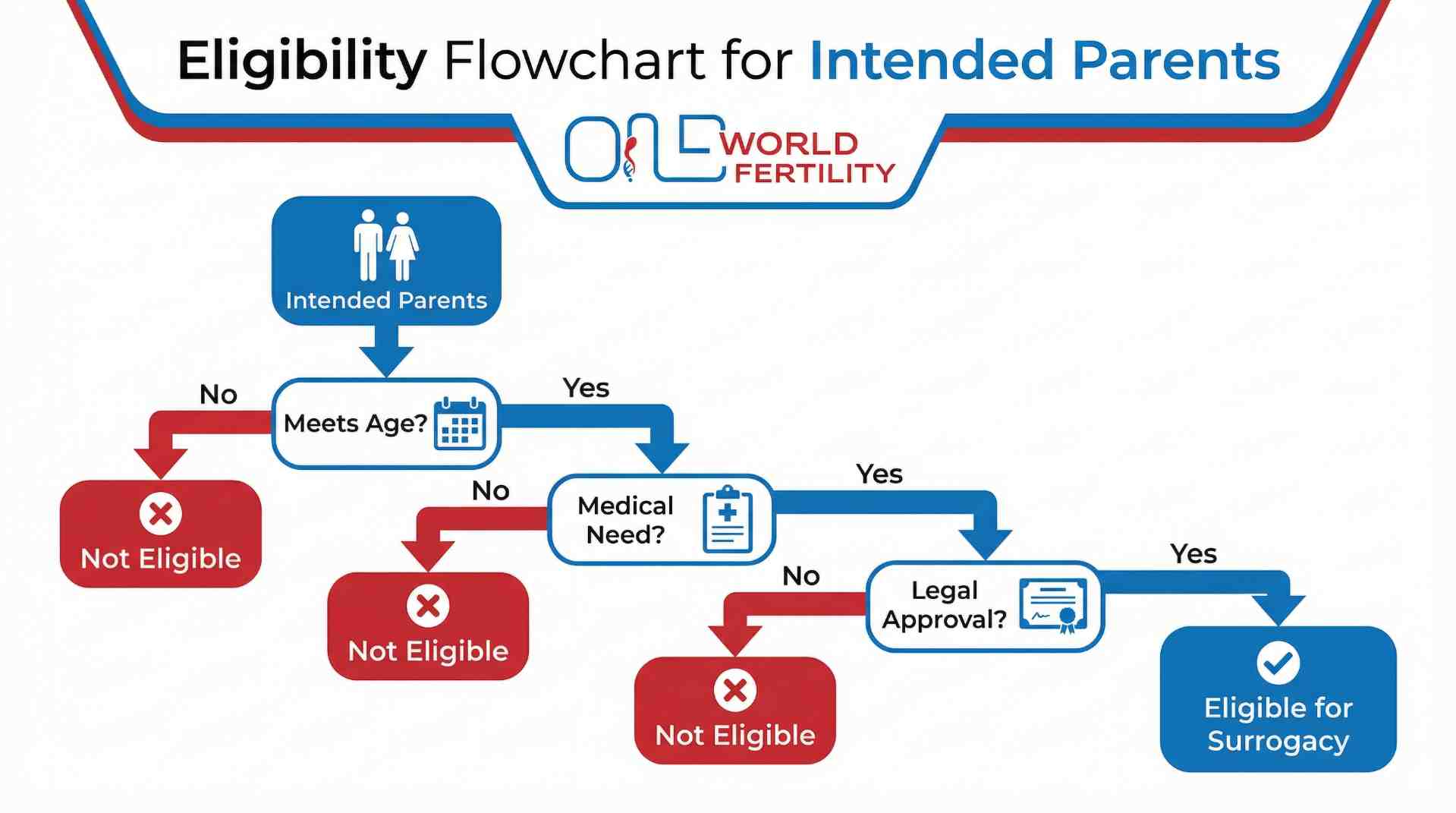
For Intended Parents (Couples)
If you and your spouse want to have a baby through surrogacy in India, you must meet these standards. You can't miss even one of these, or you may be disqualified.
Mandatory Requirements:
Indian citizenship (this includes OCI cardholders)
Both people in the relationship must be Indian nationals. If you are an NRI (Non-Resident Indian) or have an OCI (Overseas Citizen of India) card, you can apply, but it will take longer, and you will have to go to India more than once for court hearings and medical procedures.
Legally Married Heterosexual Couple
You have to be married to a man and a woman legally. Under present Indian laws, live-in partners, same-sex couples, and unmarried couples are not eligible, no matter how long they've been together.
Married for Minimum 5 Years
You have to show proof that you've been married for at least five years. You will need to show proof of your marriage by giving them your marriage certificate. This rule is in place to make sure the relationship is stable before having a child through surrogacy.
Wife's Age: 23-50 Years
The woman who is applying must be between the ages of 23 and 50. Some new interpretations say 25 to 50 years, although most State Boards say 23 to 50. Don't wait if you're close to the maximum age restriction. If you turn 50 while your application is being processed, it could be denied.
Husband's Age: 26-55 Years
The man must be between 26 and 55 years old. Time is really important again if you're getting close to the upper limit.
Certificate of Proven Infertility from District Medical Board
Surrogacy is not as simple as getting one in India. Medical documentation of infertility or a condition that renders a natural pregnancy risky or impossible is required. After reviewing your medical records, the District Medical Board will only issue a certificate if they determine that surrogacy is medically necessary. If the following problems are present, the woman may not be able to conceive or carry a pregnancy safely: absent uterus (MRKH syndrome or hysterectomy), severe medical conditions making pregnancy life-threatening (such as severe heart disease, kidney failure, or uncontrolled diabetes), repeated IVF failures despite good quality embryos (implantation issues or recurrent miscarriages), severe uterine abnormalities (Asherman's syndrome or severe scarring), or medical treatments that damaged the uterus (radiation or chemotherapy). In such cases, surrogacy becomes the only viable path to biological parenthood.
Exception: If Existing Child Has Life-Threatening Disability/Illness
The rule stated above does not apply in all cases. You might still be eligible for surrogacy if your child has a medically confirmed lethal handicap, terminal illness, or life-threatening problem. If a parent loses their only kid or if their child is unable to live a typical life, this exception may provide some relief.
For Single Women
Indian surrogacy law does give single women a modest chance, but it's very small. Here's everything you need to know if you're a single woman who wants to become a mother through surrogacy.
Only Widows or Divorcees Eligible
The law employs the phrase "intending woman" to mean only widows and divorcees. In India, surrogacy is not permitted for single women who opted not to marry or are living together with someone.
Age Range: 35 to 45
Do you see the difference? The age range is substantially less for single women than it is for married couples. You have to be between 35 and 45 years old when you apply. Because of this little window, timing is key. If you're a single woman thinking about surrogacy, don't wait to make your choice.
Must Have Medical Certificate of Necessity
You can't pursue surrogacy to avoid getting pregnant, just like married couples can't. You need a medical certificate from the District Medical Board that says surrogacy is medically necessary. This could be because you can't have children, you don't have a uterus, or have a medical condition that makes pregnancy dangerous, or because other fertility methods have failed over and over again.
No Existing Biological or Adopted Child
You cannot be a surrogate if you already have a child through birth, adoption, or surrogacy. Surrogacy is only available to women who are single and don't have children. The same exception applies as for couples: you may still be able to get help if your child has a disease or illness that will kill them soon.
Important Note for Single Women:
You'll also need to use your own eggs for the surrogacy process. And the District Medical Board can now approve donor sperm as of February 2024. For single women who are considering surrogacy, the process can be challenging on an emotional level and legally tricky, so it's best to have strong family support and legal advice.
Who Cannot Pursue Surrogacy in India
A lot of people have to deal with this hard truth: Indian surrogacy law is exclusionary. If you belong to any of the following groups, you are not allowed to get a surrogate in India. Let us be clear about who can't do something and why.
Restricted Categories:
Foreign Nationals (Except OCI/PIO Cardholders)
If you are not from India and are a foreign person, you can't use surrogacy in India. To stop "reproductive tourism" and the abuse of Indian women, the government banned foreign commercial surrogacy. Surrogacy can only be done by Indian citizens or people who have an OCI (Overseas Citizen of India) or PIO (Person of Indian Origin) card. If you're not an Indian citizen or OCI holder and are from the US, UK, Europe, or another country, you'll need to look into surrogacy choices in your home country or in places like the USA, Canada, Georgia, or Ukraine.
Single Men
This is one of the most talked-about exclusions. In India, single men (whether they are unmarried, widowed, or divorced) cannot legally become surrogates. The legislation only recognizes "intending couples" (married straight couples) and "intending women" (widows and divorcees). Single dads are not included at all. If you're a single man who wants to become a parent through surrogacy, you'll need to look into alternatives in other countries, including the US, Canada, or Colombia, where single men can legally seek surrogacy.
Unmarried Women (Except Widow/Divorcee)
In India, you can't use surrogacy if you're a single woman who has never been married. The legislation makes a difference: widows and divorcees are eligible (as we discussed earlier), but women who have chosen not to marry or haven't found a spouse are not allowed. A lot of people who fight for women's rights have said that this is unfair, but the law is still in effect.
Live-in Partners
The law doesn't recognize you, even if you've been living together for 10 or 20 years and think of yourselves as married. Indian surrogacy law says that you need a marriage certificate that is officially registered and shows that you have been married for at least five years. Even if a live-in relationship is secure and lasts a long time, it doesn't count. If you want to be a surrogate and are living together, the only thing you can do is get married first and then wait five years to apply.
LGBTQ+ Couples
This is probably the most talked-about exclusion. In India, same-sex couples, transgender people, and anyone who don't identify as either male or female can't use surrogacy at all. Even though Section 377 was struck down and being gay is no longer a criminal in India, same-sex marriage is still not allowed. This means that LGBTQ+ couples can't use surrogacy. The legislation makes it clear that a "intending couple" is a married man and woman. Many LGBTQ+ campaigners and legal experts have said that this is unconstitutional discrimination, however until the legislation changes, LGBTQ+ people have to go to other countries like the USA, Canada, or some European countries to find a surrogate.
Couples with Existing Healthy Children
You can't be a surrogate in India if you already have a healthy child, whether you gave birth to them naturally, adopted them, or had them through a previous surrogacy. The law is only for couples who don't have kids. Some couples who really want a second child have taken this rule to court, especially those who are having trouble getting pregnant again, but the Supreme Court has mostly supported it. The only time you might be able to get this is if your current child has a handicap, terminal sickness, or incurable condition that medical authorities have confirmed.
The Reality Check:
The Indian law on surrogacy is meant to be very strict. It's not meant to help everyone who wants to use surrogacy to have a child. It's only meant to help Indian couples who are married and straight and can't have children. If you don't meet this very specific requirement, you'll have to look into adoption, surrogacy, or other methods of reproduction in countries with less strict laws. As of 2025, it's the rule, even though many people think it's unfair.
Eligibility Criteria For Surrogate Mothers
To be a good surrogate mother, the woman must meet strict legal requirements set by Indian law. It's not enough to just find someone wanting to help. It's important to know these requirements because if the surrogate you choose doesn't meet them, the officials will not allow the surrogacy process to go forward. Let us look at the Indian laws that say who can officially be a surrogate mother.
Mandatory Requirements
There are strict rules in place about who can and cannot be a substitute mother. There is no way around these standards; they all have to be met.
Must be an "Ever-Married" Woman (Married/Widowed/Divorced)
Your surrogate had to be married before. She cannot be a woman who has never been married. She can be married, widowed, or divorced. Why is this rule in place? The law assumes that married women are more mature, have more family support, and understand better how hard it is on their bodies and minds during pregnancy. Women who are not married are not allowed to be surrogates at all.
Age: 25-35 Years
This age range is very strict. She doesn't qualify if she's 24 or 36. End of story. This age range is considered the safest for pregnancy, with the lowest risk of complications. If a family member is ready to act as your surrogate but is 36 years old, the law does not allow it.
Must Have at Least One Biological Child of Her Own
This can't be changed. Your surrogate must have had at least one healthy baby before. Why? For one, it shows that she can safely carry a pregnancy to term. Second, it makes sure she knows what to expect physically and emotionally during pregnancy and birth. Indian law says that a woman who has never been pregnant can't be a surrogate.
Can Act as Surrogate Only ONCE in Lifetime
This is a critical restriction. A woman can only be a surrogate mother once in her whole life. She can't go through the surrogacy process again, not for a new couple, not if it didn't work, and not even if she really wants to help a family member. If the first or second attempt at embryo transfer doesn't work, the law does allow up to three more tries within the same surrogacy arrangement.
Close Relative of Intended Couple (Requirement Relaxed in 2023 Rules, but Preference Given)
This is where things get tough. When the 2021 Act was first passed, the surrogate had to be a "close relative" of the couple who wanted to have a child. In this case, the surrogate had to be a sister, sister-in-law, cousin, or aunt. On the other hand, the 2023 change made this rule a little less strict. She doesn't have to be connected by blood, but family members do get the most attention. It is very hard to find a willing and qualified surrogate outside your family, and the officials may look more closely at your case. Advertising or publicly looking for surrogates is also against the law. For example, you can't put up ads that say "Looking for surrogate mother."
Medical Fitness Certificate Required
Your surrogate must undergo thorough medical examinations and obtain a fitness certificate from a licensed medical professional. This certificate says that she is healthy enough to have a baby without putting herself or the baby at risk.
Psychological Fitness Certificate Mandatory
Your surrogate needs to be checked out and certified for more than just their physical fitness. This makes sure she's ready for the emotional hurdles of being pregnant with a baby she'll give to someone else after birth. Screening for mental health helps stop situations where the surrogate gets too connected and can't let go of the child.
Cannot Donate Her Own Eggs (Only Gestational Surrogacy Allowed)
We talked about this before: traditional surrogacy is not allowed. Your surrogate can't utilize her own eggs. She has to carry an embryo made from your eggs (or donor eggs) and your partner's sperm (or donor sperm). This makes sure she isn't related to the baby by blood, which eliminates custody fights and mental problems.
Surrogate Health & Screening
Once you've found a possible surrogate who passes the basic qualifying requirements, she must go through a comprehensive health screening before being accepted. This isn't just a trip to the doctor; it's a whole review process that may take 4 to 8 weeks.
| Screening Type |
What's Evaluated |
Timeline |
| Medical Evaluation |
Blood tests (HIV, Hepatitis B & C, Syphilis), Ultrasound for uterine health, Diabetes & hypertension screening, Complete physical examination |
2-4 weeks |
| Psychological Assessment |
Emotional stability, Understanding of surrogacy process, Family support verification, Voluntary decision confirmation (no coercion) |
1-2 weeks |
| Pregnancy History Review |
Previous delivery complications, Normal vs C-section delivery, Miscarriage history, Postpartum issues, Time gap since last pregnancy |
1 weeks |
The registered ART (Assisted Reproductive Technology) clinic, basically a licensed fertility facility that does IVF and surrogacy, will let her know that she can safely carry the baby without putting herself or the baby at risk. A certified psychologist's evaluation of her mental health is also very important that makes sure she's ready to carry the baby and then be away from it after birth.
In the end, acceptance isn't guaranteed even if you find a willing surrogate who meets all the requirements. Get ready for the screening process to last between 4 and 8 weeks, and have a plan B ready in case she fails the physical or psychological test.
Complete Documentation Required
It's essential to make sure all of your paperwork is correct. If you forget one document, it could take months to get your permission. In India, the surrogacy process requires a lot of paperwork, and the government is very strict about it. Let's list everything you need to get ready.
For Intended Parents
As the intended parents, you will need to collect a lot of paperwork to show that you are eligible and are following the law. Get these papers together early because it can take a while to get some of them. This is your whole list:
Essential Documents:
- Marriage Certificate (Proof of 5+ Years Marriage): You need your original marriage certificate to prove that you have been lawfully married for at least five years. If the date of your marriage isn't apparent on your certificate, seek a certified affidavit that says how long you've been married.
- Aadhaar Cards of Both Spouses: Both the husband and wife must have valid Aadhaar cards. These are the main ways to prove your identity and address.
- Passport Size Photographs: Recent passport-sized pictures of both partners (typically 4–6 copies of each). These will be sent with different application forms.
- Certificate of Essentiality (from Appropriate Authority): The Appropriate Authority gives you this certificate when they make sure that surrogacy is medically necessary for you. You can't move forward without this; it's one of the most essential papers in your whole application.
- Certificate of Eligibility (from State Appropriate Authority): This certificate proves that you meet all of the legal requirements, such as your age, how long you've been married, your citizenship, and the fact that you don't have any children. After looking over your complete application, the State Surrogacy Board gives you this.
- Medical History and Health Records: Complete medical records for both parties, including past surgeries, therapies, fertility treatments, IVF cycles, and any other health issues that might be important. The more complete, the better.
- Certificate of Infertility from District Medical Board: There is no way to change this. The District Medical Board must confirm that you have a genuine medical issue that requires surrogacy, such as infertility, a missing uterus, pregnancy risks that could kill you, or other disorders. If you don't have this certificate, your application will be turned down right away.
- Proof of Indian Citizenship: A passport, voter ID, or other government-issued document that shows both partners are Indian citizens. You need your OCI card if you have one.
- Affidavits Before Magistrate/Notary: You will have to sign legally binding affidavits saying that:
- You will provide the surrogate with 36 months of insurance coverage.
- You will accept the child no matter what after birth.
- You won't leave the child no matter what.
- All the information provided is accurate and true.
You have to get these affidavits notarised or sworn before a magistrate.
- Insurance Arrangement Proof (36 Months for Surrogate): You need to set up and show proof of health insurance for your surrogate mother for 36 months (3 years). This should cover problems that come up during pregnancy, delivery, and after the baby is born. You have to do this by law: acquire a policy from an IRDAI-registered insurer and submit the insurance paperwork.
- Authority Letter from Lawyer (Vakalatnama): You'll need the lawyer who specializes in surrogacy law. This is a legal authorization letter, called a Vakalatnama, that lets your lawyer speak for you in court and in front of the State Board.
Here are some important tips:
- You will need to make multiple copies of all the paperwork for different authorities.
- Keep the originals safe and send only certified copies unless the originals are requested.
- Put everything in a file folder with labels. This will make it go faster in the submission process.
- Get certified English translations of any documents that are in a regional language.
- At least two to three months before you plan to apply, start getting these papers together.
Reality Check: If you're starting from scratch, this paperwork process can take 2 to 4 months, especially getting the medical board certificates. Don't think it will take less time than it does-plan ahead.
For Surrogate Mother
Your surrogate mother also needs to submit her own set of papers to show that she fits all of the legal standards. You need to send these papers to the State Appropriate Authority for her approval. They are not the same as your papers.
Essential Documents:
- Medical Fitness Certificate: A complete medical fitness certificate from a licensed medical professional stating that she is healthy enough to get pregnant. This includes reports from all health screenings, such as blood tests, ultrasounds, gynaecological exams, and general health checks. The certificate must be new (no more than 3 months old).
- Psychological Fitness Certificate: A letter from a certified psychologist or psychiatrist saying that she is psychologically and emotionally fit to be a surrogate mother. This must show that she knows how surrogacy works, is choosing on her own, and is mentally strong enough to carry the kid and then give it up after birth.
- Proof of Existing Child (Birth Certificate): She needs to show proof that she has already given birth by giving her biological child's birth certificate. Submitting all of her children's birth certificates makes her application stronger, even though only one is necessary by law.
- Age Proof Documents: A valid government-issued proof of age that shows she is between 25 and 35 years old. Her Aadhaar card, passport, voter ID, or birth certificate might be used for this. The date of birth must be easy to see and verifiable.
- Marital Status Proof: Proof that she is an "ever-married" woman, meaning she is either married, widowed, or divorced. For a married woman, you need to submit a marriage certificate. The husband's death certificate for widows. The divorce decree or legal separation documents for ladies who are divorced.
- Certificate of Eligibility from State Authority: The State Appropriate Authority will give her a Certificate of Eligibility once she has sent in all of her paperwork and passed the medical and psychological tests. This proves that she meets all the legal requirements to be a surrogate mother. The surrogacy process can't go forward without this certificate.
Important: The surrogate mother and the intended parents each get their own Certificates of Eligibility. You can only move on with the legal agreement and medical procedures if you have both certificates. The whole deal falls apart if either party's certificate is turned down. You'll have to start over with a new surrogate or fix whatever problem with eligibility caused the rejection.
Legal Agreements
You need to make a legally enforceable surrogacy agreement when both parties get their Certificates of Eligibility. This isn't something you can choose to do; it's required by Indian law and must be written by a qualified lawyer who is specialized in surrogacy.
What the Agreement Covers:
- Surrogate's commitment to carry pregnancy to term
- Medical care and prenatal protocols
- Reimbursement of permitted expenses (medical, food, clothing, travel)
- Mandatory 36-month insurance policy details
- Delivery hospital arrangements
- Abortion rights (per Medical Termination of Pregnancy Act, 1971)
- Intended parents' absolute commitment to accept the child
- Clear statement: child is legally the biological child of intended parents from birth
- Surrogate has NO parental rights-must hand over baby after delivery
Rights and Obligations:
| Party |
Rights/Obligations |
| Surrogate's Rights |
• Quality medical care throughout pregnancy • Timely reimbursement of all permitted expenses • 36-month insurance coverage • Respectful and dignified treatment |
| Intended Parents' Obligations |
• Cover all permitted expenses (medical, food, travel, clothing) • Provide mandatory 36-month insurance • Accept child unconditionally (regardless of health/disability) • Never abandon or exploit the surrogate |
Critical Legal Requirement:
| Requirement |
Details |
| Where Agreement Must Be Signed |
Before Metropolitan Magistrate, Judicial Magistrate of First Class, Executive Magistrate, or Notary Public |
| Who Must Be Present |
Intended parents, surrogate mother, and often surrogate's spouse |
| Approval Required |
Agreement needs approval from appropriate authority before medical procedures begin |
| Consequences of Informal Agreement |
Criminal charges and complete rejection of surrogacy arrangement |
Bottom Line: No agreement = No surrogacy. This legal agreement protects everyone and makes sure that everything is done according to Indian law.
The Complete Treatment Process
Now that you know what you need to do to be eligible and what documents you need, let's go through the surrogacy treatment procedure step by step. This is where your journey really starts, from your first visit to the clinic to holding your baby. If you understand each step thoroughly, it will help you to get ready physically, mentally, and financially.
Initial Consultation & Medical Evaluation
Your surrogacy journey starts at a registered ART (Assisted Reproductive Technology) clinic. This means not just any fertility clinic can execute surrogacy procedures. Only the clinics licensed under the ART Regulation Act, 2021, have the legal permit to perform surrogacy.
Here's what happens in the initial stages:
- Consultation at Registered ART Clinic
The first thing you need to do is set up a meeting with a fertility expert at a registered clinic. The doctor will ask you about your entire fertility history during this first visit. This includes how long you've been trying to become pregnant, what treatments you've already tried (IUI, IVF, etc.), why those procedures didn't work, and why you think surrogacy is your only option. The consultation generally takes 30 to 60 minutes. The doctor will go over the steps of surrogacy, the laws that apply, the chances of success, the time frame, and the fees. This is your chance to ask questions and find out what will happen next. Don't rush this meeting; make sure you understand everything. - Medical Examination of Intended Parents
Both couples will get thorough medical exams. This includes a pelvic ultrasound, testing for hormones (FSH, LH, AMH, estrogen, progesterone), checking the quality of the eggs and the ovarian reserve, and figuring out why the intended mother can't carry a pregnancy (for example, if she doesn't have a uterus, if she has serious health problems, or if she keeps losing pregnancies). And for the expected father, this includes a semen analysis to get the sperm count, motility, and morphology, as well as a general health check. Blood testing for both partners will look for infectious disorders (including HIV, Hepatitis B and C, and syphilis), blood type, and general health markers. These tests assist the doctor figure out the best way to treat you and learn more about your reproductive health. - Fertility Testing and Diagnosis
The clinic may suggest more specialized testing based on the initial tests. They will check the quality of the intended mother's eggs by looking at her AMH (Anti-Müllerian Hormone) levels and the number of antral follicles. Genetic screening may be considered if there are concerns about egg quality due to age or health issues. If a man is having trouble getting pregnant, he may need advanced sperm tests like DNA fragmentation analysis. The clinic will also review your complete medical history, any past IVF reports, and your surgical records. This diagnostic step is very important because it tells you if you can use your own eggs and sperm or if you require donor gametes (which is now allowed under the 2024 amendment if a doctor says so).
- Treatment Plan Creation
Once all of the tests are done, your fertility specialist will design a treatment plan just for you. This plan tells you what to expect from your IVF treatment, including the stimulation method, medications, and dosages you'll need, the timeline for each stage of treatment, whether you need donor eggs or sperm, how many embryos to create and transfer, and what genetic testing you should do (PGT-A for chromosomal screening). It also includes a full cost breakdown and the expected success rates for your specific case. The doctor will also talk about what to expect. Since surrogacy isn't a sure thing, and success depends on a number of things, such as- the quality of the eggs and sperm,
- how well the embryos develop, and
- how well the surrogate's uterus can accept them.
You can move on to the formal approval process once you agree to this treatment plan and understand everything about it.
Timeline for This Phase: The first consultation and medical evaluation usually take 2 to 4 weeks, depending on when tests are scheduled and when reports are available.
Important: Before you get any medical treatment, be sure you have all the legal documents and approvals you need. Some couples make the mistake of starting IVF while waiting for legal clearance. And if their surrogacy application is rejected, they will have to face complications.
Legal Approval Process
There are legal steps that must be made before any medical treatment can begin. In India, this is often the most frustrating part of surrogacy because it includes a lot of different authorities, hearings, and long wait times. But you have to do it because no short-cuts allowed.
Here is the formal process, step by step:
- District Medical Board Application (2-4 weeks): The first thing you need to do legally is get a Certificate of Essentiality from the District Medical Board (DMB). This document shows that you need surrogacy for medical reasons—it's not a choice about how to live your life, it's a real medical need. What you need to do:
- Submit all of your medical documents, such as test results, records of previous treatments, fertility tests, and diagnostic reports that explain why you can't have a natural pregnancy or IVF with your own uterus.
- Your fertility doctor will write a detailed letter of recommendation that explains your situation.
- The DMB will look over your case. They are looking for things like a missing uterus (MRKH syndrome), life-threatening pregnancy risks, repeated failed IVF attempts, serious health problems that make pregnancy dangerous, or proof of infertility.
What happens next: The DMB schedules a meeting, where you may have to show up in person (though some boards do review cases on paper). They will verify your medical necessity, and if satisfied, they will provide the Certificate of Essentiality. This license is only valid for a limited time, so don't wait to move on to the next step.
-
State Appropriate Authority Application (4-8 weeks): After you get the Certificate of Essentiality, you go to the State Appropriate Authority (SAA) to get the Certificate of Eligibility. This is the most thorough step of approval.
What you need to submit:- All documentation listed in Section 5.1 (marriage certificate, Aadhaar cards, photographs, medical history, proof of citizenship, etc.)
- Certificate of Essentiality from DMB
- Authority letter from your lawyer (Vakalatnama)
- Affidavits sworn before Magistrate/Notary
- Insurance arrangement proof for the surrogate (36 months)
- Surrogate mother's documents and her Certificate of Eligibility application (submitted simultaneously)
IMPORTANT: If the SAA detects any mistakes or missing documents, they will either reject your application or ask for further information. This can add weeks or even months to the process. Do everything right the first time.
-
Court Order for Parentage (2-4 weeks): You need a court order to set parental rights and custody after you get both Certificates of Eligibility. This is an important legal step that makes sure the child delivered through surrogacy is yours from the moment they are born.
What you need to do:- File an application before a Magistrate of First Class or above
- Submit all certificates obtained (Essentiality and Eligibility)
- Submit the signed surrogacy agreement
- Both intended parents and the surrogate must appear before the court
What the court evaluates:
- Verification that all legal requirements have been met
- Confirmation that the surrogacy agreement is valid and consensual
- Establishment of parental rights- the court will issue an order declaring that the child to be born through surrogacy is the biological child of the intended parents
- Custody order confirming you have full legal custody from the moment of birth
- This order also ensures the surrogate has no parental rights or claims over the child
Why is this important?
After the child is born, this court order becomes the birth affidavit. You will use it to register the birth in your names, get a birth certificate, and prove that you are the child's legal parents. You could have problems with the law about parentage if you don't have this court order.
Overall Timeline for Legal Approvals: 3-6 Months on Average
If everything goes properly, it will take 3 to 6 months to finish all three legal processes.
But delays happen often because of:
- DMB or SAA backlogs and limited hearing dates
- Document problems that need to be fixed and resubmission
- Differences in processing speed by state (some states are faster than others)
- Delays in the court schedule
Pro Tip: Start the legal process early, even before you find a surrogate. Some couples start getting their paperwork together and going to the DMB while they are still looking for a good surrogate. You have to get help from a lawyer who knows the system well. They can help you go through the procedure quickly and prevent common mistakes.
Important Warning: Do NOT try to skip this legal process or use shortcuts. Some dishonest agents could claim "faster approvals" using illegitimate means. It is against the law to undertake any surrogacy without the right legal papers, and you could go to jail for it. There are no easy ways out; you must follow the law completely.
Medical Treatment Steps
The real medical treatment starts after all the legal approvals are in place. Here is the full process of IVF and surrogacy from beginning to end:
| Step |
Procedure |
Duration |
What Happens |
| 1 | Ovarian Stimulation |
10-14 days |
The intended mother (or egg donor) receives daily hormone injections to stimulate the ovaries to produce multiple eggs. Regular ultrasound monitoring tracks follicle growth. |
| 2 | Egg Retrieval |
1 day procedure |
A minor surgical procedure under sedation where eggs are collected from the ovaries using a thin needle guided by ultrasound. The intended mother rests for a few hours post-procedure. |
| 3 | Fertilization (IVF) |
3-5 days |
Retrieved eggs are fertilized with the intended father's sperm (or donor sperm) in the laboratory. Embryologists monitor fertilization success over the next few days. |
| 4 | Embryo Development |
5-6 days |
Fertilized eggs develop into embryos in a controlled lab environment. Embryologists monitor growth and select the best quality embryo(s) for transfer. Genetic testing (PGT-A) may be done if recommended. |
| 5 | Embryo Transfer to Surrogate |
1 day |
One embryo (or maximum 3 in special circumstances) is transferred into the surrogate's prepared uterus. This is a simple, painless procedure taking 10-15 minutes. The surrogate rests briefly and goes home the same day. |
| 6 | Pregnancy Confirmation |
14 days post-transfer |
Blood test (Beta hCG) confirms whether the embryo has implanted and pregnancy has occurred. This is the most nerve-wracking wait for intended parents. |
| 7 | Prenatal Care |
9 months |
Regular prenatal checkups, ultrasounds, blood tests, and monitoring of the surrogate's and baby's health. Intended parents often attend key appointments like ultrasounds. |
| 8 | Delivery |
1 day (Normal/C-section) |
The surrogate delivers the baby at the designated hospital. Intended parents are usually present. Immediately after birth, the baby is handed to the intended parents as per the surrogacy agreement. |
Important: If the first embryo transfer doesn't lead to pregnancy, the process may have to be done again. The law says that each surrogate can try to transfer up to three embryos. If all three tries fail, you'll need to find a new surrogate (if she agrees) or look into other options.
Post-Birth Procedures
Once your baby is born, several critical legal and medical procedures must be completed immediately:
| Procedure |
What Happens |
Timeline |
| Birth Registration |
Birth certificate issued in intended parents' names (not surrogate's). Submit court order as proof of parental rights to municipal authority. |
Within 21 days of birth |
| Parental Rights Certificate |
Court order obtained earlier becomes official proof that you're the biological parents. Child gets full legal rights—inheritance, citizenship, surname. Keep certified copies safe. |
Effective from birth |
| Legal Custody Transfer |
Baby handed to intended parents immediately after delivery (within hours). No waiting period. Surrogate has no custody rights or claims. |
Immediate (same day) |
| Post-Delivery Care for Surrogate |
Provide postpartum medical care, follow-up checkups, recovery support. 36-month insurance covers pregnancy-related complications for 3 years. Clear all pending expense reimbursements. |
Up to 36 months post-delivery |
Important: Before you leave the hospital, make sure you get the baby's medical documents, birth documents that show you as parents, and discharge papers. To avoid legal problems, make sure to register your child's birth within 21 days.
Surrogacy Cost Breakdown In India
In India, the average cost of surrogacy is at ₹5,41,500, however the total cost can range from ₹4,73,000 to ₹6,10,000. The real cost will depend on your specific medical needs, how complicated the legal process is, and any extra treatments you need along the way.
Approximate Cost Breakdown
| Procedure |
Minimum |
Average |
Maximum |
| Consultation Charges |
₹2,000 |
₹3,500 |
₹5,000 |
| Gynaecologist Consultation |
₹8,000 |
₹9,000 |
₹10,000 |
| Ovulation Induction |
₹10,000 |
₹12,500 |
₹15,000 |
| Surrogate Screening |
₹50,000 |
₹62,500 |
₹75,000 |
| Surrogate Investigations |
₹13,000 |
₹14,000 |
₹15,000 |
| Hormonal Stimulation |
₹70,000 |
₹70,000 |
₹70,000 |
| IVF with ICSI |
₹1,50,000 |
₹1,75,000 |
₹2,00,000 |
| Blastocyst Culture |
₹15,000 |
₹15,000 |
₹15,000 |
| Embryo Freezing |
₹25,000 |
₹25,000 |
₹25,000 |
| Embryo Transfer |
₹30,000 |
₹45,000 |
₹60,000 |
| Legal Assistance |
₹1,00,000 |
₹1,10,000 |
₹1,20,000 |
| Total Estimated Cost |
₹4,73,000 |
₹5,41,500 |
₹6,10,000 |
Additional Expenses(If Needed)
- Surrogate Insurance: Required coverage is between ₹20,000 and ₹50,000 for 36 months.
- Preimplantation Genetic Testing (PGT): It costs between ₹30,000 and ₹1,00,000 to check embryos for genetic problems.
- Donor Gametes: Donor sperm costs ₹30,000, and donor eggs cost ₹1,20,000 (if medically certified by DMB).
- Oral Medications: Prenatal vitamins and fertility medications cost between ₹60,000 and ₹75,000.
- Surrogate Care and Monitoring: Prenatal visits during pregnancy cost between ₹50,000 and ₹1,50,000.
- Emergency Transportation: Medical emergency transportation for a surrogate costs between ₹50,000 and ₹75,000.
Please note that these costs only apply if the surrogate has passed the first screening. According to the law, the intended parents must find a surrogate; clinics cannot do this for you.
What Influences the Total Surrogacy Cost?
- Medical complexity: Need for multiple IVF cycles, embryo freezing, or genetic testing
- Location and experience of the clinic: Prices may vary across cities and centres.
- Type of surrogacy: Gestational procedures and other relevant rules
- Legal requirements: Paperwork, contracts, and things that need to be done once the baby is born
Insurance Coverage for Surrogacy
Most health insurance plans in India don't cover surrogacy therapy. Some plans may only cover certain medical procedures to a limited extent, so intended parents should check with their insurance company for more information.
Tips to Manage Surrogacy Costs in India
- Plan Comprehensively: Get a full breakdown of all the costs, including medical treatments, legal fees, surrogate care, and insurance, so there are no surprises in the middle of the process.
- Choose Registered Clinics Wisely: Choose ART-registered centers that are clear about their prices and have a high success rate.
- Seek Legal Guidance Early: Talk to an experienced surrogacy lawyer from the start to avoid mistakes in the paperwork that will cost a lot of money and court delays.
- Explore Financing Options: Many clinics offer options like medical loans or different payment plans. So, make sure before you choose a center.
Permitted Expenses for Surrogate
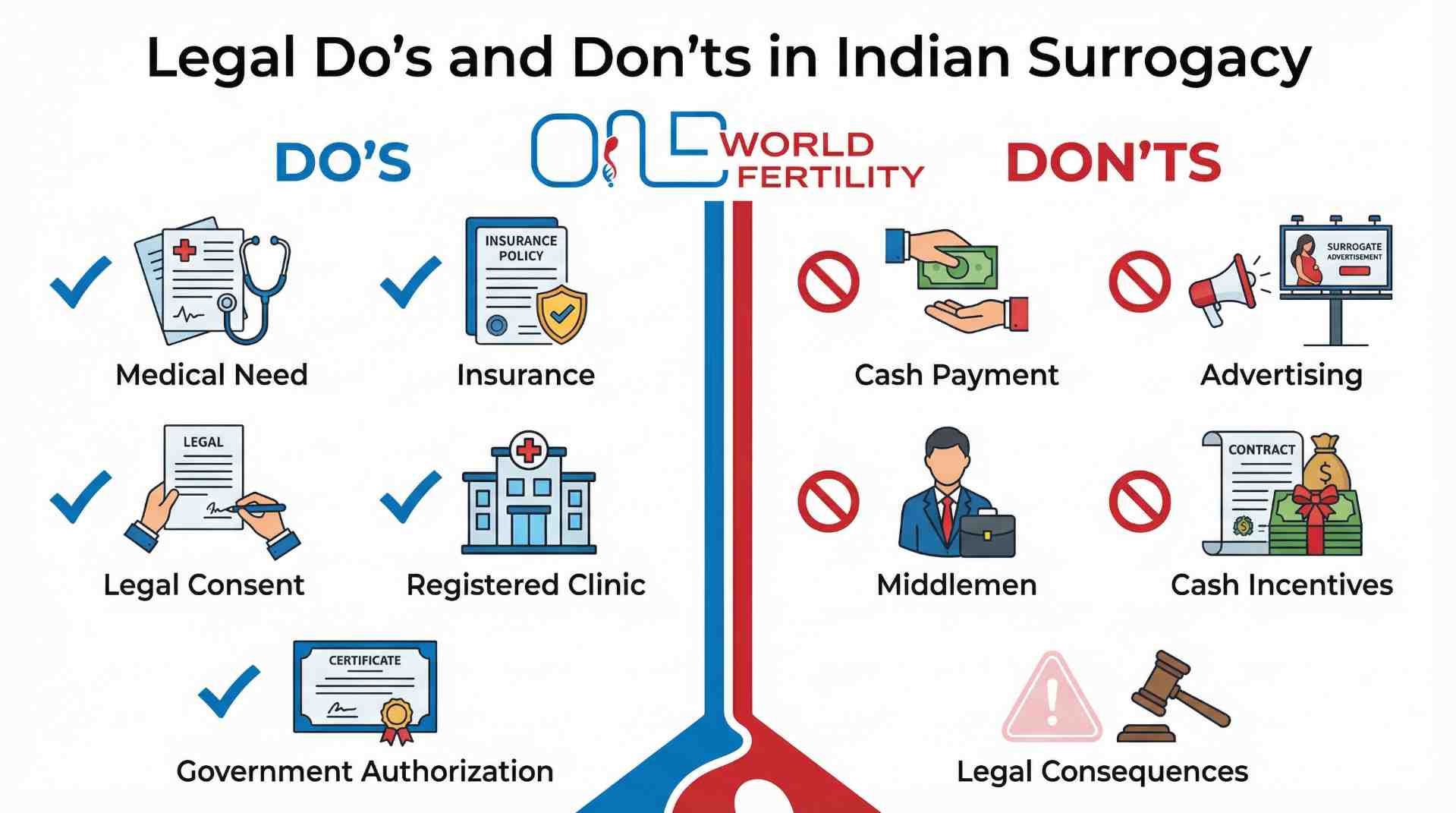
It is very important to know how much you can and cannot pay your surrogate. If you cross the line into commercial surrogacy, you could face criminal charges.
Here is a list of what is legal and what is not:
- Medical expenses (prenatal care, delivery, hospital charges, doctor fees)
- Health insurance (mandatory 36 months coverage for pregnancy-related complications)
- Nutritional food during pregnancy (healthy diet, supplements, vitamins)
- Maternity clothing (comfortable clothes as her body changes)
- Travel expenses for medical visits (transportation to/from clinic and hospital)
- Temporary accommodation if needed (if she lives far from the clinic/hospital)
- Lost wages documentation (if she needs to take time off work for medical appointments)
- Medical tests and screenings (blood tests, ultrasounds, routine checkups)
What is PROHIBITED:
- Direct cash payments/compensation (paying her a "fee" for being a surrogate)
- Any form of commercial benefit (buying her gifts, jewelry, property, vehicles)
- Monetary rewards or inducements (bonuses, incentives, "thank you payments")
- Monthly salary or allowance (treating surrogacy as paid employment)
- Any payment beyond actual documented expenses (cannot profit financially from surrogacy)
Bottom Line: You can pay for her genuine pregnancy-related costs with bills and records, but you can't pay her to carry your baby. But in altruistic surrogacy, she helps you because she cares, not because she wants to make money. If the police find proof of business payments, you and the surrogate could go to jail for up to 10 years and be fined up to 10 lakhs.
Cost Variations by City
Choosing the Surrogacy place will have a huge impact on the total cost. As in metro cities, hospital, doctor, and clinic fees are higher than in smaller towns. But the fact is, metros have better services and facilities, and also higher-qualified doctors. Here's the city-wise breakdown:
| City/Region |
Estimated Total Cost |
Why the Difference? |
| Delhi |
₹5 - 6.1 lakhs |
High clinic fees, premium hospital charges, experienced specialists, expensive legal services |
| Mumbai/Bangalore |
₹5.5 - 6 lakhs |
Most expensive due to premium clinics, top-tier doctors, high real estate costs affecting clinic fees |
| Hyderabad/Chennai |
₹5 - 6 lakhs |
Moderate costs, good medical infrastructure, competitive pricing, experienced fertility centers |
| Pune/Kolkata |
₹4.7 - 6.1 lakhs |
Growing fertility hubs, quality care at relatively lower costs than metros |
| Smaller Cities (Lucknow, Indore, Jaipur, Ahmedabad) |
₹4.5 - 5.8 lakhs |
Lower overhead costs, competitive pricing, but fewer specialized centers and longer legal processing times |
Important: Don't pick a place solely based on cost. Think about things like the clinic's success rate, the doctor's experience, how close it is to your home (you'll have to make several trips), how fast the legal process works in that state, and how many suitable surrogates are available. It's sometimes worth spending an extra cost in a city to get better medical care and faster legal approvals.
Complete Surrogacy Timeline
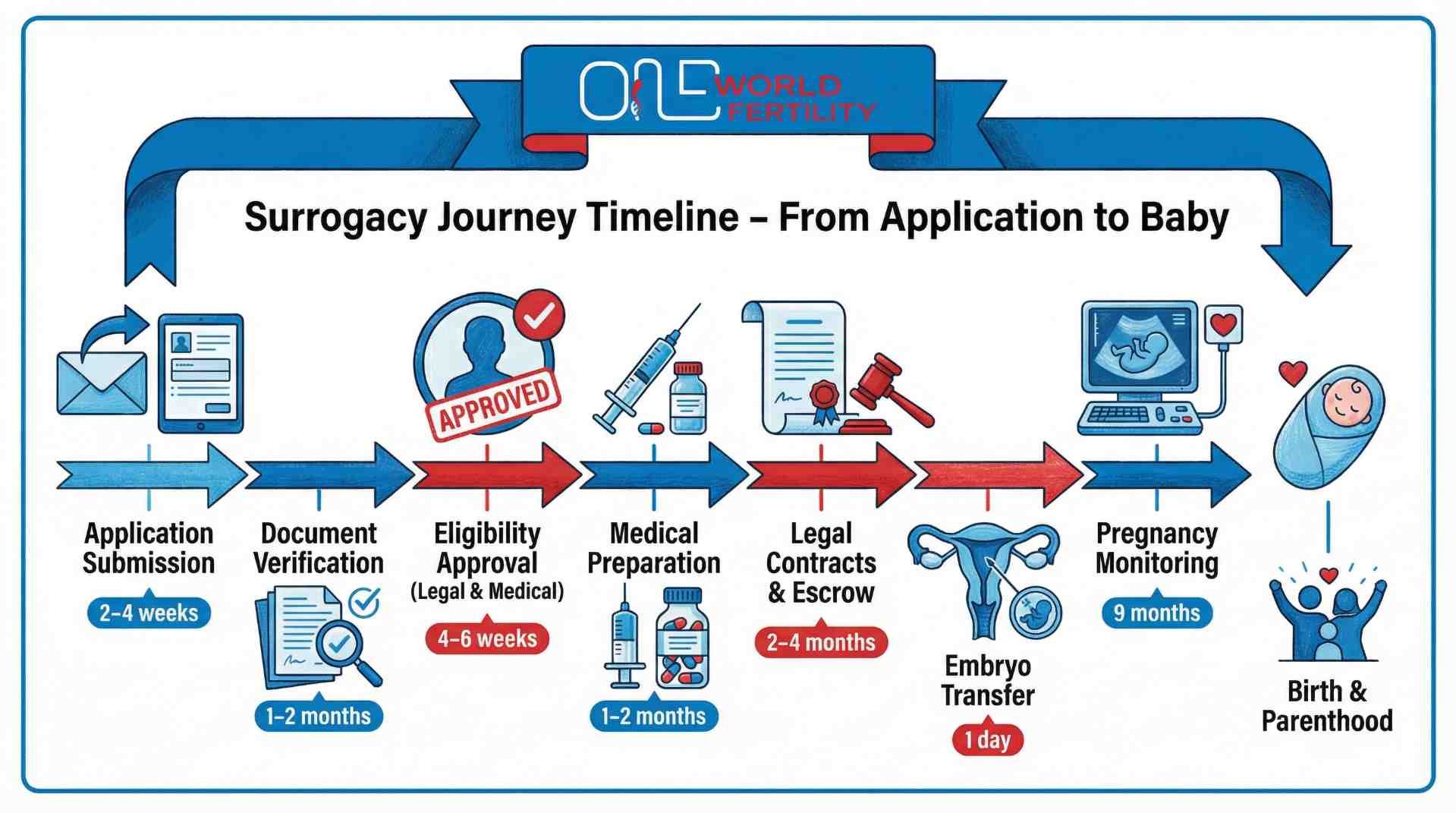
It's a question that many couples ask: "How long will this take?" The real answer? More time than you think. Surrogacy in India is a long process that takes 18 to 24 months from your first visit to the clinic until you bring your baby home. You need to be patient, plan ahead, and mentally get ready for this trip.
Why did it take so long? Because Indian law needs approval from more than one level, and each level has its own due date. Plus, the time it takes to find a good surrogate, go through medical treatments, carry the pregnancy to term, and take care of things after the birth. Let's go through the whole schedule step by step so you know what to expect:
Phase-Wise Breakdown:
- Legal Approvals & Documentation: 3-6 months This part is often the longest and most frustrating. You'll first apply to the District Medical Board for the Certificate of Essentiality, which will take 2 to 4 weeks. Then you'll submit your complete application to the State Appropriate Authority and attend hearings for the Certificate of Eligibility, which will take 4 to 8 weeks. Finally, you'll get a court order for parentage from the Magistrate, which will take 2 to 4 weeks. There are often delays because of backlogs, missing papers, or processing that takes too long. Delhi and Mumbai tend to move faster than other states, while smaller states may take longer.
- Finding Suitable Surrogate: 2-4 months This is the frustrating part because to find a willing surrogate who meets all the requirements is really a tough one. She has to be between the ages of 25 and 35, married at least once, have at least one child, and pass a full physical and mental health screening. A lot of couples try to approach their sisters, sisters-in-law, or cousins, but they are often turned down because of age limits, health problems, or family opposition. Once you find someone, it takes another 4 to 6 weeks for her to be screened and approved. This stage is uncertain; some people find a surrogate right away, while others have a hard time for months.
- Medical Preparation: 1-2 months After getting legal permission and choosing a surrogate, medical preparations can begin. If the expected mother is going to use her own eggs, she gets fertility tests and starts taking medicine. To get the surrogate's uterus ready for the implantation hormones are used. The cycle of retrieving the eggs and transferring the embryo need to be in sync. This phase includes consultations, baseline tests, medication protocols, and endometrial preparation-typically taking 4-8 weeks.
- IVF Procedure: 1 month The IVF method itself doesn't take too long. 10 to 14 days are needed to stimulate the ovaries. After that, the eggs are retrieved and fertilized in the lab on the same day. The embryo develops for 5 to 6 days before being transferred to the surrogate. Then there is the scary two-week wait until a blood test proves that the woman is pregnant. This part should be over in about 4 weeks if everything goes well on the first try. If the first transfer fails, you may have to try again, but this time add one more month to the process (each donor can only be used three times).
- Pregnancy: 9 months The surrogate mother will carry your child for the entire nine months (around forty weeks) after the pregnancy is confirmed. On a regular basis, she will go to her prenatal appointments for checks, ultrasounds, and monitoring. Major milestones, including growth monitoring ultrasounds, are likely to be attended by you alongside her. Given that most pregnancies last around the same amount of time and that some infants are born a week early or late, this is the easiest phase to plan for in terms of timing.
- Post-Birth Formalities: 1-2 months You have 21 days after the birth to register it in your name. The court order will be proof that you are the child's parents. You will get the official birth certificate, pay any outstanding medical bills at the clinic and hospital, make sure the surrogate receives the right treatment after giving birth, and finish all the legal paperwork. If the couple is an NRI and plans to travel with the baby, they may also need to get the infant's passport and other paperwork ready. This part of the process usually takes four to eight weeks.
Total Duration: 18-24 Months (Approximately)
Donor Gametes: 2024 Amendment
This changes everything for a lot of couples who were previously turned down for surrogacy. Rule 7 of the original 2021 Act was very strict and said that donor eggs or sperm could not be used in any way for surrogacy plans. In other words, both the egg and the sperm had to come from the couple who wanted to have a child. But this caused a huge problem: what about couples where the woman's eggs aren't very good because of old age, early ovarian failure, or genetic conditions? Also, what about men who have serious genetic disorders or male factor infertility? They were not allowed to use surrogacy at all, even though they really needed it.
Recent Rule Changes
The amendment that went into effect on February 21, 2024, allows the use of one donor gamete (either donor egg or donor sperm-not both) in surrogacy contracts, but only under certain medical conditions. There are strict rules you must follow. This is not a free-for-all.
Conditions Under Which Donor Egg/Sperm is Permitted:
You can only utilize a donor gamete if the District Medical Board (DMB) says that you have a medical condition that makes it difficult or medically inadvisable for you to use your own gametes. What qualifies?
- For donor eggs: Premature ovarian failure, poor egg quality due to advanced maternal age (typically over 40), MRKH Syndrome (absence of uterus and ovaries), genetic disorders that could be passed to the child, complete absence of ovarian function, previous chemotherapy/radiation affecting egg quality, or repeated IVF failures due to egg quality issues.
- For donor sperm: severe male factor infertility (very low or no sperm count), genetic disorders in the male partner that could be passed on, azoospermia (no sperm production), previous treatments that hurt sperm quality, or cases where using the husband's sperm could put the child's genes at risk.
District Medical Board Certification Requirement:
You must have legal permission, which is an official certification, to decide to use donor gametes. The DMB will look over your complete medical history, fertility reports, genetic testing results, and the advice of your doctor. They'll decide if using donor gametes is medically required or merely something they want to do. They will turn down your request if they find that your gametes are of good quality and viable. The genuine medical need is only count. This certification process will take an extra 2 to 4 weeks, but it is essential.
At Least One Gamete Must Be from Intended Couple:
This means:
- Intended mother's egg + Donor sperm = Allowed (if DMB certified)
- Donor egg + Intended father's sperm = Allowed (if DMB certified)
- Donor egg + Donor sperm = NOT allowed (child would have no genetic link to either parent)
Single ladies (widows or divorced women) must use their own eggs, but they can use donor sperm if they need to. This makes sure that the child is at least genetically related to the mother.
Why This Amendment Matters:
Before February 2024, many couples who would have been great candidates for surrogacy were turned down because of problems with their eggs or sperm. Women over 40 whose partners were healthy, men with genetic diseases whose wives were healthy, and couples who had been through cancer treatments were all not allowed to participate. This change made it possible for thousands of couples who didn't have a legal way to become parents through surrogacy in India before. This is a big step toward making surrogacy easier to get while still keeping safety measures in place to stop abuse.
Specific Medical Conditions Covered
Here are the specific conditions that typically qualify by the District Medical Board:
| Medical Condition |
Description |
Gamete Allowed |
| MRKH Syndrome (Mayer-Rokitansky-Küster-Hauser Syndrome) |
Rare congenital disorder where women are born without a uterus and often without functional ovaries. This landmark case led to relaxing the donor gamete ban. |
Donor Egg |
| Premature Ovarian Failure (POF) |
Woman's ovaries stop functioning before age 40, leading to no egg production. Includes early menopause, diminished ovarian reserve, or complete loss of ovarian function. |
Donor Egg |
| Advanced Maternal Age with Poor Egg Quality |
Women over 38-40 years with poor egg quality, repeated IVF failures, chromosomal abnormalities, or inability to produce viable embryos due to age-related decline. |
Donor Egg |
| Genetic Disorders (Female) |
Intended mother carries hereditary conditions like Thalassemia, Hemophilia, Muscular Dystrophy, or other genetic diseases that could be passed through her eggs. |
Donor Egg |
| Post-Cancer Treatment (Female) |
Chemotherapy or radiation damaged ovarian function and egg quality, making natural conception with own eggs impossible. |
Donor Egg |
| Absence of Ovaries |
Surgical removal of ovaries due to cancer, severe endometriosis, ovarian cysts, or medical emergencies. |
Donor Egg |
| Severe Male Factor Infertility |
Complete absence of sperm (azoospermia), extremely low sperm count, poor sperm motility/morphology making fertilization impossible even with ICSI. |
Donor Sperm |
| Genetic Disorders (Male) |
Husband carries genetic conditions that could be inherited by the child, making use of his sperm medically inadvisable. |
Donor Sperm |
| Post-Treatment Infertility (Male) |
Chemotherapy, radiation, or surgery permanently affected sperm production or quality. |
Donor Sperm |
| Congenital Absence of Vas Deferens |
Men born without tubes that carry sperm, making natural sperm retrieval impossible or ineffective. |
Donor Sperm |
| Repeated IVF Failures |
Multiple IVF cycles (typically 3+) failed specifically due to poor egg or sperm quality, not other factors. Requires documented evidence. |
Donor Egg or Sperm |
| Chromosomal Abnormalities |
Either partner has chromosomal issues (balanced translocations) leading to recurrent miscarriages or failed pregnancies. |
Donor Egg or Sperm |
The DMB wants a medical proof that using your own gametes is medically impossible or would pose serious risks. This can be in the form of fertility reports, genetic testing, a history of treatment, or advice from an expert. Preferences for looks or ease of use don't count. You should be ready to provide a lot of medical evidence to back your case.
Prohibitions & Penalties
It is very clear from Indian surrogacy law not only what you can do, but also what you must not do. If you break these rules, you will face major criminal charges. Knowing the law is important, but knowing what is illegal is even more important.
What is Strictly Prohibited
The Surrogacy (Regulation) Act, 2021, explicitly bans the following practices. These aren't gray zones; they're crimes:
- Commercial Surrogacy (Paying Surrogate Beyond Permitted Expenses): It is against the law to pay the surrogate anything other than medical bills, insurance, food, pregnancy clothes, and travel costs. No money, bonuses, salaries, land, jewelry, or any other kind of payment for carrying the baby. Surrogacy has to be completely selfless.
- Sex Selection of Embryo: Both the Surrogacy Act and the PCPNDT Act make it illegal to choose the baby's gender through embryo selection. Clinics are not allowed to tell you what gender an embryo is, choose male or female embryos for transfer, or do any other process to determine gender, no matter what your family situation is.
- Advertising Surrogacy Services: It is against the law to publish "surrogate wanted" ads on social media, in newspapers, or on websites to find surrogate mothers. It is also against the law to promote commercial surrogacy agencies. You can't publicly ask for surrogates. Instead, you should only approach willing family members through certified clinics.
- Selling/Buying Human Embryos or Gametes: It is against the law to buy or sell human embryos, eggs, or sperm. Donor gametes are allowed (as of 2024), but they must come from licensed ART banks and not be bought through private deals or brokers. It is against the law to buy and sell reproductive material.
- Abandoning Surrogate-Born Child: You CANNOT refuse to take care of, give up, or disown the child after delivery, even if the infant has disabilities, health problems, or isn't the gender you wanted. From the moment the child is born, you are legally their parent. Abandonment is a serious crime. You signed documents saying you would accept without conditions.
- Exploiting Surrogate Mothers: It is against the law to force, mistreat, or take advantage of the surrogate in any way. This includes pressuring family members to do something they don't want to do, not giving her sufficient medical care, not paying for her bills, leaving her after issues, or treating her with disdain. The law is very strict about protecting surrogates.
- Other Violations: Running clinics that aren't registered, letting a woman be a surrogate more than once, making it easier for those who shouldn't be surrogates (including foreigners, single men, and LGBTQ+ couples), or moving more than three embryos every cycle.
Legal Penalties
Breaking surrogacy laws is not a minor crime; it's a serious criminal offense with severe consequences that can destroy your life. Here's what happens if you break the law:
For Violations:
Imprisonment: Up to 10 Years
- Commercial surrogacy, sex selection, child abandonment, or embryo selling
- First-time offenders: 5 years
- Repeat offenses/severe violations: 10 years
- Serious jail time-cannot be substituted with just a fine
Fine: Up to ₹10 Lakhs
- Maximum fine: ₹10 lakhs (₹1 million)
- First offenses: ₹5 lakhs typically
- Repeat violations: maximum penalty
- Fine imposed IN ADDITION to imprisonment, not instead of it
Clinic License Cancellation
- Immediate suspension or permanent license cancellation
- Cannot perform any ART procedures
- Business effectively shut down
- Clinic assets and medical equipment can be seized
Medical Practitioner License Suspension: Minimum 5 Years
- Minimum 5-year suspension of medical license
- Cannot practice medicine anywhere in India during suspension
- Career effectively destroyed
- Loss of income and professional standing
Reporting to State Medical Council
- Permanent violation record on professional file
- Black mark remains even after suspension ends
- Affects future employment and hospital privileges
- Damaged professional reputation permanently
Who Gets Penalized?
The people who broke the law include the intended parents, the surrogate mother (if she knew she was doing commercial surrogacy), the doctors, the owners of the clinic, the embryologists, the agents, the traders, and anyone else who helped with the illegal surrogacy. Simply saying "I didn't know it was illegal" is not a good enough reason to escape responsibility.
Real Consequences: These aren't just threats. Commercial surrogacy, illegal sex selection, and exploitation have all been punished by the Indian government. Courts have given people long jail terms and large fines. Don't try to break the rules because it could cost you your freedom, your money, or your future family. The legal road might be more difficult and take longer, but it is the only safe way to get there. You could lose your baby, your freedom, and your money if you take one illegal route.
In the end, you should always follow the rules. Only work with clinics that are registered, qualified lawyers, and clear methods. If you think something is wrong or if someone offers you a "faster way" that includes taking shortcuts, leave right away. The fines are too harsh to take a chance on.
Rights Of The Surrogate Child
One of the most important protections of the Surrogacy (Regulation) Act, 2021 is the legal rights for children born through surrogacy. The law makes it very clear that a child born through surrogacy is the biological child of the intended parents from the start and not the child of the surrogate.
Legal Rights Guaranteed to Surrogate-Born Children:
- Child Deemed Biological Child of Intended Parents from Birth: There are no parental rights or formal ties between the surrogate and the child. As soon as the baby is born, the law says they belong to you (the intended parents). The birth certificate carries your names, not the surrogate's. So, there is no more confusion or any custody battles about parentage.
- Full Legal Rights and Privileges: The child born through surrogacy has all the rights of a child born naturally. Legally, there is no difference or "second-class" standing. Under Indian law, they have the right to an education, health care, social benefits, and legal security.
- Inheritance Rights: The child can receive all of your property, assets, businesses, and estate, just like any biological child would. They can get real land, businesses, and property from their ancestors. Legally, they are your child, so no one can dispute their inheritance by saying "they're not really your child."
- Citizenship Rights: If you are an Indian citizen, the child immediately becomes an Indian citizen. Like every other Indian kid, they get a birth certificate, an Aadhaar card, and a passport. If you have an NRI or OCI card, the normal citizenship rules apply based on your parents' status.
- Abandonment Strictly Prohibited by Law: You CANNOT leave the child, reject them, or refuse to accept them under any circumstances, even if they are disabled, sick, or not the gender you wanted. There are major penalties for abandonment, including jail time and fines. There is no way you can back out of your formal promise to accept the child no matter what.
Why These Rights Matter: These rights are there to protect children born through surrogacy from prejudice, legal confusion, and social shame. They look out for the child's future, including their schooling, marriage, job, property rights, and social standing. These also stop cases where parents might treat surrogate-born children differently from children who were conceived naturally, or where relatives might question the child's legitimacy.
Important for Parents: Knowing these rights should make you feel good about yourself and give you peace of mind. Your child born through surrogacy will not have any legal problems in their life. Anything an Indian citizen can do, they can do. They can go to any school, marry anyone, inherit land, run for office, and more. The fact that they were surrogates doesn't affect their rights or position legally. Your child should grow up knowing they are loved, wanted, and accepted in your family and society.
Challenges In Surrogacy Process
Surrogacy gives childless couples hope, but the process is not easy. Knowing what real problems you'll have to deal with will help you get ready psychologically, financially, and emotionally. Let's be honest about the issues you will face.
Legal & Administrative Challenges
The legal framework for surrogacy in India is comprehensive but comes with significant bureaucratic hurdles:
- Lengthy Approval Process (6+ Months Common): Official timeframes say it will take 3 to 4 months, but most couples have to wait 6 to 8 months for all the legal paperwork. It is normal for District Medical Boards and State Appropriate Authorities to have backlogs. Your case is in line with hundreds of others, and there's not much you can do to hurry things up.
- Multiple Hearings Required: You'll have to attend at least three or four hearings with different authorities, such as the DMB, the State Appropriate Authority, and the Magistrate's Court. You have to take time off work, travel (often to various cities), and show up for each hearing with a lawyer. If you miss a hearing, your case could be delayed by weeks.
- Complex Documentation Requirements: There is so much documentation to deal with, like marriage certificates, medical reports, affidavits, insurance policies, eligibility certificates, and more. If you don't have all the proper documents or make a small mistake, your application could be denied and you would have to start over, which could add 4 to 8 weeks to your timetable. A lot of couples hire document coordinators merely to take care of the paperwork.
- State-Wise Variation in Processing Time: If you live in Delhi or Mumbai, it could take 4 to 5 months to get permissions. But in smaller states or union territories with less infrastructure, the same process can take 8 to 12 months. Each state works at its own pace and with its own level of efficiency, thus there is no uniformity.
- Limited Number of Registered ART Clinics: Not every fertility clinic is allowed to do surrogacy. Only ART-registered clinics that have the proper licenses can lawfully do surrogacy treatments. There may be only one or two registered clinics in many tier-2 and tier-3 cities, limiting your options and making it hard to get an appointment or an operation.
Finding Suitable Surrogate
The hardest thing for couples is finding a good surrogate. Laws limit you to a small group of people-close relatives are best, though in 2023, the strict rule was loosened. It is tough to find someone who meets all the criteria.
Surrogate Must Meet ALL These Criteria:
- Age: 25-35 years (many sisters/cousins fall outside this range)
- Must have at least one biological child already
- Must be ever-married (married/widowed/divorced)
- Pass rigorous medical and psychological screening
- Can only be a surrogate ONCE in her lifetime
- Cannot have been a surrogate for anyone else previously
Aside from the legal issues, asking a family member to carry your baby for nine months can be hard on them emotionally. Family relationships can become tense and relationships after the birth can be awkward. Many willing cousins fail medical screening because they are sick or mentally unfit. Because of the laws, the choices available, and the mental problems that come up, many couples look for months, or even over a year, before they find the right person.
Medical Challenges
After getting cleared of all the legal issues and finding a surrogate, there are still medical challenges that remain. Surrogacy doesn't guarantee a baby; the outcome relies on many biological factors that no one can change.
Medical Success Challenges:
- IVF Success Rates: Typically 40-60% per cycle—meaning 40-50% chance of failure even at top clinics
- Multiple Attempt Limitations: Maximum 3 embryo transfers per surrogate—if all fail, you need a new surrogate
- Age-Related Factors: Women under 35 have 50-60% success rates; over 40 drops to 15-25% per cycle
- Health Complications: Gestational diabetes, preeclampsia, premature labor, miscarriage can occur despite initial success
If you fail at IVF, it will take two to three months longer and cost two to three lakhs more. Age has a big effect on outcomes-bad egg quality means that fertilization or embryo growth doesn't happen. Complications can occur during even successful pregnancies, needing hospitalisation or emergency care. Also, some couples lose the pregnancy after receiving a first positive result.
Emotional & Social Challenges
Couples often don't realise how emotionally and socially difficult surrogacy may be, in addition to the legal and medical issues it might cause.
- Family Relationship Dynamics: When a family member becomes your surrogate, it can be hard to get along with them. It can be hard to get together with family in the future, and conventional family ties are now more complicated.
- Social Stigma in Some Communities: Even if it is legal, there is still a societal stigma. Relatives might talk behind your back, neighbours might ask too many questions, and some individuals might have conflicting opinions about your surrogate or child.
- Emotional Bonding Issues: Emotions could be complicated during these nine months, and how involved should you be? It's extremely draining to see someone else carry your biological child and feel like you can't do anything.
- Post-Birth Relationship Management: It can be hard to keep good ties with your surrogate once the baby is born. Some families stay close, while others fade apart. Some families have problems that last at family functions.
To get through these problems, you typically need expert counselling and strong family support.
Financial Challenges
Money is one of the hardest realities couples face in their surrogacy journey:
- High Upfront Costs (₹18-35 Lakhs): To get such a large sum, you need to borrow money, sell things, or ask family members for help. Most middle-class families have a hard time getting these kinds of funds.
- Limited Insurance Coverage: Most health insurance plans don't pay for surrogacy costs. You have to pay for all of your medical bills, IVF treatments, and legal fees out of your own wallet.
- No Refund if Unsuccessful: If you try IVF but fail or get pregnant but don't have a baby, you lose 5 to 8 lakhs and don't get refunds.
- Additional Costs for Complications: Pregnancy problems, NICU treatment, and emergency C-sections might add ₹3–5 lakhs without warning. Most couples spend 20 to 30 per cent more than they thought they would.
Many families take out personal loans, max out their credit cards, or use up all their retirement funds. Financial stress makes emotional tension worse.
Regulatory Oversight
The surrogacy system in India has a very strict rules and regulations which make sure that everyone follows them, also stop abuse, and keeps the ethical standards. Also, you should know who is in charge of the process so you can be prepared when something goes wrong.
National & State Surrogacy Boards
The Surrogacy Act set up a two-tier system of rules to keep an eye on all surrogacy practices in India.
Role and Responsibilities:
- National Surrogacy Board (NSB) sets national policies, creates guidelines, and coordinates with State Boards
- State Surrogacy Boards (SSBs) handle ground-level regulation, approve eligibility certificates, register clinics, and address complaints
Monitoring and Enforcement:
- Conduct surprise inspections at registered clinics
- Review surrogacy agreements for legal compliance
- Investigate reports of commercial surrogacy or exploitation
- Suspend or cancel clinic registrations for violations
- Maintain databases tracking all surrogacy arrangements and outcomes
Complaint Mechanisms:
- File complaints directly with your State Surrogacy Board if you face exploitation or illegal practices
- Complaints accepted online through state health portals or in person
- Boards investigate within specified timeframes and take corrective action
- Can impose penalties, cancel licenses, and initiate criminal proceedings
Registered ART Clinics
Only fertility clinics that are registered under the ART (Regulation) Act, 2021 are allowed to do surrogacy.
Registration Requirements Under ART Act 2021:
- Must obtain registration from both ART and Surrogacy Act authorities
- Demonstrate adequate infrastructure: labs, operation theaters, recovery rooms, counseling facilities
- Employ qualified staff: reproductive specialists, embryologists, gynecologists, counselors
- Maintain patient confidentiality systems and ethical protocols
Compliance Standards:
- Maintain detailed records of every surrogacy case
- Obtain informed consent before each procedure
- Ensure no sex selection or unethical practices
- Report all surrogacy arrangements to State Board
- Provide transparent cost breakdowns (no hidden charges)
- Cannot advertise surrogacy services or engage in commercial surrogacy
Regular Audits and Inspections:
- Face scheduled and surprise inspections by State Boards and health officials
- Inspectors check medical records, equipment, staff protocols, and patient consent forms
- Violations result in warnings, fines, suspension, or permanent license cancellation
- Clinics must maintain inspection-ready documentation at all times
Make sure that your clinic always has valid ART and surrogacy registration certificates on display. Before you pay, ask for registration numbers and check them with your State Board. It is against the law to work with unregistered clinics, and you have no legal protection.
Surrogacy For NRIs & OCIs
You can get a surrogate in India if you are an Indian citizen living outside of India or if you have an OCI (Overseas Citizen of India) card, but the process is more complicated and takes more time than for Indian residents.
Eligibility Status (Permitted with Conditions):
People with an NRI or OCI card CAN get surrogacy in India, as long as they meet all the standard requirements:
- Legally married heterosexual couple
- Correct age range (wife 23-50, husband 26-55)
- Married for 5+ years
- Proven infertility with medical certification
- No existing children
- Must prove Indian connection through passport or OCI card
People from outside of India who are not Indian citizens or have OCI status are not allowed to do surrogacy in India at all.
Documentation Requirements:
Beyond standard documents, NRIs/OCIs need additional paperwork:
- Valid Indian passport or OCI card
- Proof of residence abroad (visa, work permit, utility bills)
- Marriage certificate with apostille certification (if married abroad)
- Overseas address proof
- All foreign documents translated to English and notarised
- Proof of legal stay in current country of residence
Multiple Trips to India Needed (Typically 3):
Unlike Indian residents, NRIs must plan at least 3 separate trips:
- Trip 1: Initial consultations, medical evaluations, legal applications, finding surrogate (2-3 weeks)
- Trip 2: Attending legal hearings—DMB, State Authority, court for parentage order (1-2 weeks)
- Trip 3: Birth, collecting baby, completing paperwork, arranging travel documents (3-4 weeks around delivery)
Each trip adds a lot to the total cost, like flights, lodging, and time off work, usually between 3 and 5 lakhs.
Court Hearing Attendance Mandatory:
At State Board meetings and court for a parentage order, you have to be there in person. For important hearings, videoconferencing or having a lawyer defend you alone is not enough. You must postpone your travels if you have a plan around these times.
Extended Timeline (Up to 24 Months):
Surrogacy for the Indian Citizen mostly takes 18-20 months but for an NRI it usually takes 22-24 months. It is due to travel coordination, international document processing, time zone challenges, and scheduling delays around your availability.
Baby's Citizenship and Passport Issues:
This is often the trickiest part for NRIs:
- Baby automatically gets Indian citizenship (you're Indian/OCI)
- Apply for baby's Indian passport at Regional Passport Office (2-4 weeks processing)
- If living abroad (USA, UK, Canada, etc.), baby may need that country's visa/citizenship to enter
- Baby is NOT automatically a citizen of your residence country in most cases
- May need immigrant visa for baby (requirements vary by country)
- This can extend your post-birth stay in India by several weeks
Example: If you're already in the US, your baby needs an immigrant visa to enter the US. They are not automatically US citizens. Consult immigration experts in both countries well before the birth.
Practical Advice for NRIs/OCIs:
Start early, make plans for multiple trips ahead of time, work with lawyers who have experience with NRI cases, let your boss know about the longer leaves, set aside an extra 5–10 lakhs for travel and stays, and see if you can work from home. It takes longer and costs more, but thousands of NRIs have successfully done surrogacy in India. Just be ready for things to be more complicated.
Final Thoughts
We know that this is a lot of information to take in but here's what we want you to remember from this guide: surrogacy in India is legal and thousands of couples' dreams have come true through this way. Just remember, the most important thing to do is to do it legally. No shortcuts, no compromises, just time and the right advice.
Make sure you really understand these laws before you do anything further. Don't simply skim over it. Visit a professional lawyer of this field, go to registered clinics, and chat to couples who have been through it. Be honest about your budget (₹20–30 lakhs and 20+ months), get ready for setbacks, and never, ever think about illegal options, no matter how bad things seem.
It's very important to work with the right people from the start, follow all the rules, and believe that the system, even though it's hard to understand, is there to protect you and your child. It's worth the time, money, and trouble to do things the right way for your child. Don't give up. Stay strong and know that parenthood is waiting for you at the end of this journey.