This is the week you've been waiting for. Everything you've felt, worried, and hoped for in the past several weeks comes down to this moment - a tiny flicker on a screen. Most clinics schedule your first ultrasound at 6 weeks IVF pregnancy. And for many women, this is the first time they can see the heartbeat.
But let's be honest: this week is also full of stress. Even when there is hope, there is a silent worry that won't stop asking, "What if it's not there?"In this blog, we will show you what a 6-week heartbeat development looks like, what your ultrasound will show, what's normal, what to do if you don't see a heartbeat yet, what to eat, how to take care of yourself, and how to stay strong emotionally through the biggest milestone of this journey so far.
Take a deep breath. You've made it to the scan. Let's walk through this together.
Where Are You at Week 6? - A Quick Orientation
If you had a Day 5 blastocyst transfer, you're now about four weeks past that day. In obstetric terms, you are currently six weeks along. Most fertility clinics arrange the first IVF ultrasound 6 weeks into pregnancy, making this one of the most important milestones of your journey.
Things are moving very rapidly inside your body. The embryo is growing quickly. The neural tube is forming, the heart cells are beginning to beat, and the gestational sac is growing. But this week is different from all the others because your pregnancy is going to go from numbers on a lab report to something you can actually see.
What Does Heartbeat Development Look Like at 6 Weeks?
This is the moment the entire journey has been building toward. So let's talk about what's really going on with you, in a simple, honest way, without using unnecessary medical jargon.
How Does the Heartbeat Start?
The fetus (your baby's) heartbeat at 6 weeks isn't entirely formed yet. Right now, a small group of heart cells are forming. These cells are grouped in a "heart tube" and have started to beat on their own. Electrical impulses are firing through these cells, causing them to contract and relax in a steady rhythm. That rhythm is what makes the ultrasound screen flicker.
It's not a fully formed heartbeat as we think of it. Instead of a heartbeat, your doctor might label it "cardiac activity." But when you see a little, quick flicker inside a small dark circle on the screen, then none of the medical terms matter.
Many women cry the first time they see it. Some laugh with joy. While some people are speechless. This is the first time your pregnancy has looked back at you after weeks of blood tests, numbers, and waiting. And there are no words to describe how it feels.
What's a Normal Heart Rate at 6 Weeks?
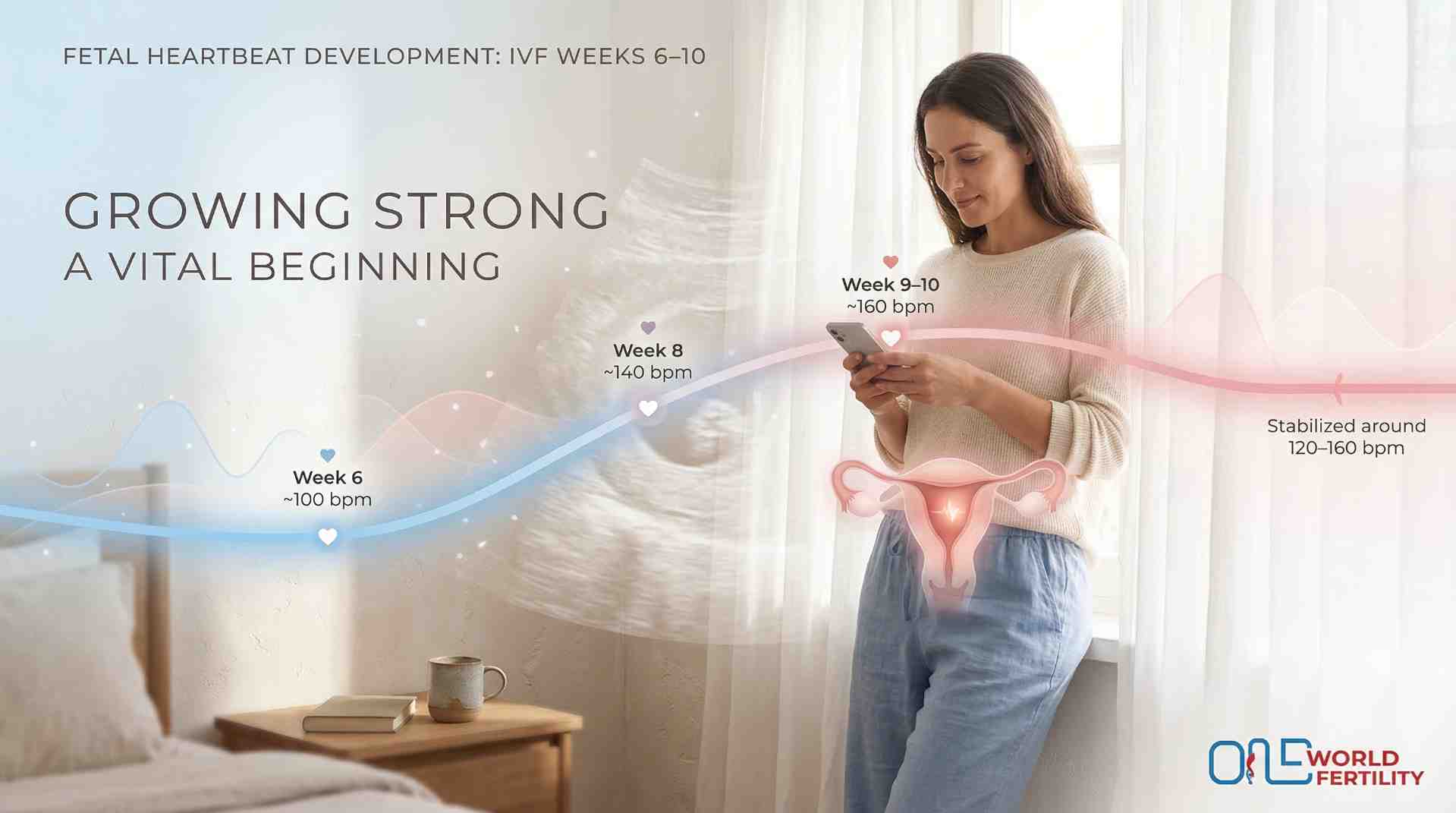
A normal fetal heart rate is between 90 and 110 beats per minute at 6 weeks. That might feel like a low number, but at 6 weeks, that's exactly normal. The heart is just getting started.
Over the next few weeks, it picks up quickly:
Fetal Heart Rate by Week (Simplified)
Gestational Week
|
Normal Heart Rate Range
|
6 weeks
|
90–110 bpm
|
7 weeks
|
110–130 bpm
|
8 weeks
|
130–150 bpm
|
9-10 weeks
|
140–170 bpm
|
12+ weeks
|
120–160 bpm (stabilizes)
|
These are approximate ranges. Slight variations are normal. Your doctor will assess what's healthy for your specific pregnancy.
Your doctor may want to keep a closer eye on you if your heart rate is below 90 beats per minute at 6 weeks, but that doesn't mean something is wrong. Some embryos are just a day or two behind, for example, what looks like 6 weeks 1 day heartbeat at 3 days behind in growth, and the pace catches up at the next scan.
At this point, a heart rate below 70 beats per minute is more concerning, and your doctor will explain what that can signify and what will happen next.
The most important thing to know is that your doctor interprets the heart rate in the context of your gestational age, the size of your embryo, and your medical history. They don't just look at one number. Don't trust an online chart; trust their reading.
What If No Heartbeat Is Seen at 6 Weeks?
Every woman walking into her first scan has this question in her mind. So let's talk about it frankly, honestly and compassionately.
In 10 to 15% of IVF pregnancies, the heartbeat can't be seen on the 6-week ultrasound, but the pregnancy still turns out to be perfectly healthy.
Here are several reasons why it might not be seen:
- You might be a little earlier than 6 weeks - even two or three days can make the difference between seeing a flicker and not. Gestational dating isn't always right to the day, even with IVF.
- The embryo is still very small - at 2 to 4mm, the cardiac cells may be developing, but haven't yet produced a flicker strong enough to detect on screen.
- The ultrasound angle or equipment sensitivity - sometimes the positioning makes it harder to capture. The next scan from a different angle can show something completely different.
What your doctor will do:
Your doctor may schedule a follow-up scan in 7 to 10 days in almost all cases. So, this is a normal procedure, not an emergency response. They want to give the embryo more time to grow before making any conclusions.
What you should NOT do:
Don't assume the worst, and don't search for "no heartbeat at 6 weeks" on Google. The internet will show you the worst possible outcomes, but none of them is your story. Don't look at someone else's scan online and compare it to yours. Let your doctor, who knows your history, your stats, and your embryo, tell you what to do next.
And if you're sitting in that room right now, having just heard the words "we can't see it yet":
This is one of the hardest moments in the entire IVF journey. Your chest tightens and your mind races. What you've been holding together threatens to fall apart. We want you to know that it's okay to cry and to be terrified, too.
You can, however, wait. One scan at one moment in time is not the final word on your pregnancy. Many women who hear "we can't see it yet" at week 6 go to their follow-up scan around heartbeat 6 weeks 5 days later and see a strong, flickering heartbeat waiting for them.
This chapter isn't over. Let your doctor turn the next page.
Your First Ultrasound - What Happens in That Room
You've thought about this meeting a hundred times. Now it's here. Your IVF ultrasound at 6 weeks is one of the most important moments of the journey, so let's go over exactly what will happen so that you aren't surprised by anything.
What the Scan Will Look For
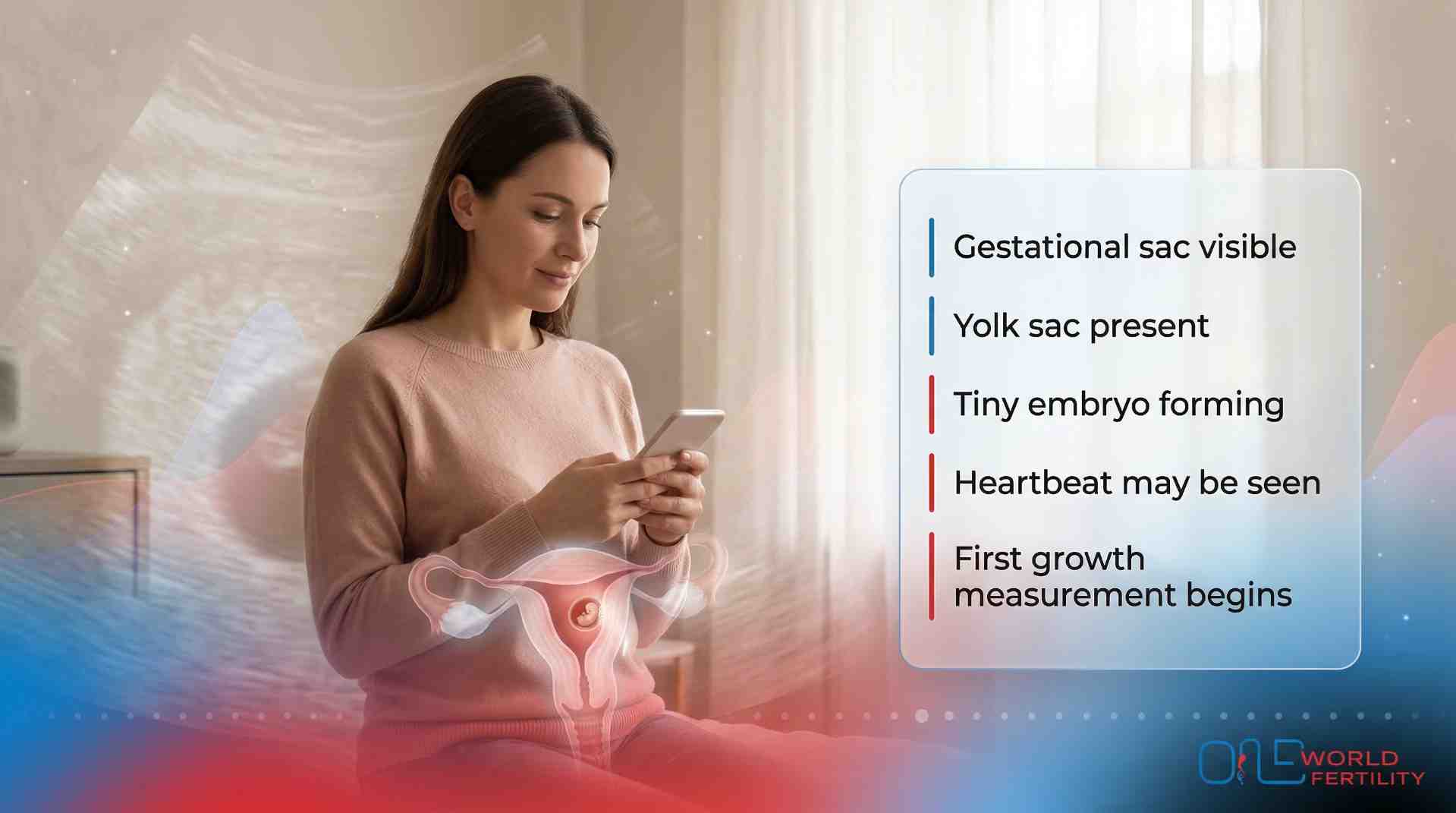
Your doctor or sonographer will check several things during this scan, usually in this order:
- Gestational sac - a small, dark, round structure inside your uterus. This proves that the pregnancy is in the appropriate place and not ectopic.
- Yolk sac - a tiny ring-shaped structure inside the gestational sac. This is what nourishes your embryo right now, but in a few weeks the placenta will take over that task.
- Fetal pole - the earliest visible form of your embryo. At 6 weeks, the fetus 6 weeks 3 days along is usually about 2 to 5 mm long, which is about the size of a lentil. It's small, but it's real.
- Cardiac activity (heartbeat) - the flicker that shows your embryo is alive and growing. This is the moment everyone holds their breath for.
- Crown-rump length (CRL) - a measurement from one end of the embryo to the other. For example, an embryo 6 weeks 3 days along should measure within an expected range. Your doctor utilises this to make sure that the size of the embryo is right for your pregnancy.
- Number of embryos - this scan will confirm whether it's a singleton or multiple pregnancy.
- Ovaries - your doctor will also check your ovaries for any cysts or lingering effects from the IVF stimulation cycle.
What It Will Look Like on Screen
To be honest, it doesn't look like a baby. Not even close. At 6 weeks, you will see a small dark circle with a tiny dot or flicker in the middle. That's it. No arms, no legs, no face. Just a sac and a speck.
For many women, it looks anticlimactic at first, but then it hits them hard emotionally. Because that tiny speck is yours, and that flicker is a heartbeat.
Your doctor or sonographer will show you everything and tell you what they see. It's fine if you can't understand what they're saying. They've spent years studying how to read these subtle pictures. Believe what their trained eyes see. You don't have to be an expert at reading ultrasounds. You just have to be there.
What Happens After the Scan?
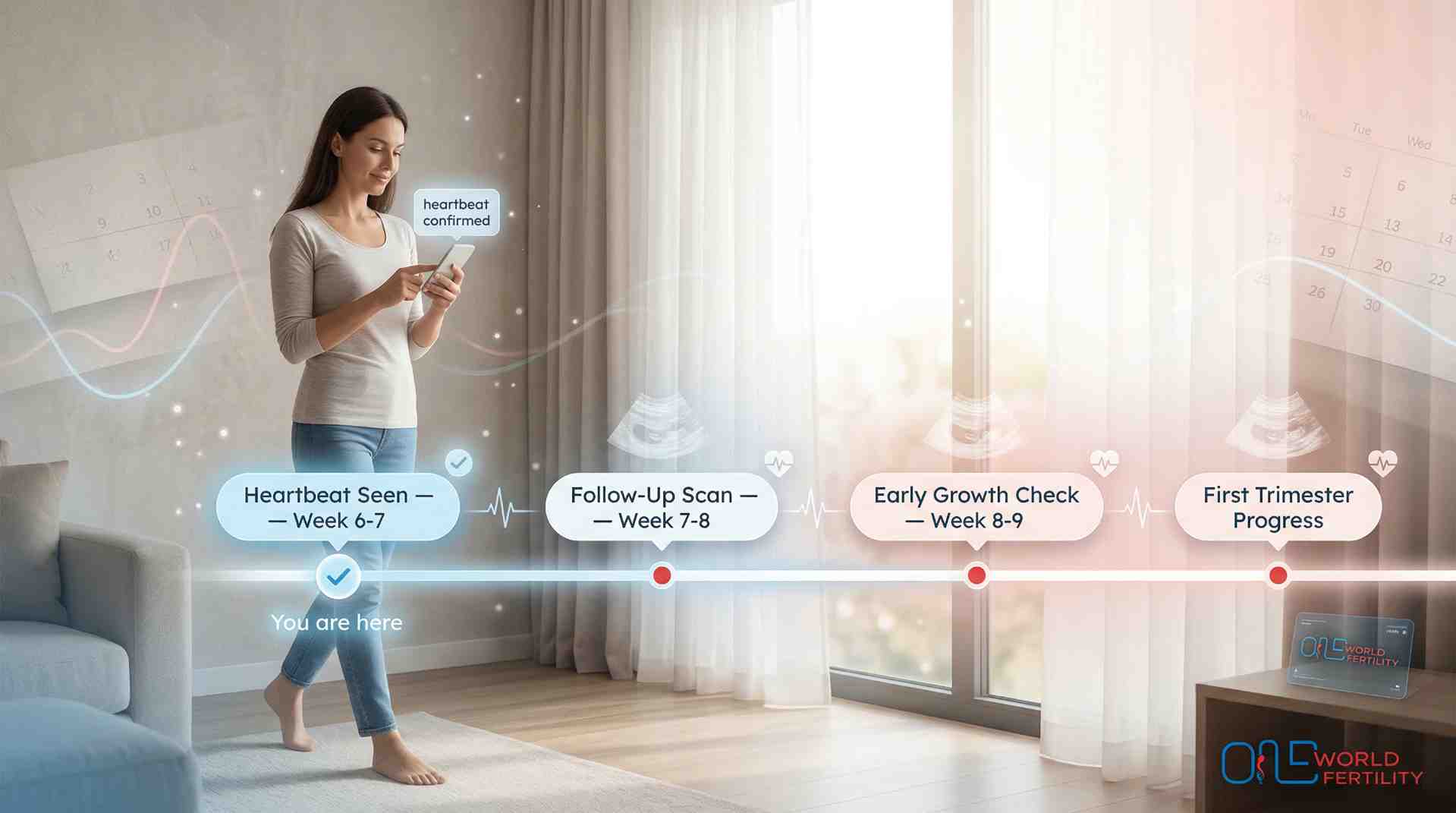
If the heartbeat is visible and everything else looks normal, your clinic will likely schedule a follow-up scan to reassess the growth and heart rhythm again in 1 to 2 weeks. You will keep taking all of your meds exactly as directed. Nothing has changed yet.
And something might start to change in your feelings. You might start to think, "Is this real?" and then quietly the question changes to "This is really happening." Let that sink in. You don't have to rush past it.
If anything is unclear or needs monitoring, such as if the heartbeat wasn't seen, or the measurements seem early, your doctor will calmly explain the next steps. Don't leave that room with unanswered questions. Ask all the questions you need to. You have the right to know what's going on with your pregnancy and your baby.
Symptoms at Week 6 - What's Normal Now?
Week 6 can feel like a lot because of the ultrasound emotions and the hormones that are rising higher than before. This week, your body is working harder than ever. Here's what that might look and feel like.
Symptoms That May Be Peaking
- Morning sickness: For many women, this is the week when nausea stops being occasional and becomes constant. It could happen in the morning, last all day, or come in waves that you can't predict. It usually worsens between weeks 8 and 10, so it can get worse before it gets better.
- Extreme fatigue: This tiredness is getting deeper than anything you've felt in the previous weeks. This is like what a typical day feels like running a marathon. Your body is making a placenta right now, which takes a lot of energy.
- Breast changes: Your breast is getting heavier, sorer, and more swollen. You might see that your veins are more prominent or that your nipples are getting darker. Your body is getting ready for what comes next.
- Bloating and constipation: Progesterone continues to slow your digestion down. Even though there isn't a bump yet, your belly may feel tight and uncomfortable.
- Mood swings: Intensified this week. Emotional before the scan. Emotional after. Teary over things that wouldn't normally bother you. Your hormones are at their loudest right now.
- Cramping: Your uterus may still have mild, dull cramps while it stretches and grows. This is normally nothing to worry about as long as it stays moderate.
- Headaches: This week, they are common because your hormones are changing and your body is managing increased blood volume.
- Food aversions: May be at their worst this week. You might not like foods you loved last month anymore. Some cooking smells might make you gag before you even reach the kitchen.

What If Symptoms Suddenly Ease Up?
This worries women every single week, but week 6 is especially worse because the ultrasound is happening and everything feels high-stakes. But the truth hasn't changed: symptoms can fluctuate day to day. A "good day" where nausea takes a break is not a bad sign. It's okay for your body to be quiet sometimes.
If symptoms drastically and suddenly disappear and you also have bleeding or pain, urgently call your clinic. Otherwise, don't let one calm day ruin your peace of mind.
Warning Signs - Same Rules Apply
- Heavy bleeding - soaking through a pad
- Severe, one-sided, or sharp pain
- Fainting
- High fever
- Can't keep any food or water down for 24+ hours
Call your clinic. Don't wait. Don't search for answers online. Just call.
What Should You Eat This Week?
If nausea is happening all the time right now, then the thought of "eating well" undoubtedly seems impossible. So let's keep it simple: eat what you can when you can, and focus on the few items that truly help.
Nausea-Friendly Foods (Your Foundation This Week)
Everything from week 5 still applies in this week too - BRAT foods, ginger, lemon, small frequent meals, cold foods, and protein snacks remain your go-to strategy. But this week, let's add some things that can really help:
- Protein at every meal or snack: Even a small amount of protein - a boiled egg, a few cubes of cheese, a spoon of nut butter- will help stabilise your blood sugar. When blood sugar drops, nausea gets worse. So, keeping protein in the mix directly reduces nausea.
- Complex carbs: Oats, sweet potatoes, whole grain crackers, brown rice. Instead of the spikes and crashes that come from sugary or processed foods, these provide your body with steady, sustained energy. Also, easy on the stomach.
- Electrolytes: When you throw up a lot, your body loses more than simply food; it also loses vital minerals and salts. Coconut water or electrolyte drinks can help replace what's lost. Ask your doctor which ones are safe for you to take.
Foods to Still Avoid
The same list carries forward, and it's still non-negotiable:
- Raw or undercooked fish, meat, or eggs
- Unpasteurized dairy and soft cheeses
- High-mercury fish (shark, swordfish, king mackerel)
- Alcohol
- Caffeine beyond 200mg per day
- Junk food and heavily processed snacks
- Unwashed fruits and vegetables
Week 6 Food Guide
Eat This
|
When Nausea Wins
|
Still Avoid
|
Protein at every meal
|
BRAT: banana, rice, toast
|
Raw fish, meat, eggs
|
Complex carbs (oats, sweet potato)
|
Crackers, dry cereal
|
Unpasteurized dairy
|
Leafy greens, cooked eggs
|
Ginger tea, ginger chews
|
High-mercury fish
|
Cooked fish, nuts, seeds
|
Lemon water, popsicles
|
Alcohol (zero)
|
Greek yogurt, fruits
|
Cold foods, smoothies
|
Caffeine >200mg
|
8-10 glasses water
|
Coconut water, ice chips
|
Junk food, processed snacks
|
What Should You Do and Avoid This Week?
This is the week of the big scan, so everything you do should help you be as calm as possible when you go into that room.
Do's
- Continue all medications: Keep taking all of your medications, including progesterone, estrogen, and prenatal vitamins, unless your doctor tells you to change something.
- Attend your ultrasound appointment: This is the moment you've been looking for. Don't reschedule out of fear. Rest as much as your body needs: You will find that fatigue is at its highest point. So, get some sleep when you can. If needed, cancel every schedule if your body is asking for rest. This week, you have to take a break.
- Light walking if you feel up to it: A short, gentle walk can help with bloating and calm your nerves before the scan. But if you're too tired, don't feel bad about skipping it.
- Stay hydrated: This is very important if you often feel sick and throw up. Keep water within reach at all times.
- Before the scan, talk to your partner: Share your feelings, whether it's enthusiasm, fear, or anything else. Walking into that room together emotionally, not just physically, makes a difference.
- Ask your doctor every question during the ultrasound: What shape is that? Is that the sound of a heart beating? Is the size right? This week, there are no dumb questions. This is your baby. Ask whatever you need.
- If the scan goes well, let yourself feel the joy. Don't hold back your emotions. You've been through weeks of not knowing what would happen to get here. Let yourself have this moment.
Don'ts
- Don't stop taking any medicine, just like every week. Especially progesterone.
- Don't work out too hard; keep it gentle.
- Don't use hot tubs, saunas, or steam rooms - still not safe.
- Don't smoke or drink alcohol - no exceptions.
- Don't take new supplements without your doctor's approval.
- Don't compare your ultrasound images with others you've seen online. What counts is what your doctor sees, not what someone else said on a forum. Each scan looks different.
- Don't hold your breath through the whole scan - literally and emotionally. Take a breath. No matter what that screen says, you will get through it.
Quick Questions
Can I record the ultrasound? Before the appointment, ask your clinic. A lot of them let you take a picture or make a short video. Not all of them do. Checking in ahead of time keeps things from getting awkward in the room.
Can my partner come? Yes, at most clinics. But policies are different, especially since COVID. A day or two before your appointment, call your clinic to make sure everything is set.
Will I hear the heartbeat? At 6 weeks, you might see the flicker on the screen but not hear it through the speakers. Later scans frequently show an audible heartbeat. But seeing that little heartbeat is equally as strong.
Can I have sex after seeing the heartbeat? Talk to your doctor. After a standard first scan, many clinics say it's okay to proceed, but every case is different. There is no universal answer; only your doctor's individual advice.
Is my pregnancy safe now? A heartbeat that can be seen at 6 weeks lowers the chance of miscarriage by a lot. But "safe" isn't a single moment; it's a journey. Your clinic will keep an eye on you, and each passing week gives you greater confidence.
After the Heartbeat - What Happens Next?
You saw the flicker. The room went quiet. You might have cried. You might have simply stared. But now that it's over, the first thing that comes to mind is, "What happens now?" Let's answer that.
Follow-Up Scans
Most clinics arrange a second ultrasound between weeks 7 and 8 to check the heartbeat again, make sure the heart rate is rising, and measure how much the embryo has grown. If your first scan indicated anything borderline, such as a slower heart rate or measurements that were a little early, the follow-up may be performed sooner.
Your doctor keeps track of something called crown-rump length throughout these scans. This is the distance from one end of the embryo to the other. At this point, a healthy embryo grows about 1mm every day. That consistent rise is one of the best signals that everything is going as planned.
When Do I Graduate from My Fertility Clinic?
One of the happiest moments in the IVF journey is the day your fertility clinic says, "You're ready to move on."
Around weeks 8 to 10, most patients move on to their OB-GYN. Your fertility clinic will monitor your hCG and progesterone levels and early scans until then. They will keep you on progesterone and other medications for as long as you need them.
The transition is a good sign that your pregnancy is stable enough for regular prenatal care. And you don't need to arrange anything yourself. When you're ready, your clinic will help you with the handover. This is something they've done thousands of times.
Miscarriage Risk After Heartbeat
Let's be honest about this because every IVF patient is thinking about it.
According to clinical data from 2024 to 2025, the IVF miscarriage rate after seeing heartbeat lowers to about 5% or less once a heartbeat is detected at 6 to 7 weeks. That is the most comforting number for a woman who is pregnant with IVF. This suggests that most pregnancies that have a heartbeat at this point will be healthy and successful.
But "low risk" doesn't mean "no risk," which is why your clinic keeps an eye on you with follow-up scans and blood tests. There is still a long way to go.
For now, though, enjoy the relief. Don't say to yourself, "It's too early to feel good." There is a heartbeat. And so is the lower danger that comes with it. You deserve this breath of fresh air. Take it.
The Emotional Reality of This Week
Week 6 is the most emotional week in this series. So let's not pretend this is just another appointment.
Before the scan: The anxiety is almost too much to handle. For weeks, maybe months, or even years, you've been waiting for this moment. Your hands can shake while you wait. Your chest might feel tight. You may practice what you'll say if the news is good and what you'll say if it's not. That's not overthinking. That woman has been through a lot, so she can't take anything for granted.
During the scan: This is the mixed moments. It is like time is slowing down. And every second from then until the doctor opens their mouth to say something feels like an hour. You glance at the screen without knowing what you're looking for. You look at their face for clues. Your lover holds your hand tightly. And you wait.
After the scan, if the heartbeat is seen: A wave of relief overcomes you. You start crying without even realising it. Happiness. Sometimes not believing. A moment, almost dreamlike experience of "Is this really happening to me? After everything?" Some women laugh. Some people don't say anything at all. It's normal if some people don't feel anything immediately away. Later on, it sinks in.
After the scan, if the heartbeat isn't seen: If it happens, it feels like the world stops. Your ears are ringing. After that, everything the doctor says sounds like it's coming from a long way away. But keep in mind that not having a heartbeat at 6 weeks doesn't necessarily mean a loss. It could mean you're a few days ahead of schedule. It could suggest that the embryo needs more time. Your doctor will let you know what to do next. Follow their lead. Don't come to any judgments in that ultrasound room.
Everyone who goes into that ultrasound room should know this: You are brave to be here. You walked through that door after everything you went through: the shots, the waiting, the terror, and the hope that never died. You came, no matter what that screen said. That's what courage is.
Final Thoughts
Week 6 is where you finally see what your body has been building. The numbers become a flicker. The time spent waiting becomes a moment. And everything is different.
Whether you left that room smiling or still waiting for answers, you showed up. And that means more than you think.
Our fifth week blog post guides you through what happened before this week. Our seventh week guide will be there for you when you're ready to look ahead.
One World Fertility has been with you since the very first injection. And today, we are so proud of you that we can't even explain how proud we are.
Frequently Asked Questions
There's no perfect way to prepare, but a few things help. Talk to your partner about your feelings before the appointment. Don't build the scan into a pass-or-fail moment. Bring someone who calms you. Breathe in the waiting room. And remind yourself, no matter what that screen shows, you were brave enough to walk in. That matters.
Light walking is still safe and encouraged if you feel up to it. But this is not the week to push your body. Avoid intense workouts, heavy lifting, and hot yoga. Fatigue is peaking; if your body is asking for rest, give it rest without guilt.
Most patients graduate from their fertility clinic to an OB-GYN around week 8 to 10. Your clinic will continue monitoring your hCG, progesterone, and scans until then. When your pregnancy is stable enough for routine prenatal care, they'll guide the transition. You don't need to arrange it yourself.
Once a heartbeat is confirmed at 6 to 7 weeks, miscarriage risk drops significantly, to approximately 5% or less based on 2024-2025 clinical data. This is the most reassuring milestone in early IVF pregnancy. Your clinic will continue monitoring, but this number means the vast majority of pregnancies with a confirmed heartbeat go on to be healthy.
Focus on protein at every meal, complex carbs like oats and sweet potatoes, and plenty of water. When nausea is bad, stick with BRAT foods: bananas, rice, toast, along with ginger tea, lemon water, and cold foods. If vomiting is frequent, coconut water or electrolyte drinks can help replace lost fluids and electrolytes.
Yes. Week 6 is when morning sickness often shifts from mild and occasional to stronger and more constant. This is driven by rapidly rising hCG levels. For most women, it peaks around week 8 to 10 and starts improving by week 12 to 14. If you can't keep anything down for 24 hours, call your doctor.
At 6 weeks, you'll see a small dark circle, the gestational sac, with a tiny structure inside it. Your doctor will look for a yolk sac, a fetal pole measuring 2 to 5mm, and a heartbeat flicker. It doesn't look like a baby yet, but everything on that screen is your pregnancy beginning to take shape.
In 10 to 15% of healthy IVF pregnancies, the heartbeat isn't visible at 6 weeks. This can happen if you're a few days earlier than expected, or the embryo is still too small to produce a detectable flicker. Your doctor will schedule a follow-up scan in 7 to 10 days. One scan is not the final answer.
At 6 weeks, a normal fetal heart rate is approximately 90 to 110 beats per minute. That might sound low, but the heart is just getting started. It increases rapidly over the coming weeks, reaching 140 to 170 bpm by week 9 to 10. Your doctor will assess what's healthy for your specific stage.
At 6 weeks, the embryo's heart isn't fully formed yet. A tiny cluster of cardiac cells begins pulsing rhythmically, creating what doctors call "cardiac activity." On ultrasound, this appears as a small flicker inside the gestational sac. It's subtle to look at, but it's the first visible sign that your baby's heart is beginning to work.