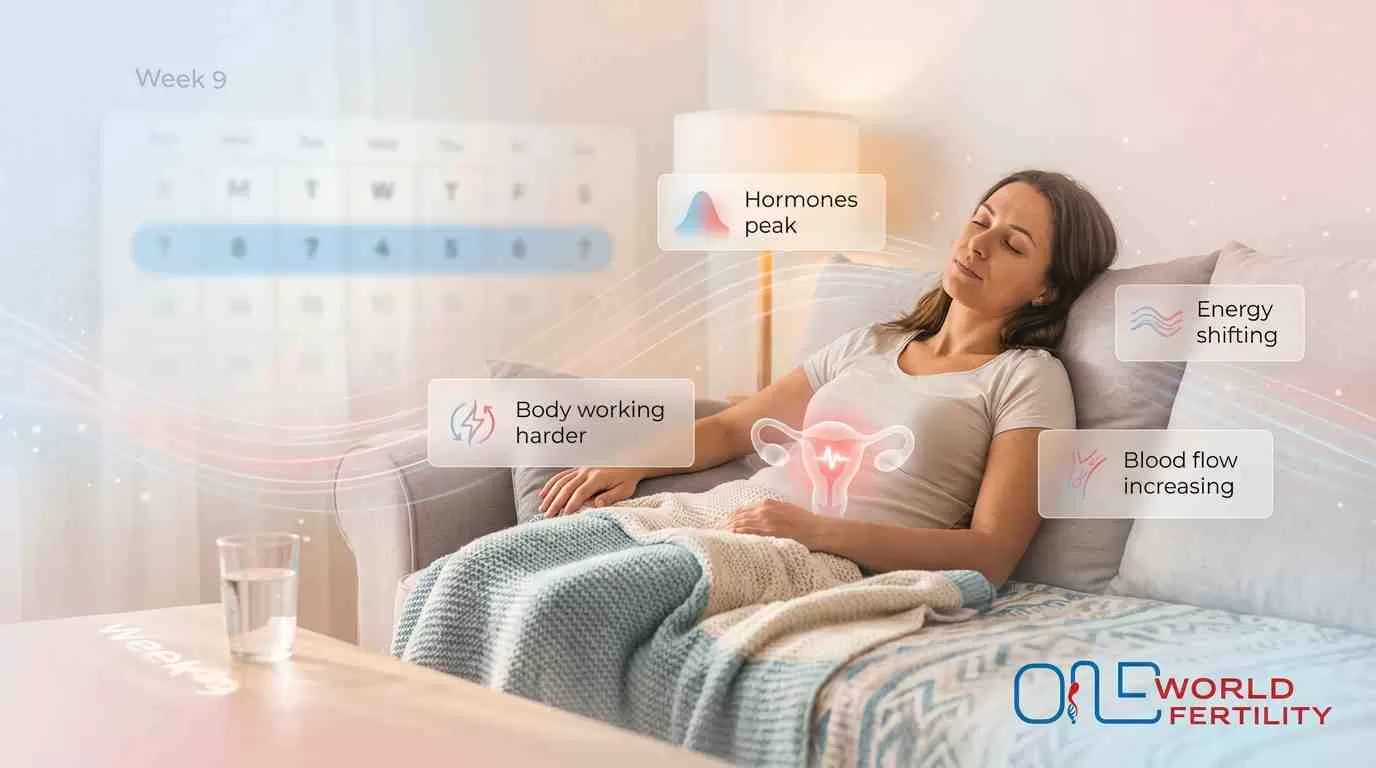
You had nine hours of sleep last night and still woke up tired. You made it to lunch but couldn't stay up. You used to have a lot of energy, but now even taking a shower feels like a struggle. If that sounds like your week, welcome to the 9th week of IVF pregnancy, when exhaustion is at its worst.
This isn't simply being tired. This is a tiredness that affects your whole body and cannot be fixed by sleep alone. And it's really happening for biological reasons that have nothing to do with laziness or weakness.
In this blog, we'll talk about why you get so tired around week 9, what's going on in your body that needs so much energy, what other symptoms look like this week, what happens at your first OB-GYN visit, how to deal with the exhaustion in a practical way, and when it starts to get better.
Remember, you are not lazy or weak. You're building a human being. Let's talk about what that actually takes.
Where Are You at Week 9? - A Quick Orientation
If you had a Day 5 blastocyst transfer, you're currently about 7 weeks past that day, which is 9 weeks in obstetric terms. By now, you probably have graduated from your fertility clinic, or you're about to. You might have your first OB-GYN appointment this week or next.
Your baby is about the size of a grape, roughly 2.3cm. Your hCG is at or near its highest point, which is why everything feels so strong right now. But here's the good news: you're getting close to the conclusion of the first trimester. It's still a few weeks away, but it's coming.
Why Does Fatigue Increase Around 9 Weeks?
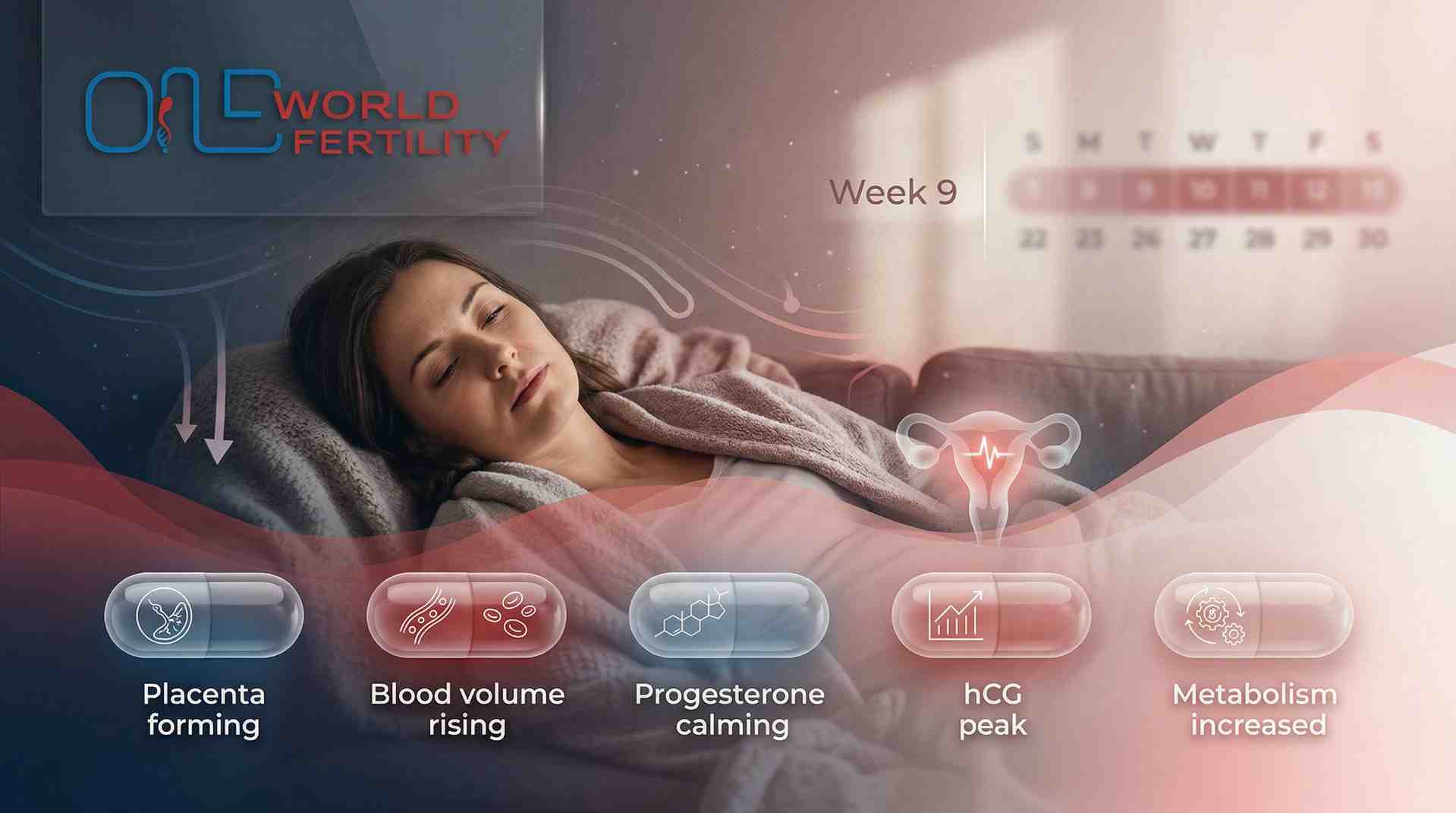
You've been exhausted for weeks, but week 9 seems different. More weighty. More profound. It feels like your body is running on empty all the time, no matter how much you sleep. Here are the five real reasons your exhaustion has hit a new level.
Your Body Is Building an Entire Organ - The Placenta
Your body is doing something it has never done before right now: building a brand new organ from scratch. The placenta is still under construction and won't be fully functional until about week 12. Making a whole organ takes a lot of energy, which is one of the hardest things your body has ever had to do.
The thing is, you can't see any of this happening. But your energy levels are communicating what your eyes can't see. That fatigue that goes all the way down to your bones? That's your body silently performing one of the most complicated construction undertakings in human biology.
Your Blood Volume Has Increased by Up to 50%
Your body is now producing significantly more blood than it was before pregnancy - up to 50% more. You need all that additional blood to provide your baby and the placenta with oxygen and nutrition.
But your heart has to work harder and faster than normal to pump that much additional blood. Even when you're not moving, your heart and blood vessels are working harder than usual. While you sit at your desk, your body is basically running a marathon, which is why you feel extremely tired by the end of the day.
Progesterone Is at Full Force
Progesterone, the hormone that has been helping you with your pregnancy since before your transfer, has a well-known side effect that no one tells you about loudly enough, and that is, it makes you sleepy.
Progesterone levels are very high at week 9. This hormone makes your body naturally sleepy by slowing you down. That sleepy feeling in the afternoon that you can't fight? That's not a lack of willpower. That's progesterone doing what it's supposed to do.
Progesterone also reduces your blood pressure, which can make you feel lightheaded, tired, and like you're "running on fumes" all day.
hCG Is Peaking
Around weeks 9 to 10, hCG, the hormone that causes nausea and many other first-trimester symptoms, is at its highest level. That peak doesn't just affect your stomach; it also makes you feel even more like you've had enough.
There's also a secondary effect: nausea from hCG makes it harder to eat properly. And when you don't eat enough, your body doesn't obtain the energy it needs, which makes you feel tired. You're exhausted because you can't eat, and you can't eat because you're nauseous. And the nausea is at its worst when hCG levels are at their peak. It's a loop, and week 9 is where it tightens the most.
Your Metabolism Has Increased
Your metabolic rate is higher now than it was before pregnancy. Even if you're lying on the couch doing nothing, your body is burning extra calories just to maintain itself and support fetal development.
When you're nauseous, it's normal not to eat enough. This makes a big difference between what your body requires and what it really gets, which causes a deep energy deficit. When you don't eat often enough, your blood sugar can drop, which can cause sudden drained of energy.
What Other Symptoms Are Happening at Week 9?
This week, fatigue may be the main symptom, but it's not the only one. Here's what else your body might be doing right now.
Symptoms Still Near Their Peak
- Morning sickness/Nausea: This is still intense for many women. The toughest time is usually between weeks 9 and 10. But some people may notice the first hints that it is starting to change: it is less continuous and easier to handle on some days. The entire relief isn't here yet, but it's getting closer.
- Breast changes: They are still heavy, tender, and sore. You might notice that your nipples are getting darker and that your veins are becoming even more evident across your chest.
- Bloating and constipation: They are still significant. Your enlarged uterus is putting more pressure on your intestines, while progesterone is still slowing down your digestion.
- Mood swings: Your emotions are still quite strong. The anxiety of adjusting to a new OB-GYN after leaving your fertility clinic may be adding another layer on top of the hormonal rollercoaster.
- Frequent urination: This continues as the uterus grows; it's now roughly the size of a huge orange and puts greater pressure on your bladder.
- Headaches: A mix of changes in hormones, not drinking enough water, and the profound exhaustion you're feeling this week.
- Heartburn: It can happen more often now that progesterone is relaxing the valve between your stomach and oesophagus.
- Nasal congestion: This is a surprise for many women. A stuffy or blocked nose that isn't caused by a cold or flu? That's pregnant rhinitis, which occurs when the increased blood volume causes the nasal passages to enlarge. It's not dangerous, but it is bothersome, and it can affect your sleep quality.
- Vivid dreams: Still continuing. Changes in hormones can impact how you sleep, and many women say they have bizarre or very intense dreams around this time.
Are Symptoms Starting to Ease?
You're getting close to the turning point at week 9, but you might not feel it yet. This week, some women realise that their nausea isn't as bad all the time. Instead, it comes and goes in waves while some people still feel it strongly.
This is when hCG starts to level off. The hormone isn't going away; it's just levelling off. And as it does, the symptoms it causes will slowly start to go away. Around weeks 12 to 14, you should start to feel real relief.
Warning Signs - Same Rules
- Heavy bleeding - soaking through a pad
- Severe or one-sided pain
- Fainting
- High fever
- Can't keep anything down for 24+ hours
Call your doctor. Don't wait. Don't search for reassurance online. Just call.
Your Baby at Week 9
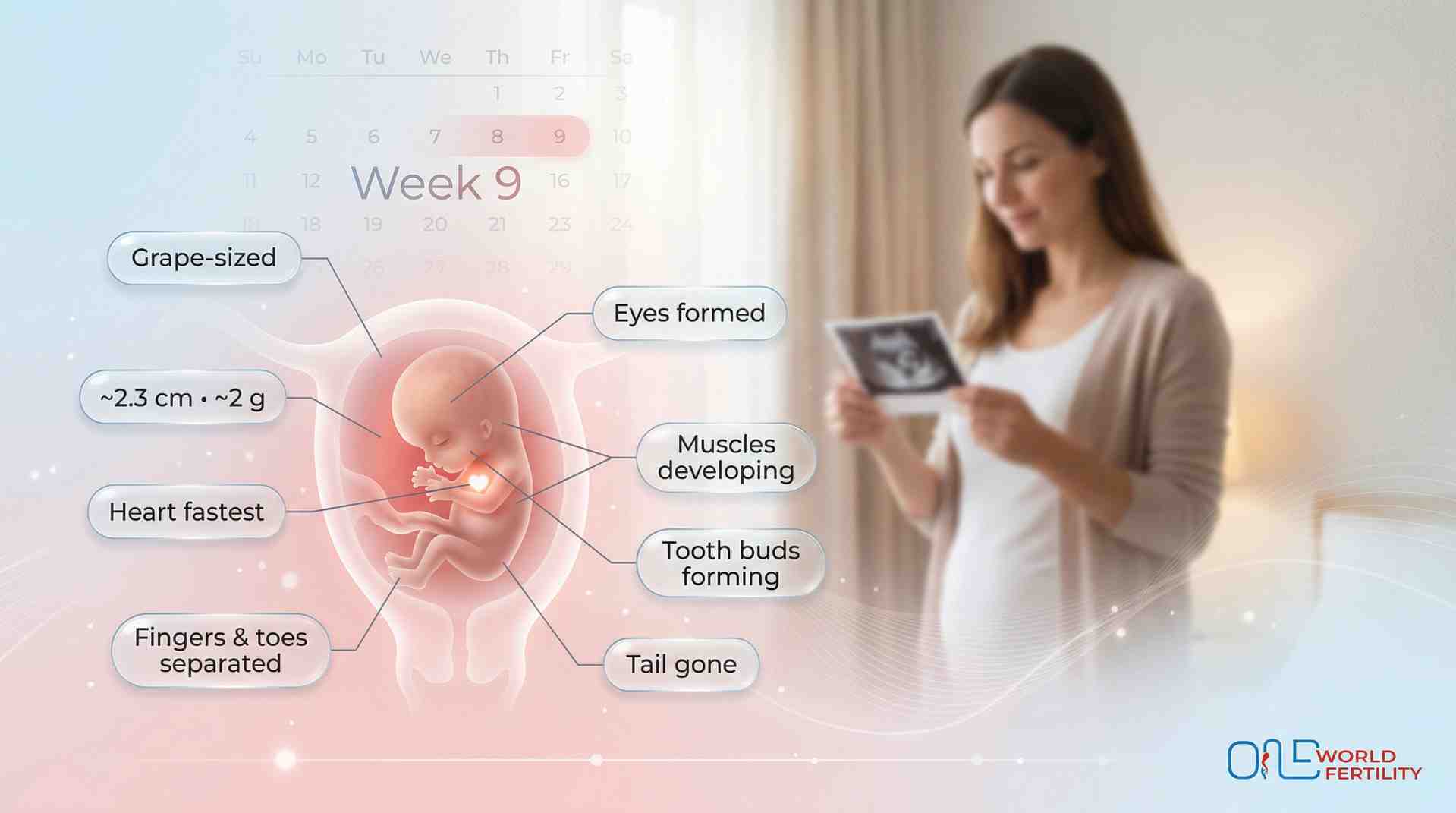
While you're fighting to keep your eyes open, your baby is wide awake and developing faster than ever. Here's what's happening inside you right now.
- Size: Roughly the size of a grape, which is about 2.3cm and weighs around 2 grams. Baby is small enough to sit on your fingertip, but growing every single day.
- Heart rate: between 170 and 180 bpm, which is the fastest it will ever be in your baby's life. From here, it slowly slows down and becomes more stable over the next few weeks.
- Organs: All major organs are now formed. Your baby is no longer building; they are now refining and growing, which makes everything stronger, more defined, and more functional.
- Fingers and toes: They are fully separated now. No more webbing. Ten little fingers. Ten little toes. It's all there.
- Eyes: They are fully formed but are closed by fragile eyelids. They won't open for months, but they're already set up.
- Muscles: Growing quickly. Your baby is moving around on their own in little ways that you can't feel, but they're happening right now as you read this.
- Embryonic tail: Completely gone. Your baby now appears like a real person.
- Tooth buds: Forming under the gums; the very earliest foundation of a future smile.
Your baby is the size of a grape, with a heart that beats faster than yours, fingers that have separated, and a face that is unmistakably becoming a person. All of that is happening while you're trying to stay awake through lunch.
How to Actually Manage the Fatigue
If you tell a pregnant lady in week 9 to "just rest more," it's like telling someone in a storm to "just stay dry." You need real, practical advice that works within the reality of your life right now. Here it is.
Sleep - Unapologetically
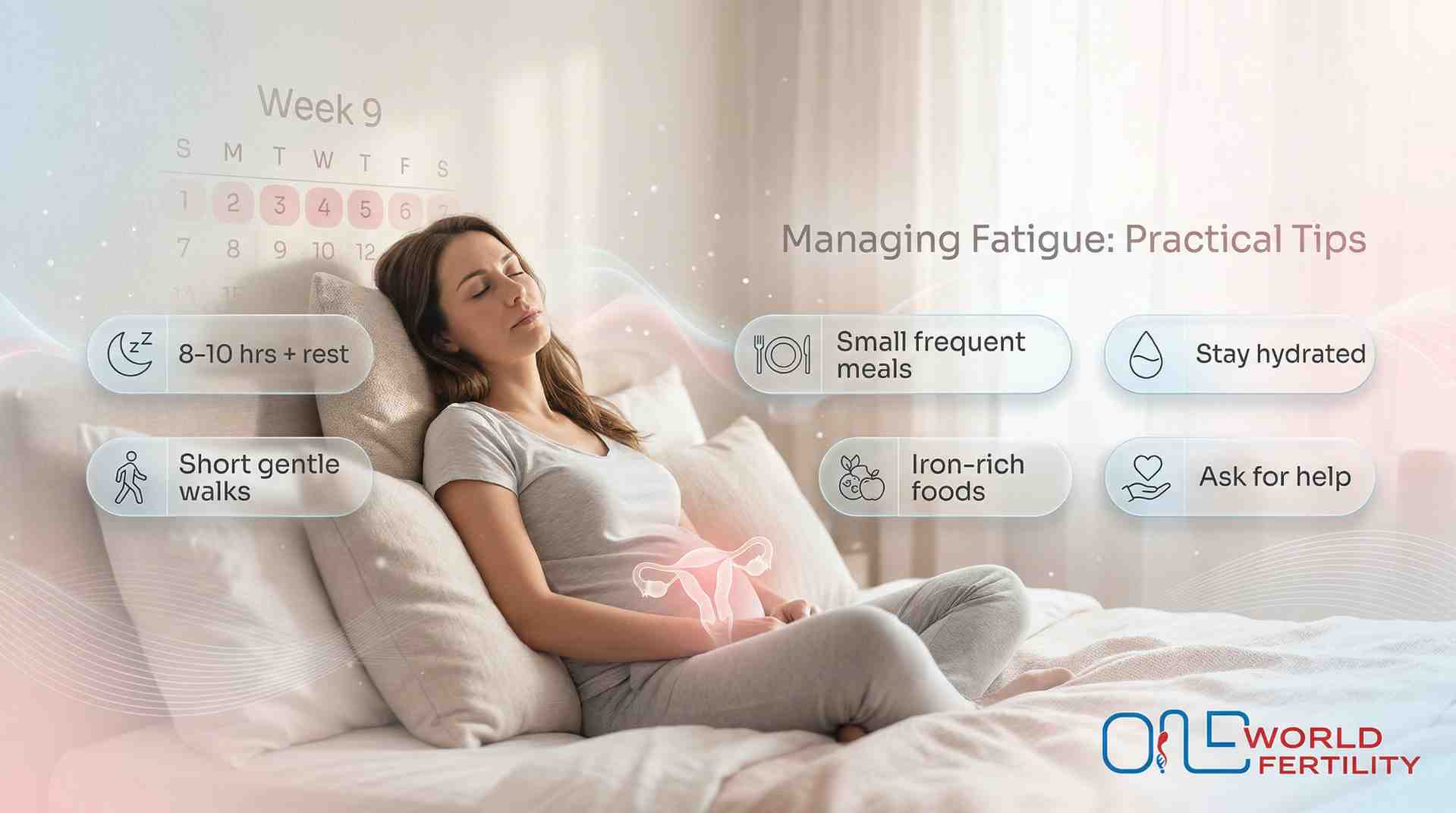
- Get to bed earlier. Take a nap when you can. You don't have to feel sorry for needing a 10-hour nap. Don't feel bad about going to bed at 8 PM. Every minute of that rest is good for your body and baby.
- Sleep on your left side when possible; this position helps blood flow to the uterus and placenta, supporting both you and your baby.
- Keep some crackers by your bed if nausea is keeping you awake at night. A few bites before bed or in the middle of the night will help your stomach feel better so you can go back to sleep.
- If you can, try to get 8 to 10 hours of sleep. And if it doesn't happen, try to sleep whenever you can, no matter the time. This week, getting a nap is very essential for your body.
Eat for Energy - Not Perfection
- Eating small meals every two to three hours keeps your blood sugar from dropping too low, which can make you feel suddenly very exhausted.
- At every meal, eat protein and complex carbs together. For example: eggs and toast, crackers and nut butter, granola and yoghurt. These combinations provide you with steady, long-lasting energy instead of a fast rise and fall.
- Iron-rich foods like spinach, lentils, well-cooked red meat, and iron-fortified cereals will help you fight fatigue. Even small amounts of iron on good days make a difference.
- Drink enough water. Dehydration makes tiredness much worse. You need to drink 8 to 10 glasses of water daily, even if you have to take small sips all day.
Move Gently - Even When You Don't Want To
- Walking for 10 to 15 minutes provides you with more energy than sitting on the couch for another hour. It may seem strange, but moving your body slowly makes blood flow better and also makes you feel more awake.
- Don't push yourself to work out hard this week. Only light movement. Just walking and light stretching, nothing more.
- Prenatal yoga (if your doctor has approved it) can help with energy, mood, and sleep quality; all three things you desperately need right now.
Manage Your Day Around the Fatigue
- Do your most demanding work during your highest-energy window, which for many women is in the middle of the morning. Plan meetings, focus on work, and handle anything else that requires brainpower during those hours.
- Take short breaks during the day. Even just five minutes of closing your eyes or going outside for fresh air will give you the energy you need to keep going.
- Don't fill every free minute to get things done. Right now, rest is not a waste of time. Rest is helpful. Your body is using that time off to build a placenta and grow a baby.
- Ask for help from your partner, family, and coworkers. Let them help you. You don't have to do everything alone, and this is the week to stop pretending you can.
When Fatigue Isn't Just "Normal Pregnancy Tiredness"
It's normal to be tired during week 9. But extreme exhaustion that doesn't improve at all, even with rest, food, and hydration, then it could sometimes point to something that needs medical attention:
- Anemia (poor iron) is very common during pregnancy and can be easily treated with supplements. Your body's increased blood volume demands more iron than usual.
- Problems with the thyroid can get worse or start during pregnancy. Thyroid problems directly affect how much energy you have.
- Dehydration can happen when you don't drink enough water or when you throw up and lose fluids. Even a little bit of dehydration can make you feel quite tired.
Your OB-GYN will typically check for all of these at your first appointment through routine blood work. But if you feel like you're more than just "normal tired" before that appointment, let your doctor know. It's always a good idea to check because you're not overreacting, but rather you are paying attention.
What Should You Eat This Week?
It's hard to eat well when fatigue and nausea are both at their worst. But here's the irony: not eating makes both of them worse. So this week, the strategy is simple: eat for energy, keep it easy, and don't aim for perfection.
Energy-Focused Eating
- Protein and complex carbs = sustained energy: Eggs with toast, oats with nuts, sweet potato with lentils, and chicken with brown rice. These combinations give your body continuous, sustained fuel instead of the highs and lows that come from sugar or processed foods.
- Iron-rich foods: It is very essential this week. Your blood volume is at its highest demand, and iron is what keeps your body from running on empty. Your best choices are spinach, well-cooked red meat, beans, and iron-fortified cereals.
- Vitamin C alongside iron: It helps your body absorb iron better. Spinach pairs well with a glass of orange juice or a squeeze of lemon juice over your lentils. A small pair makes a big difference.
- Don't let your stomach stay empty for too long: Try a small portion to prevent blood sugar crashes that turn mild tiredness into sudden, floor-level exhaustion.
- Lots of water: Being dehydrated makes you feel much more tired. Even being a little dehydrated makes your day feel heavier. Aim for 8 to 10 glasses; take a sip consistently, don't try to catch up all at once.
When Nausea and Fatigue Collide
This is the worst combination of week 9: too tired to eat, too nauseous to eat, and not eating makes both worse. When you're locked in that loop, surviving is the only goal.
- Keep basic snacks like crackers, bananas, bread, and cheese cubes close by. Nothing that needs cooking or preparation. Just grab and eat.
- Smoothies can be a lifesaver. Mix up some fruit, yoghurt, nut butter, and a handful of spinach. You can obtain protein, calories, iron, and water in one glass without having to chew or cook.
- Ginger tea and lemon water still help with nausea when nothing solid sounds manageable.
Foods to Still Avoid
Same list - no changes, no exceptions:
- Raw or undercooked fish, meat, or eggs
- Unpasteurized dairy and soft cheeses
- High-mercury fish (shark, swordfish, king mackerel)
- Alcohol - zero
- Caffeine beyond 200mg per day
- Junk food and heavily processed snacks
- Unwashed fruits and vegetables
Week 9 Food Guide - Energy Edition
Energy Foods
|
When Too Tired & Nauseous
|
Still Avoid
|
Eggs, chicken, lentils
|
Crackers, bananas, toast
|
Raw fish, meat, eggs
|
Oats, sweet potato, whole grains
|
Smoothies (fruit + yogurt + nut butter)
|
Unpasteurized dairy
|
Spinach, red meat (iron)
|
Cheese cubes, dry cereal
|
High-mercury fish
|
Nuts, seeds, nut butter
|
Ginger tea, lemon water
|
Alcohol (zero)
|
Vitamin C foods with iron
|
Popsicles, cold foods
|
Caffeine >200mg
|
8-10 glasses of water
|
Small bites every 2-3 hours
|
Junk food, processed snacks
|
Your First OB-GYN Appointment - What to Expect
If you've recently graduated from your fertility clinic, this may be the week you walk into a completely new doctor's office for the first time. That's a significant issue, so let's make sure you know what's going to happen.
When Does It Happen?
Most people's first OB-GYN appointments are between weeks 8 and 12. If you graduated from your fertility clinic around week 8, this appointment could happen this week or next. Plan on spending at least an hour at the appointment so you don't feel rushed. It should be longer than what you're used to.
What Will Happen?
At your first visit, your OB will want to know everything about you, so be ready for a long visit:
- Medical history: Your IVF journey, how many cycles you went through, what medications you've taken, and any complications that came up along the way. They'll also want to know about your family's health, past pregnancies and operations, and how you are doing overall. Don't keep anything from them; the more they know, the better they can help you.
- Blood work: They will take blood for several reasons, including your blood type, Rh factor, iron levels, thyroid, HIV, hepatitis B, rubella immunity, and more. This lets your OB get a complete picture of your health right now.
- Urine sample: A routine check for infections, protein, and glucose levels. There is nothing complicated; it is just part of the standard process.
- Blood pressure and weight: These are your starting numbers. Your OB will compare all of your future readings against these, so they can catch any changes early.
- Possible ultrasound: Not all, but many OBs do one ultrasound at the first visit. If your does, get ready for a moment. Your baby looks very different now than when you saw that little flicker a few weeks ago.
- Prenatal testing discussion: Your OB will walk you through what's ahead: the NT scan, genetic screening options, and the schedule of upcoming visits. This is a wonderful moment to ask any questions you have.
What Should You Bring?
- Your IVF records and fertility clinic summary - your fertility clinic should have prepared this for you at graduation. If you don't have it, phone them and ask.
- A list of all current medications - including progesterone, estrogen, prenatal vitamins, and anything else. Make sure to mention when you are scheduled to discontinue or lower your progesterone dose.
- A list of questions - write them down ahead of time. It's easy to forget what you wanted to ask in the moment.
- Your partner, if possible - this is a good appointment for them to be part of. It's the start of a new relationship with a new care team, and having someone there to help is a big help.
It's Okay to Feel Strange About a New Doctor
You spent weeks, maybe even months, with your fertility team. They knew your name the moment you walked in. They knew your history, your worries, and your stats. They were there for you throughout some of the hardest times in your life.
And now you're sitting in a different waiting room, filling out fresh paperwork, and introducing yourself to someone who doesn't know any of that yet. It seems like you're starting over.
Take your time. Your OB-GYN will get to know you, and you will get to know your OB-GYN. It takes more than one appointment to create trust. Soon, this new place will feel like it's yours too.

What Should You Do and Avoid This Week?
In Week 9, you should work with your body, not against it. You are exhausted for a reason, and the sooner you quit fighting it, the easier this week will be.
Do's
- Continue medications until your doctor says to stop: Even if you've graduated from your fertility clinic. Your OB needs to give you explicit instructions for anything to change.
- Attend your first OB-GYN appointment: Bring your IVF documents, a list of your medications, and any queries you have. This visit is the start of the care you will get for the duration of your pregnancy.
- Prioritise sleep: This is the week to stop treating rest as something you'll "get to later." Get to bed early. Don't feel bad about napping. Your body needs it more than your to-do list.
- Eat something every few hours: Even when you don't feel like it. A few nibbles of anything will keep your blood sugar from dropping too low and your energy from running out.
- Stay hydrated: Keep a bottle of water with you at all times. Drink steadily all day long.
- Move slowly: A short walk or some mild stretching is enough to keep your body from feeling completely shut down.
- Talk to your partner: Tell them exactly what they can do to help this week, like cooking, running errands, or giving you time to relax. Say what you need directly.
- Be kind to yourself: You're doing something extraordinary even when it feels like you're doing nothing. Growing a human being is invisible work, but it is the hardest one, too.
Don'ts
- Don't fight the fatigue: Your body is asking for rest because it needs rest. Pushing through doesn't get you anywhere; it just makes you more tired.
- Don't stop progesterone without your doctor's instruction: the same rule every week.
- Don't skip meals: An empty stomach and crashing blood sugar levels will make fatigue and nausea worse. A few crackers are enough.
- Don't do intense exercise: Be gentle and don't put too much stress on anything.
- Don't use hot tubs, saunas, or steam rooms: Still not safe.
- Don't smoke or drink alcohol: No exceptions.
- Don't compare your energy levels to anyone else's: Every pregnancy has its own set of problems. Just because someone else feels OK at 9 weeks doesn't imply you should, too.
Quick Questions
- When does the fatigue get better? Most women start to feel more energetic again between weeks 12 and 14, when the second trimester starts. You should feel more like yourself in around 3 to 5 weeks.
- Is it safe to nap during the day? Yes, absolutely. To nap is a necessity right now because your body is working more than you can see. So, if you can close your eyes for 20 minutes in the afternoon, do it without a second thought.
- Should I tell my employer I'm pregnant? That's entirely your decision. If you're having trouble getting through the workday because you're tired, talking to your boss or HR can lead to accommodations like flexible hours or extra breaks. A lot of women wait until 12 weeks, but some share earlier when they need help with things. That's fine too.
- Can fatigue be a sign of something wrong? At week 9, it's normal to feel tired throughout pregnancy. But if it makes you feel really dizzy, faint, or have a fast heartbeat, or if you can't do anything at all even after resting, tell your OB. Just to be safe, they might want to screen for anaemia or thyroid problems.
- I feel guilty for being so tired. Is that normal? Yes, it is absolutely normal and feeling guilty for being so tired is completely unnecessary. You're building a placenta, growing a baby, and living on crackers and willpower. That's not "doing nothing", but rather "doing many things."
Final Thoughts
Week 9 is one of the hardest weeks physically. The tiredness is real. The nausea may still be lingering. And on certain days, just existing feels like an achievement.
But here's what's also real: your baby has a face now. A heart that beats quicker than yours. Fingers and toes that are fully separated. A body that is clearly becoming a person, all because your body is doing the phenomenal job of making it happen.
Our eighth week blog has all you need to know about your graduation, the transformation from embryo to fetus, and everything else that led you to this point. And when you're ready for what's ahead, our tenth week guide will be there, as you get closer to the end of your first trimester.
One World Fertility realises that some weeks are harder than others. This is one of those weeks. And we want you to know that what you're doing right now, even if it seems like nothing, is everything.
Frequently Asked Questions
Schedule your most demanding tasks during your highest-energy window, usually mid-morning. Take short breaks throughout the day, even 5 minutes helps. Keep snacks and water at your desk. If fatigue is severely affecting your performance, consider sharing with your manager or HR for accommodations. And remind yourself, rest is not laziness, it's survival.
Light walking and gentle stretching are safe and encouraged - even a 10 to 15 minute walk can boost your energy more than staying on the couch. But avoid intense workouts, heavy lifting, or anything high-impact. If your doctor has approved prenatal yoga, that can also help with energy, mood, and sleep.
Yes. It's called pregnancy rhinitis; a stuffy or blocked nose without any cold or infection. It's caused by increased blood volume swelling the nasal passages. It's harmless but can be annoying, especially when it disrupts your sleep. A humidifier and saline nasal spray can help.
Pair protein with complex carbs at every meal: eggs and toast, nut butter and crackers, yogurt and granola. Prioritize iron-rich foods like spinach, lentils, and red meat. Eat something every 2 to 3 hours to prevent blood sugar crashes. When nausea makes eating hard, smoothies, crackers, and bananas are your survival tools.
For most women, energy starts returning around week 12 to 14 as the second trimester begins. The placenta takes over hormone production, hCG levels decline from their peak, and your body starts to stabilize. You're roughly 3 to 5 weeks from feeling noticeably more like yourself.
Your OB will take your full medical history including your IVF journey, draw blood for a screening panel, collect a urine sample, check your blood pressure and weight, and possibly do an ultrasound. They'll also discuss your prenatal testing schedule. Bring your IVF records, medication list, and any questions you have.
About the size of a grape, roughly 2.3cm and weighing around 2 grams. The heart is beating at approximately 170 to 180 bpm, the fastest it will ever be. All major organs are formed, fingers and toes are fully separated, and your baby looks unmistakably human now.
Along with deep fatigue, common symptoms include nausea still near its peak, breast tenderness, bloating, constipation, mood swings, frequent urination, headaches, heartburn, vivid dreams, and a new one for many women, nasal congestion without a cold, caused by increased blood volume swelling the nasal passages.
Yes. First trimester fatigue affects up to 90% of pregnant women, and week 9 is often when it's at its deepest. Your body is performing extraordinary biological work: building an organ, increasing blood supply, and supporting rapid fetal development. This level of exhaustion is expected, not a sign of something wrong.
Your body is building a placenta from scratch, your blood volume has increased by up to 50%, progesterone is at full force with its natural sedative effect, hCG is at its absolute peak, and your metabolism is running higher than ever. All of that happening at once is why week 9 feels like hitting a wall.