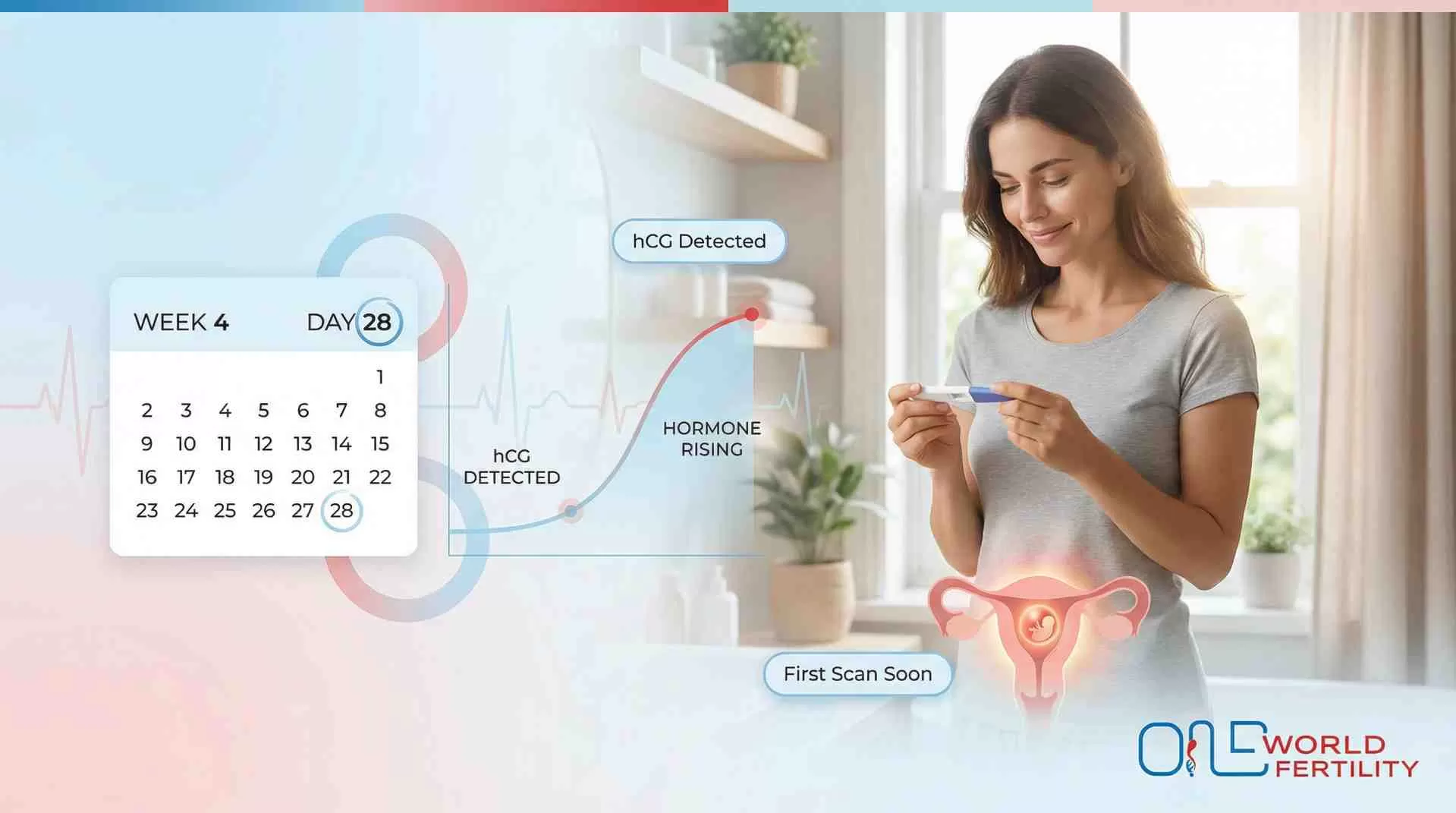
The test showed that you were positive. You've seen the number. You are now officially four weeks pregnant with IVF, which is a big deal. But instead of feeling better, your mind is racing. Is the number high enough? Will it keep going up? What happens next?
Here's something no one tells you: a positive test doesn't make the anxiety go away. It only changes the questions. That's why we're here.
We'll talk about what that positive number really means, what symptoms to expect this week, how your hCG should be changing, what to eat and what to skip, and how to take care of yourself during the worst wait of all: the time between your beta and your first ultrasound.
You deserve this moment. Let's understand it together.
What Does "4 Weeks Pregnant" Actually Mean in IVF?
This is something that still confuses almost everyone: your doctor might declare you're "4 weeks pregnant," but your transfer was only about 2 weeks ago. How does that make sense?
It's because pregnancy dating starts with your last menstrual period, not with the transfer of the embryo. When your clinic claims "4 weeks," your embryo is really only about 2 weeks into its journey. At this stage, it has implanted, hCG levels are rising, and your body is starting to respond. But it's still very early, which is fine. Every big journey starts quietly.
What Does a Positive Pregnancy Test Really Mean at This Stage?
You have seen the number, and the clinic has also confirmed it. But in the back of your mind, a quiet voice continues questioning, "What does this really mean?" Is this for real? Let's answer this clearly.
It Means Implantation Happened
Not only did your embryo survive the transfer, but it also found its place to develop. It attached to the lining of your uterus, made itself at home, and began doing what it was supposed to do. Your body made hCG, the hormone that tells you you're pregnant, and that's what your blood test found.
There is no "maybe" about this. This is not a false alarm. This is a real, confirmed pregnancy.
But it's still very early, and this is important to know. Your clinic will keep an eye on you over the next few days and weeks until they say the pregnancy is firmly established. That doesn't mean that something is wrong. That suggests your doctors and nurses are being careful, which is what you want them to be.
It Means Your Body Is Responding
There are two powerful forces working together inside you right now. Your uterine lining is thick, stable, and protective thanks to progesterone. hCG levels are rising, which signals to your body that a pregnancy is occurring and needs to be supported.
Your lining is still there. Your hormones are communicating. Even if you can't feel it happening, your body is doing what it needs to do.
Your test results show that the process is working. Not "might be working." But working right now inside your body.
It Doesn't Mean You Can Stop Worrying (And That's Okay)
No one tells you this, but for most women, the worry doesn't stop after a positive test. It changes shape. Before, the anxiety was "what if it's negative?" Now, the fear is "what if something goes wrong?"
You are pregnant. But the ultrasound won't be done for another 2 to 3 weeks. You can't see the heartbeat yet. No scan to make you feel better. A lab report with just a number and a body doing work that can't be seen is all for this time.
It's hard to sit between "confirmed" and "visible." And if you're finding it difficult, then you're not weak. You're not ungrateful. You're just human.
Your hCG values and the advice from your clinic are your only anchors until the ultrasound comes. Hold onto them. You don't have to be calm to be okay. You have to keep going.
Your hCG at Week 4 - What the Numbers Should Look Like
We know you've been looking at your beta number. Comparing it to charts. Let's be honest, not add to the noise, and talk about what your hCG should look like right now.
Where Should Your hCG Be Right Now?
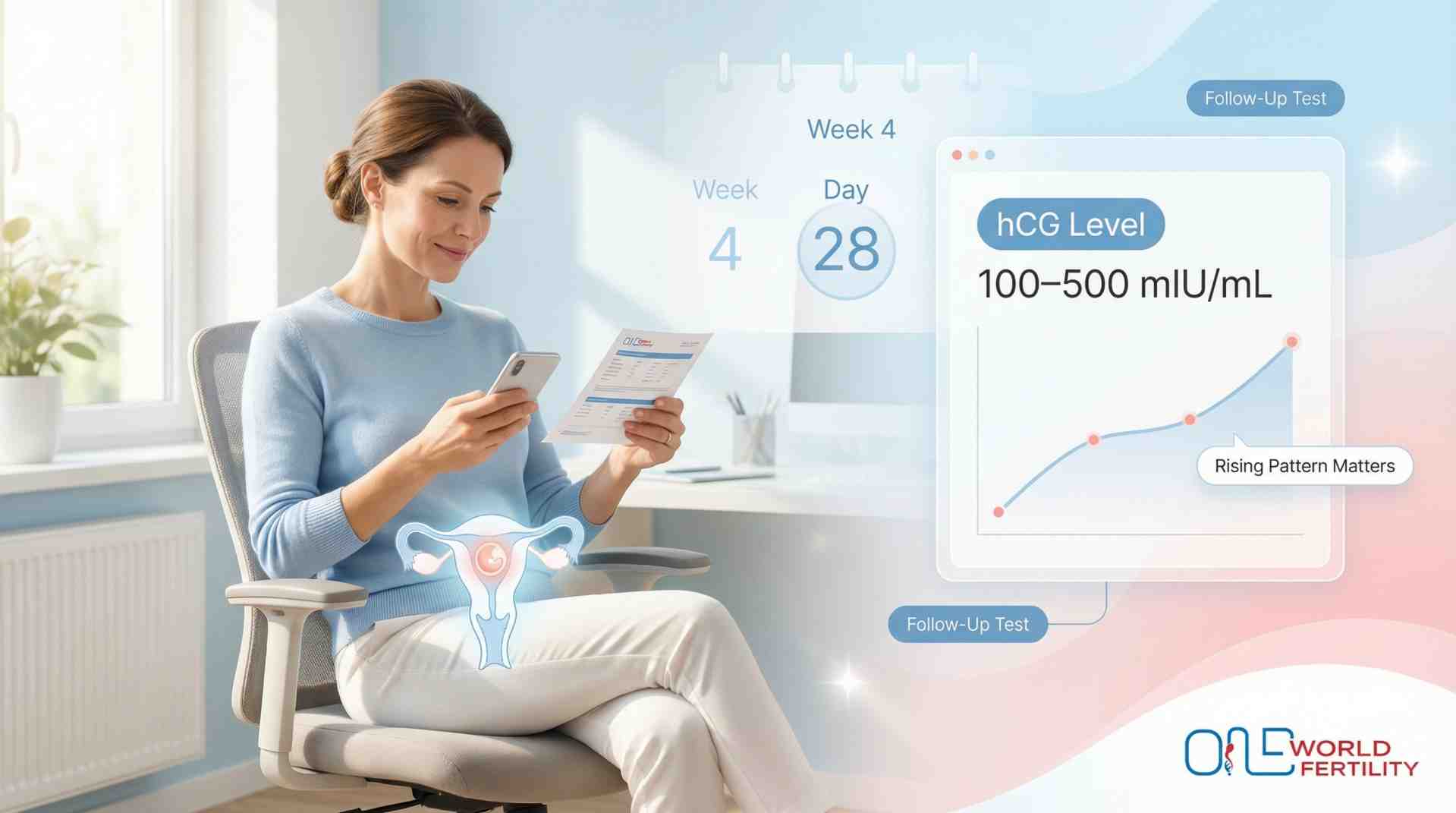
About 14 days following a Day 5 blastocyst transfer, most healthy singleton pregnancies have an hCG level between 100 and 500+ mIU/mL by week 4. Some women will be higher. Some will be lower. Both can be perfectly normal.
If your score is on the higher end, like 500 to 1,000 or higher, it may mean you could have twins. But nothing is confirmed until your ultrasound. Just because you have high numbers doesn't mean you'll have more than one baby, and your doctor won't make any decisions based on one reading.
Take a deep breath if your number is lower than you expected. There is a lot of variance among people. What your body makes on Day 14 is not a grade. It's not a score. And it is not the last word on your pregnancy.
The main point, and we'll mention it again because it's so crucial, is that the doubling pattern is still more important than any single number.
hCG Reference at Week 4 (Simplified)
Stage
|
Approximate hCG Range
|
14 days post-transfer (Day 5 blastocyst)
|
100–500+ mIU/mL
|
16 days post-transfer
|
200–800+ mIU/mL
|
18 days post-transfer
|
400–1,600+ mIU/mL
|
These are general ranges. Your specific number may be higher or lower and still be perfectly healthy. The trend is what matters.
When Does the Doubling Slow Down?
This is something that surprises many women and makes them worry for no reason.
- In the early stages(weeks 3 to 4), hCG usually doubles every 48 to 72 hours. Your clinic looks for that quick rise in the first beta testing.
- The time it takes to double naturally slows down as you get to weeks 5 and 6. This isn't a warning sign; it's how it's supposed to be.
- It could take 72 to 96 hours for hCG to double by weeks 6 to 7, which is completely normal.
- Most of the time, online calculators don't account for this natural slowness, which is why they make people more worried than calm.
- Bottom line: Your pregnancy is going precisely as it should if your statistics keep going up, even if the rate slows down.
What If My Second Beta Didn't Quite Double?
This is the question that makes women go crazy at 2 AM. Let's be clear:
- A textbook doubling, where your number doubles exactly in 48 hours, is the best. But not every healthy pregnancy follows the textbook.
- A 50% to 60% increase in 48 hours can still be a good sign, especially if your initial figure was on the upper side. The larger the starting number, the slower the percentage growth tends to be.
- Your doctor might order a third beta test to confirm the trend or schedule an early ultrasound to get a clearer picture. Both of these are normal steps, not emergency measures.
- We don't want you to use five separate online calculators to figure out how you should feel.
- Talk to your clinic. They know your history, your numbers, and your body. A calculator doesn't.
Symptoms at 4 Weeks - What's Real and What's Medication?
Things start to feel more real physically in week 4. Your hormones are rising faster now, and your body is telling you about it. But here is the honest truth that many of these signs are the same as the ones you were having last week, and they can be due to the medicines you are taking. Instead of attempting to figure out what every feeling means, recognise what's normal, what's common, and what really demands your attention.
Symptoms That May Be Getting Stronger
If you had moderate symptoms last week, they might be getting worse now:
- Nausea: It may start creeping in, especially in the mornings. For some women, it's mild queasiness; for others, it hits harder. Welcome to early morning sickness territory.
- Fatigue: This isn't last week's tiredness. This is like when you need to sit down immediately, and even after a full night's sleep, you still don't feel rested.
- Breast tenderness: They could feel heavier, fuller, and more sore than before. It can even be painful to touch them.
- Bloating: Even when nothing else has changed, your jeans may seem tighter. That's the effects of hormones and drugs working together.
- Mood swings: Feeling more emotional than normal. Crying at a commercial? Tearing up over a kind message? That's week four.
- Cramping: You can still be having mild, dull cramps. As long as it's not sharp or severe, it is usually your uterus adjusting.
- Food aversions or cravings: You might suddenly hate foods you enjoyed last week or want something totally unexpected at 10 PM. Your hormones are changing your menu.
- Increased discharge: At this point, it's normal for your vagina to have white or creamy discharge.
- Heightened smell: It may be even worse now than it was last week. Everything smells different, from cooking to perfumes to your fridge.

What If Symptoms Suddenly Disappear?
This scares more women than practically anything else at week 4. You felt sick yesterday, but now you don't. Does that mean something went wrong?
No. Symptoms can come and go; they don't always happen, and they don't have to happen every day. Your body changes in waves as your hormones fluctuate naturally. A day without feeling sick doesn't mean you're not pregnant. Don't read too much into a "good day." Just be thankful for the break and keep going.
Warning Signs - When to Call Your Doctor Immediately
Most of what you're feeling this week is normal. But there are some things that need to be done right away, without waiting or looking them up on Google:
- Heavy bleeding - soaking through a pad, not just spotting.
- Severe, sharp pain - especially if it's concentrated on one side
- Feeling dizzy or fainting
- High fever
- Severe vomiting - when you can't keep any food or water down at all
The rule is simple: if it scares you, call your clinic. Don't look for answers online. Just pick up the phone.
What Should You Eat (and Avoid) at Week 4?
The leafy greens, cooked eggs, avocado, nuts, cooked fish, whole grains, lentils, Greek yoghurt, and lots of water we talked about in the third-week blog are still the most important things for you to eat. But for many women, week 4 introduces a new problem: nausea. This week, you need to make a little but important change to your food plan.
Foods That Help This Week
Your basics stay the same. But here's what to add:
- Ginger: This is your new best buddy if you're starting to feel nauseous in the morning. Ginger tea, ginger chews, or even a little piece of fresh ginger in warm water can all help settle your stomach naturally.
- Small, frequent meals: Instead of eating three big meals a day, try eating smaller meals every two to three hours. Having an empty stomach makes nausea worse. Have some light snacks on available, like crackers, a banana, or a handful of nuts.
- Citrus fruits: Some ladies feel better when they drink lemon water, eat fresh oranges, or merely smell a cut lemon. Easy, simple, and worth a go.
- Iron-rich foods: This week, your blood volume is slowly starting to rise. Spinach, well-cooked red meat, lentils, and chickpeas are among foods that help your body keep up with the demand.
Foods to Continue Avoiding
The same rules from week 3 still hold - and they're not negotiable:
- Raw or undercooked fish, meat, or eggs
- Unpasteurized dairy and soft cheeses
- High-mercury fish (shark, swordfish, king mackerel)
- Alcohol — zero, no exceptions
- Caffeine beyond 200mg per day (roughly one coffee)
- Junk food and heavily processed snacks
- Unwashed fruits and vegetables
This week, be extra careful: if your sense of smell is really strong, avoid strong-smelling foods. Even if you aren't eating them, strong spices, frying oil, and strong-smelling food might make you feel sick. When you have to cook, use milder flavours, or ask someone else to handle the kitchen when you don't feel like it.
Week 4 Food Guide
Eat This
|
Avoid This
|
Leafy greens (spinach, kale)
|
Raw fish, meat, eggs
|
Eggs (cooked), avocado
|
Unpasteurized dairy
|
Ginger tea, ginger chews
|
High-mercury fish
|
Citrus fruits, lemon water
|
Alcohol (zero)
|
Small frequent meals
|
More than 1 coffee/day
|
Nuts, seeds, whole grains
|
Junk food, processed snacks
|
Iron-rich foods (lentils, meat)
|
Strong-smelling cooking triggers
|
8-10 glasses of water
|
Unwashed produce
|

What Should You Do and Avoid This Week?
Week 4 is not the week for big changes. This week is all about getting continuous, constant care. Attend all of your appointments, pay attention to your body, and allow the process go on without interruption.
Do's
- Continue all the medications exactly as prescribed - including progesterone, estrogen, and prenatal vitamins. Without your doctor's permission, nothing changes, nothing stops, and nothing gets adjusted.
- Attend all scheduled blood tests - If your clinic has more progesterone or beta tests planned, go to those as well. Right now, this data is important.
- Take a break when your body tells you to - This week, you're going to be really tired. If you need to sleep, do it. If you have to go to bed early, do it. Your body needs that rest.
- Light walking is still the best way to move around at this point - A moderate walk every day aids your circulation, eases bloating, and offers your mind a break.
- Must stay hydrated - especially if nausea is making it harder to eat. Even if you can't eat, keep drinking water all day.
- Talk to your partner - this journey isn't just happening to your body. Talk to each other about how you both feel, including your concerns, hopes, and everything else.
- Start thinking about your first ultrasound - It's usually planned for weeks 6 to 7, which is around 2 to 3 weeks from now. That date on your calendar can help you look ahead rather than get stuck in the present.
Don'ts
- Don't stop taking any medicine - especially progesterone. We talked about this in week three. We're repeating it because it's so important. Don't ever stop on your own.
- Don't perform any high-impact activities - including vigorous exercise or hot yoga. Keep it light. Your body doesn't need to be worked out hard right now.
- Don't use hot tubs, saunas, or steam rooms - since they can raise your body temperature, which is not safe in early pregnancy.
- Don't smoke or drink alcohol - non-negotiable, same as every week.
- Don't take any new medication or supplement without asking your doctor first - even "natural" or over-the-counter ones.
- Don't obsess over hCG calculators online - they make you more anxious than they help you. Your clinic knows everything. A calculator only has one number and no context.
- Don't compare your symptoms with anyone else's - whether it's your friend's IVF adventure, a post on a forum, or a narrative from a stranger. You are the only one who is pregnant.
Common Questions This Week
- Can I fly at 4 weeks of IVF? Most of the time, short domestic flights are OK. Before you arrange anything for a long or stressful trip, talk to your doctor.
- Can I have sex? Many clinics still advise waiting until after the first ultrasound. There's no universal rule, so ask your specific doctor.
- Can I colour my hair? Most experts say it's best to wait until after the first trimester. It can wait a few more weeks.
- Can I lift heavy things? Don't lift anything heavy right now. As a general rule, don't carry more than 10 to 15 pounds.
- Should I start buying baby things? There's no need to hurry. Think about this week and this moment. The shopping will still be there later, and it will feel even better when the time is right.
The Waiting Game - Surviving Between Beta and First Ultrasound
Let's talk about the part of the journey that no medical chart can prepare you for.
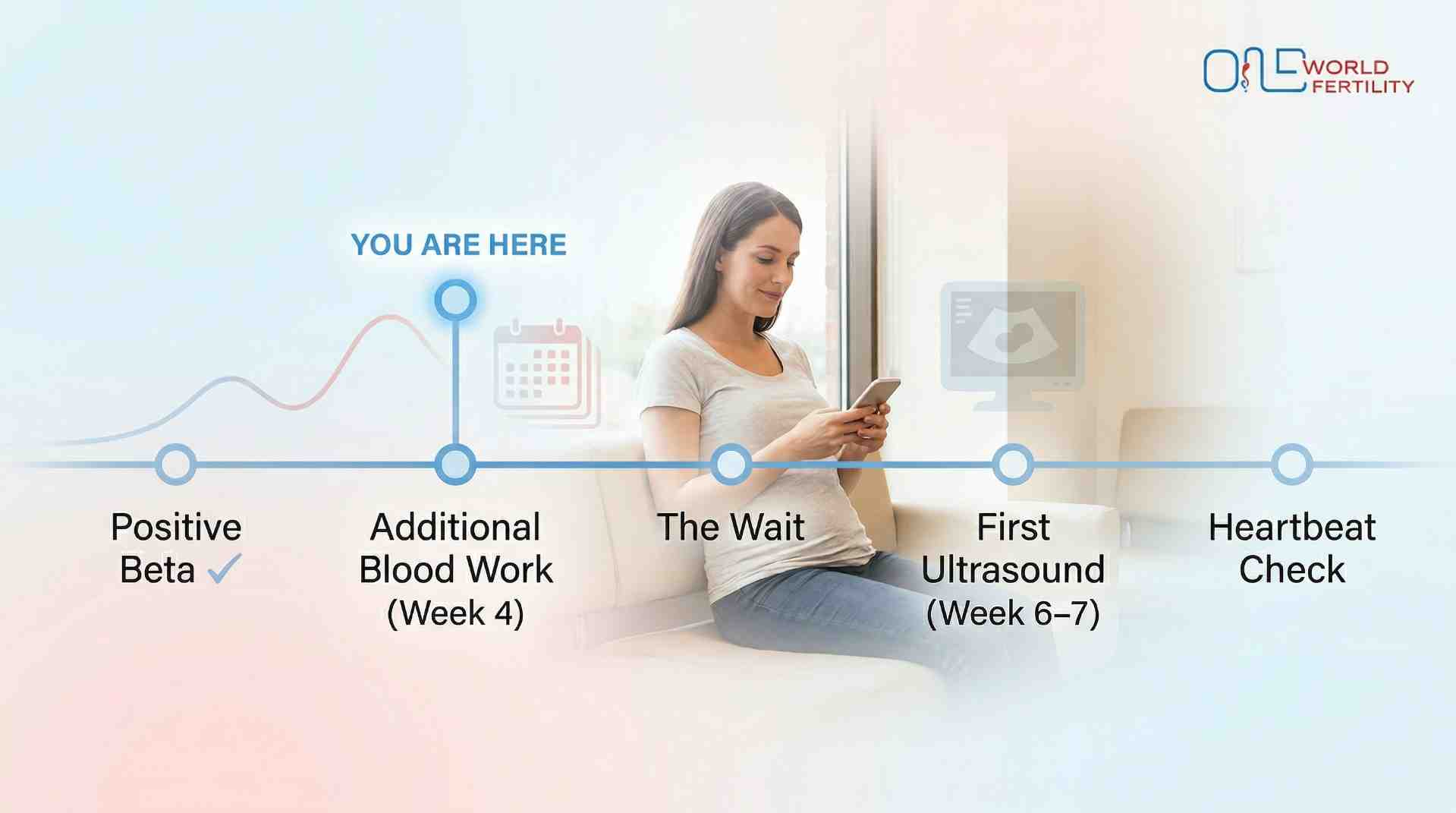
Your beta test came back positive. The numbers are going up. Everything on paper says "baby." But your first ultrasound, when you might be able to see or hear something, isn't for another 2 to 3 weeks, around weeks 6 to 7.
And what about that gap? That interval between "confirmed" and "seen"? This is one of the hardest emotional parts of the whole IVF process.
You have proof that you are pregnant. But you can't see it yet. You can't hear it yet. You can't hold on to a tiny picture or recreate a heartbeat in your head. Just a number on a lab report and a body that is working hard without being seen or heard. And some days, to be honest, it feels like too much.
If you're struggling in this space right now, here's what we want you to know:
- You will have good days and bad days. Some days will be excellent, and some will be horrible. Some mornings you'll feel good. Some nights, fear will come back. Both are parts of this, and that's normal.
- Right now, no bad news is good news. No call from the clinic means things are on track. This week, you don't have to be afraid of silence.
- Your clinic is keeping an eye on you. Your medical team is keeping an eye on the data and the timeline, even if you don't have an appointment. Have faith in their process; they've helped hundreds of women before you.
- Choose one item each day that makes you feel calm. A walk outside. Talking to someone who makes you feel safe. Music that makes you feel better. A few lines in a notebook. You don't need a big plan; just one simple thing to hold on to each day.
- You don't have to be brave all the time. You don't have to smile through the fear or act like everything is alright when it isn't. You have to keep going. That's all.
The ultrasound will happen. When it does, everything you've been keeping inside - every worry, every hope, and every quiet prayer - will finally have a face. One day at a time until then.
What Appointments or Monitoring Happen This Week?
Week 4 is quieter than the beta week, which can feel unsettling. Sometimes, having fewer appointments makes you feel like you get less attention. But it isn't. Your clinic knows exactly where you are and what needs to happen next.
Blood Tests May Continue
- Some clinics do multiple beta hCG testing around week 4, especially if your early levels were close to the line or if they want one more confirmation of the doubling trend.
- This week, they might also check your progesterone levels to make sure they are still at the proper amount to maintain your pregnancy.
- Some clinics stop betas here and just wait for the ultrasound if your hCG has been going up well and the trend looks solid. If that happens, it's not because they forgot about you. Your numbers gave them faith in you.
Your First Ultrasound Is NOT This Week
We know you want it right now. But your first ultrasound is still approximately 2 to 3 weeks away, around weeks 6 to 7.
Why the wait? Because before 6 weeks, it's often too early to see a heartbeat. Sometimes, scanning early can indicate an empty sac. This isn't because something is wrong; it's just too soon. That kind of result makes people quite worried about something that would have seemed totally normal a few days later.
Your doctor isn't being rude by making you wait. They're using their heads. They want your initial scan to show you something that makes sense, not leave you with more questions than you had when you walked in.
Medication Check-In
Your clinic may make small adjustments this week based on your blood work:
- Progesterone or estrogen dosage might be increased, decreased, or switched to a different form. This is routine optimisation, not a warning that something is wrong.
- Changes shouldn't scare you. Your doctor is fine-tuning the support your body needs based on real data, not just what they think.
- Follow all of the instructions exactly until your clinic tells you to do something else. Don't change anything on your own and don't skip doses because you "feel fine."
Final Thoughts
A positive test at 4 weeks means your body is doing exactly what it needs to do: holding on, building, growing. You might not be sure yet. You might not be ready to fully believe it. That's OK. This week isn't about being sure. It's about trusting a process that you can't see yet.
The ultrasound is on its way. The heartbeat is coming. But today, today you are pregnant. And that is real.
If you wish to go back and read about what happened before this point, our third-week blog walks you through the beta test and everything that led to this moment. Our fifth-week guide will include answers to all the new questions that come up along the way.
One World Fertility is with you in the waiting, in the hope, and every peaceful moment between now and the day you finally see what your heart already knows.
Frequently Asked Questions
A rise of 50 to 60% in 48 hours can still be normal, especially if your starting number was on the higher side. Not every pregnancy follows exact textbook doubling. Your doctor may order a third beta or an early ultrasound to get more clarity. Trust your clinic's interpretation over any online calculator.
This is one of the hardest parts. Take it one day at a time. Limit Google and forums. Talk to someone you trust - a partner, friend, therapist, or support group. Find one small thing each day that brings you peace. Remind yourself: today, you are pregnant. That is enough.
Light spotting can still occur at week 4 and is often harmless. It may be related to hormonal shifts or cervical sensitivity from medications. However, if the spotting becomes heavy bleeding - soaking a pad - contact your clinic right away.
Stick with folate-rich greens, cooked eggs, avocado, nuts, cooked salmon, whole grains, lentils, and yogurt. New this week: add ginger for nausea relief, citrus fruits, iron-rich foods, and switch to smaller, more frequent meals if morning sickness is starting.
No - absolutely not without your doctor's approval. Progesterone is essential for maintaining your uterine lining and supporting the pregnancy in these early weeks. Stopping it on your own can directly put the pregnancy at risk. Continue exactly as prescribed.
Usually around week 6 to 7 - roughly 2 to 3 weeks from now. Your doctor waits until then because that's when a gestational sac, yolk sac, and heartbeat can typically be detected. Scanning earlier often shows too little and creates unnecessary worry.
Common symptoms include nausea, deeper fatigue, breast tenderness, bloating, mood swings, mild cramping, food aversions or cravings, increased discharge, and heightened sense of smell. Some women feel all of these, some feel a few, and some feel nothing - all are normal.
Yes. Mild, dull cramping is very common at this stage and is usually caused by your uterus adjusting to the pregnancy and the effects of progesterone medication. If the cramping becomes severe, sharp, or one-sided - contact your clinic immediately.
At roughly 14 days post-transfer, most healthy singleton pregnancies show hCG levels between 100 and 500+ mIU/mL. But the exact number matters less than the trend. What your doctor watches most closely is whether your hCG is doubling every 48 to 72 hours.
It means your embryo has successfully implanted into your uterine lining and your body has started producing hCG - the pregnancy hormone. This is a confirmed pregnancy. Your clinic will continue monitoring through blood tests and eventually an ultrasound to ensure everything is progressing as expected.