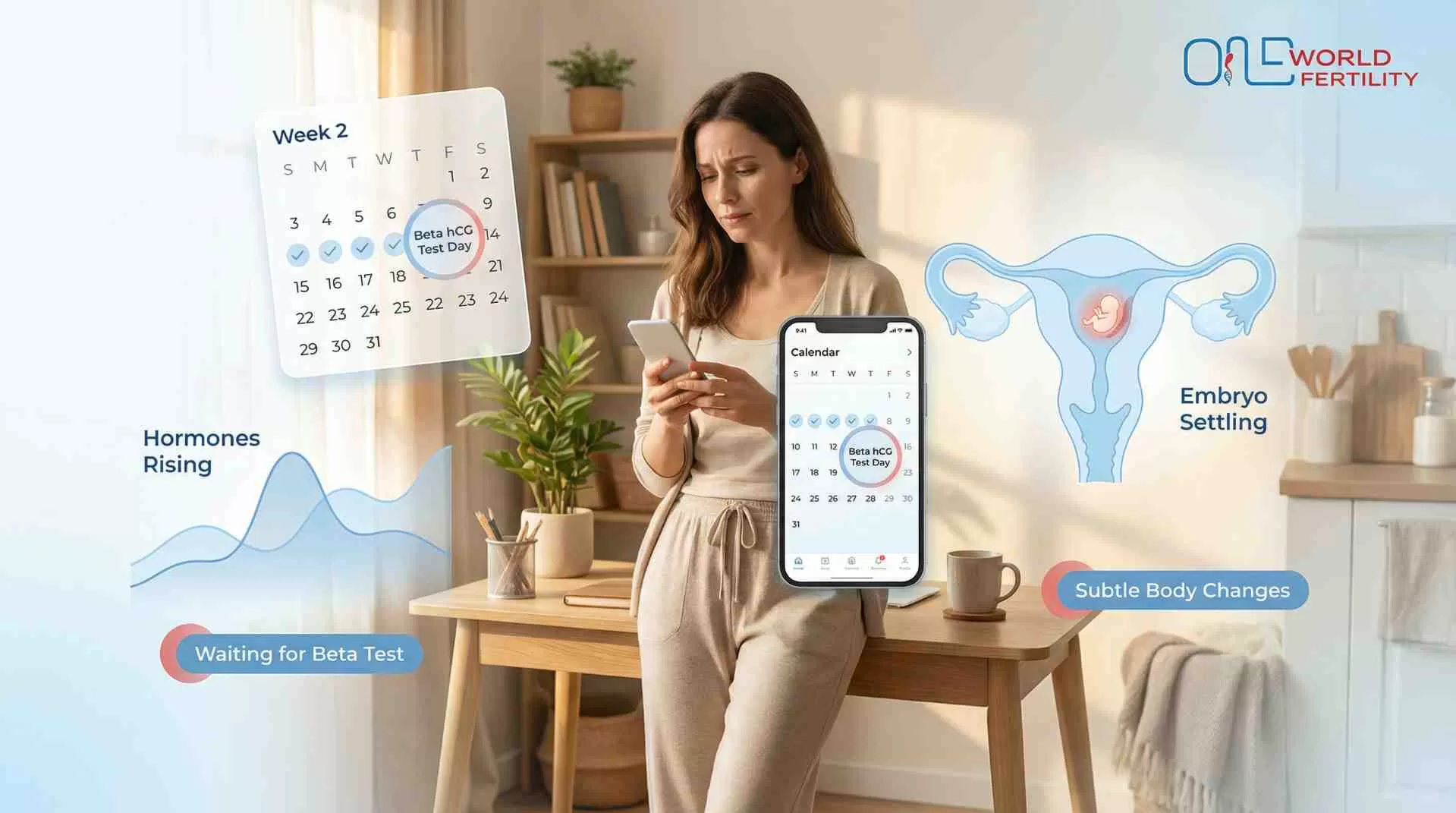
You just had your IVF transfer. The hardest part is now: the two-week wait.
Every day seems to go by more slowly than the last. You feel every tiny thing in your body. A mild cramp. A twinge. Unusual tiredness. And you find yourself wondering, "Is this an IVF two week wait symptom? Or am I just imagining things?"
Trust us, you are not imagining anything. Being 2 weeks pregnant after IVF is one of the most emotionally difficult things a woman can go through. It's normal to have the hope, the fear, the constant questions.
That's why this guide was made. We want to tell you what to expect in week 2 of IVF pregnancy in simple, honest language. No medical jargon that is hard to understand. Just simple answers on how you feel, how your body works, and how your baby is doing in the first several days.
We at OneWorld Fertility are here for you every step of the way, medically, emotionally, and personally, since we know how important this journey is to you.
Let's do it together.
What Does "2 Weeks Pregnant After IVF" Actually Mean?
Almost every IVF patient gets confused by this. We want to clear it up right away.You are not just "2 weeks pregnant after IVF" if you are 14 days past a Day 5 embryo transfer. You are really 4 weeks and 5 days pregnant by gestational age. Knowing this, IVF pregnancy week 2 explained affects how you look at everything, from your symptoms to your hCG levels.
So, where does this two-week pregnant IVF meaning come from? Doctors count the gestational age of a pregnancy from the first day of your last menstrual period (LMP), not from when the egg is fertilised. But in IVF, your embryo had a head start before it got into your body.
- Fertilised in a lab by skilled embryologists
- Grown for five full days until they reached the blastocyst stage
- Before your transfer, you had already counted those 5 days and 2 weeks of cycle prep.
This is exactly why 14 days post-transfer gestational age is far more advanced than "2 weeks" sounds. At OneWorld Fertility, we always make sure you know exactly how far along you are in your pregnancy. This makes everything else easier to comprehend, such as what 2 weeks pregnant means in IVF.
Gestational Age vs. Post-Transfer Days - Understanding the Real Gap
Gestational age in IVF is just a way to say how far along your pregnancy is, based on your last menstruation. It is the same norm that all doctors and fertility clinics throughout the world follow for both natural and IVF pregnancies.
This is what causes so much confusion about IVF weeks vs natural pregnancy weeks:
-
Natural pregnancy week 2 = ovulation has just started, and fertilisation hasn't happened yet.
- IVF Day 14 post-transfer = the embryo is already implanted, and hCG levels are rising inside you.
- When you question, "Two weeks after embryo transfer how many weeks pregnant am I?", the answer is already 4 weeks and 5 days gestational.
- Your blood test on Day 14 doesn't show that you're pregnant for two weeks; it shows that you're already four weeks and five days pregnant.
How IVF Pregnancy Dating Differs From Natural Pregnancy
It's really nice to know the 14 days after IVF transfer gestational age. Don't panic if you're further along than you thought you would be. That's just how IVF pregnancy dating works. And once you get it, a lot of other things about your symptoms, the timing of your scan, and your results start to make sense.
This is where the difference in IVF pregnancy dating becomes most evident and most crucial to know.
Week 2 of a normal pregnancy is just the week of ovulation. The egg hasn't even been fertilised yet. It's easy to see the difference between counting weeks of natural vs IVF pregnancy week counting when you look at them side by side.
| Basis |
Natural Pregnancy Week 2 |
IVF Day 14 Post-Transfer |
| What is happening |
Ovulation just occurring |
Embryo implanted, hCG rising |
| Gestational age |
2 weeks |
~4 weeks 5 days |
| Fertilization |
Yet to happen |
Already done in the lab |
| HCG levels |
Zero |
Detectable and actively rising |
| Pregnancy test |
Far too early |
Official test day |
| Symptoms possible |
No |
Yes, early pregnancy signs possible |
IVF Week 2 Symptoms - Is It the Medication or Is It a Baby?
Let's be honest: this is the stage that makes practically every IVF patient a bit nuts.
You go straight to Google every time you feel a cramp, a twinge, or a wave of nausea. And the hardest part? Most of the 2 weeks pregnant IVF symptoms are the same as the adverse effects of the progesterone drug you are already taking. So how do you know what's real?
During the two-week wait IVF, you generally can't tell. And that's totally fine. What matters is knowing what is typical, what to look out for, and that both having symptoms and not having any symptoms at all are normal.
Common Physical Symptoms at 2 Weeks Pregnant After IVF
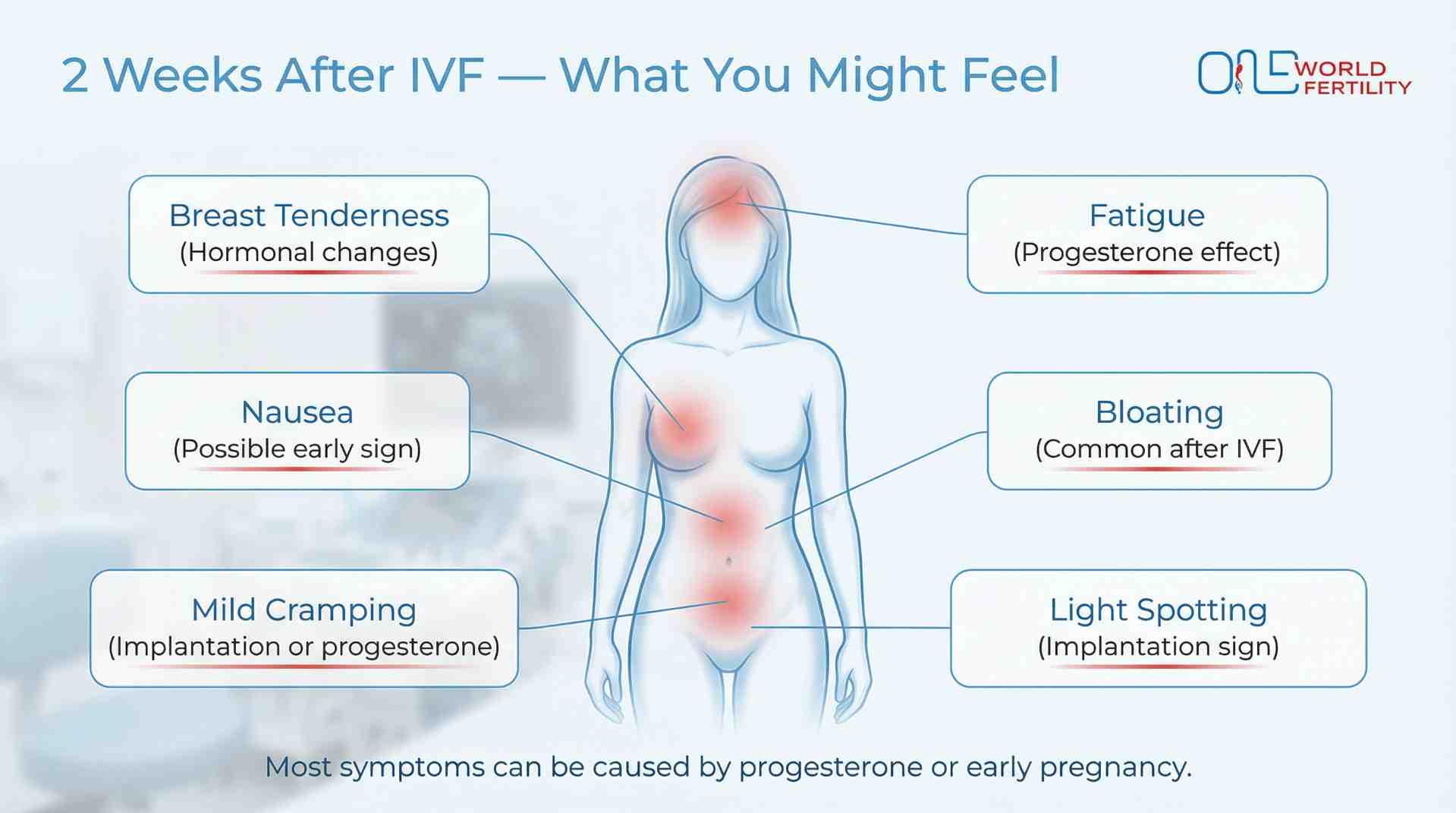
Do you feel any of these things right now?
These are the early pregnancy signs after IVF transfer. Each one could be caused by pregnancy, progesterone, or both.
- Mild cramping - Classic IVF week 2 cramping could be implantation, or it could be progesterone. Both are normal.
- Breast discomfort - Common breast tenderness after IVF transfer caused by both progesterone and hormones that happen early in pregnancy.
- Fatigue - Progesterone is a natural sleep aid. Most women who have had IVF and are pregnant in the second week feel tired.
- Nausea - Progesterone alone doesn't usually induce strong nausea. If it hits forcefully, it's a symptom of a week 2 IVF pregnancy sign.
- Bloating - It's very usual to feel bloated two weeks after IVF because of progesterone and possibly early OHSS.
- Light spotting - Implantation bleeding at IVF week 2 is a good indicator, not something to worry about.
Vaginal Discharge at 2 Weeks After IVF - What Is Normal?
Normal IVF pregnancy discharge at week 2 is clear, white or slightly thick. Progesterone suppositories significantly affect your discharge after embryo transfer; most of what you see is suppository residue, not a cause for concern.
If you see pink or light brown spots between Days 6 and 10, it's probably implantation bleeding, which is a good sign. If you have yellow or green discharge that smells bad, call your clinic right away.
At OneWorld Fertility, there is no such thing as a too minor query about two weeks pregnant discharge after IVF.
IVF Week 2 Symptoms - Pregnancy vs. Progesterone
| Symptom |
Pregnancy? |
Progesterone? |
What It Means |
| Breast Tenderness |
Yes |
Yes |
Cannot determine alone |
| Nausea |
Yes |
Sometimes |
Stronger sign if severe |
| Fatigue |
Yes |
Yes |
Cannot determine alone |
| Implantation Spotting |
Yes |
No |
Positive pregnancy sign |
| Cramping |
Yes |
Yes |
Cannot determine alone |
| Bloating |
Yes |
Yes |
Cannot determine alone |
| Frequent Urination |
Yes |
Rarely |
Early pregnancy indicator |
| Heightened Smell |
Yes |
No |
Strong pregnancy indicator |
| No Symptoms At All |
Normal |
Normal |
Does NOT mean failure |
The TWW Survival Guide- Waiting and Getting Through IVF Week 2
No one tells you how lengthy two weeks might feel following an embryo transfer. The two week wait after IVF is not only a physical wait; it's also an emotional one. Hope, worry, and the need to know weigh down every hour. And if you are looking up "surviving the two-week wait after IVF or what to do in week 2 of pregnancy" at midnight, you're not the only one. There are thousands of ladies doing the same thing right now.
Why the Two-Week Wait Feels So Emotionally Intense After IVF
Be honest: have any two weeks of your life ever felt this long? The TWW after embryo transfer is more important than the second week of pregnancy naturally. This is not just a pregnancy you hoped for; it's one you planned for. This is a pregnancy you planned, prepared, injected, monitored, and invested everything into, emotionally and financially. Every symptom seems like proof. Every time a symptom goes away, it feels like a warning. And every time you look up someone else's IVF two week wait symptoms, you end up comparing, which nearly always makes the anxiety during TWW in IVF worse, not better.
| What Makes IVF TWW Harder |
Why It Happens |
| Financial investment |
Makes every outcome feel higher stakes |
| Emotional investment |
Months of hope riding on one result |
| Medication side effects |
Mimic week 2 pregnancy symptoms perfectly |
| Uncertainty |
No way to know until test day |
| Online comparison |
Everyone's 2 week pregnancy journey looks different |
This is important: being able to detect symptoms is not a weakness. Your mind is trying to deal with something that you can't control. It's human. It is normal. And that's fine. Your mental health is equally as important as your physical health during this time.
Things You Can and Cannot Do During Week 2 of Pregnancy
Still not sure if you should not get complete bed rest after IVF embryo transfer?
The truth is that you shouldn't stay in bed for week 2 of your pregnancy, whether you got pregnant naturally or through IVF. During the second week of pregnancy, your body and mind will feel better if you move around gently.
Your embryo is not going to "fall out." It is really small and is implanted at the cellular level. Your body needs calm, steady circulation right now, not six days of stillness and anxiety.
| Activity |
During Week 2 of Pregnancy |
Why |
| Light walking |
Encouraged |
Improves circulation and mood |
| Gentle yoga |
Restorative only |
Reduces cortisol and week 2 pregnancy stress |
| Swimming |
Avoid public pools |
Infection risk during early pregnancy |
| Running or HIIT |
Avoid |
Too high impact post-transfer or post-ovulation |
| Heavy lifting |
Avoid |
Increases abdominal pressure |
| Sex |
Ask your doctor |
Protocol varies per patient |
| Work and daily life |
Carry on normally |
Distraction is genuinely helpful |
Can I Do Yoga During Week 2 of Pregnancy?
This is one of the most common questions people ask during the IVF two week wait and the second week of a natural pregnancy. The answer is comforting. Gentle, restorative yoga during the two-week wait is not only safe, but it can also help you. It lowers cortisol, increases blood flow to the uterus, and offers your mind something good to think about.
What to do in the second week of pregnancy
- Restorative yoga - Supported poses, breathwork, and moderate stretching.
- Pranayama breathing - During the second week of early pregnancy, it relaxes the nervous system.
- Walking meditation - Easy, calming, and completely safe for women who are two weeks pregnant.
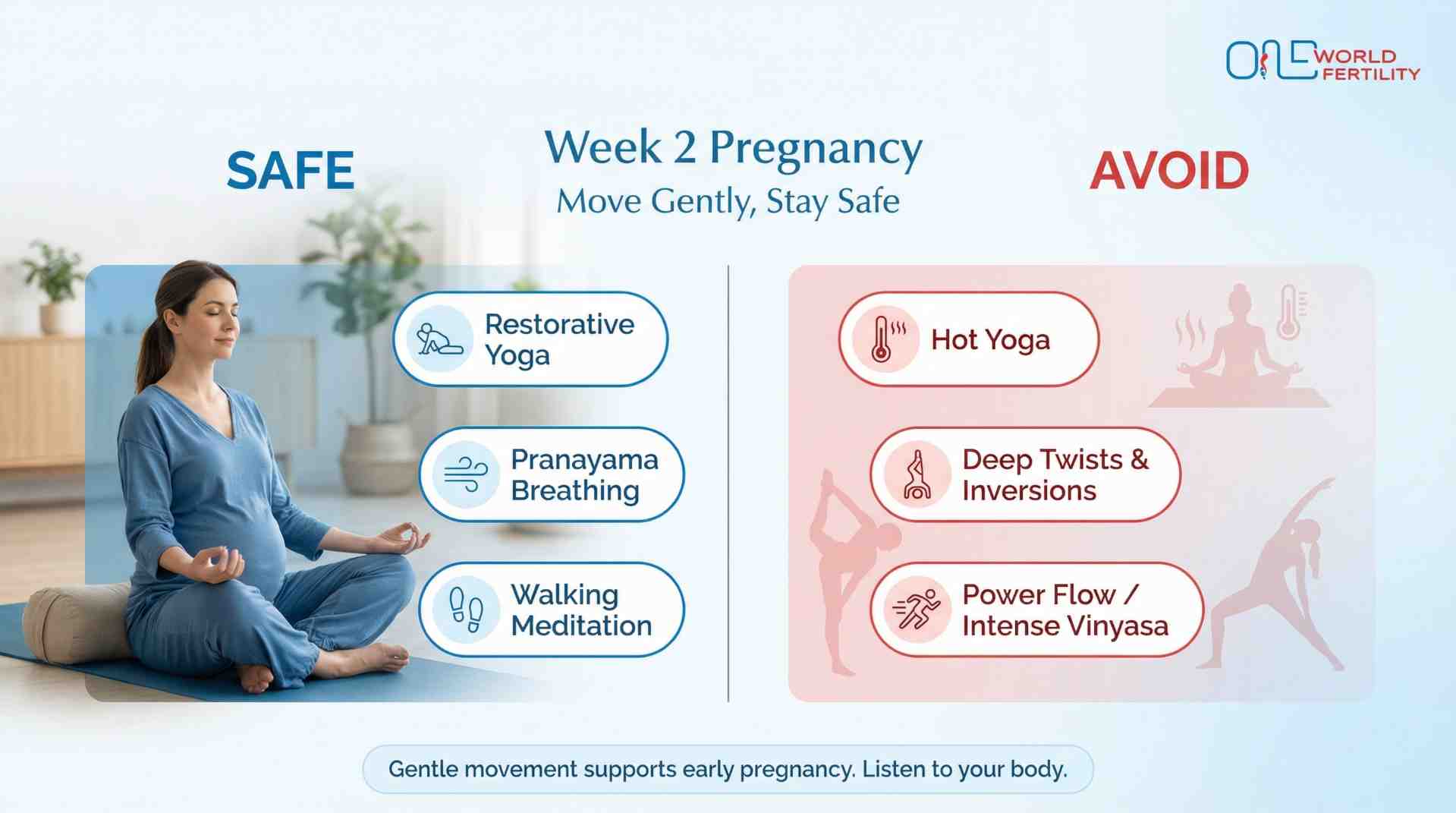
What to avoid during week 2 pregnancy:
- Hot yoga or Bikram - your body temperature rises, which is dangerous in the second week of pregnancy.
- Inversions and deep twists - it puts too much strain on the stomach.
- Power yoga or Vinyasa flow - too hard to do in the second week of pregnancy.
Foods That Support Implantation During Week 2 of Pregnancy
What you consume right now is really important. Here are some things to think about.
The implantation diet for IVF and the week 2 pregnancy nutrition doesn't have to be hard. Just warm, good for you, and anti-inflammatory.
-
Warm Whole Foods: Your body likes warmth in the second week of pregnancy. Soups, stews, cooked veggies, and warm grains are good examples. This is what your uterus needs right now. It's easy to digest, naturally anti-inflammatory, and just what you need.
- Folate-Rich Foods: They include spinach, lentils, broccoli, and avocado. Folate is one of the most important nutrients in the second week of pregnancy because it helps cells expand and your embryo grow.
- Protein-Rich Foods: Eggs, poultry, beans, and tofu are all high in protein. Protein is important for the growth of embryo cells at 2 weeks pregnant, and it also keeps your energy stable during the two-week wait following IVF.
- Healthy Fats: Walnuts, olive oil, and flaxseed are all good sources of healthy fats. These foods help keep your hormones in balance throughout your first two weeks of pregnancy and are a key part of what to eat after embryo transfer IVF.
- Hydration: warm water, coconut water, and herbal teas. Staying hydrated maintains uterine blood flow during week 2 of pregnancy. Swap cold drinks for warm ones; your body will thank you.
- Pineapple Core: You have probably seen this everywhere during the IVF two-week wait. Some people think that bromelain in the centre of a pineapple helps with implantation. There isn't much proof, but it is entirely safe. If it helps you feel like you're doing something during your two weeks of pregnancy, go for it.
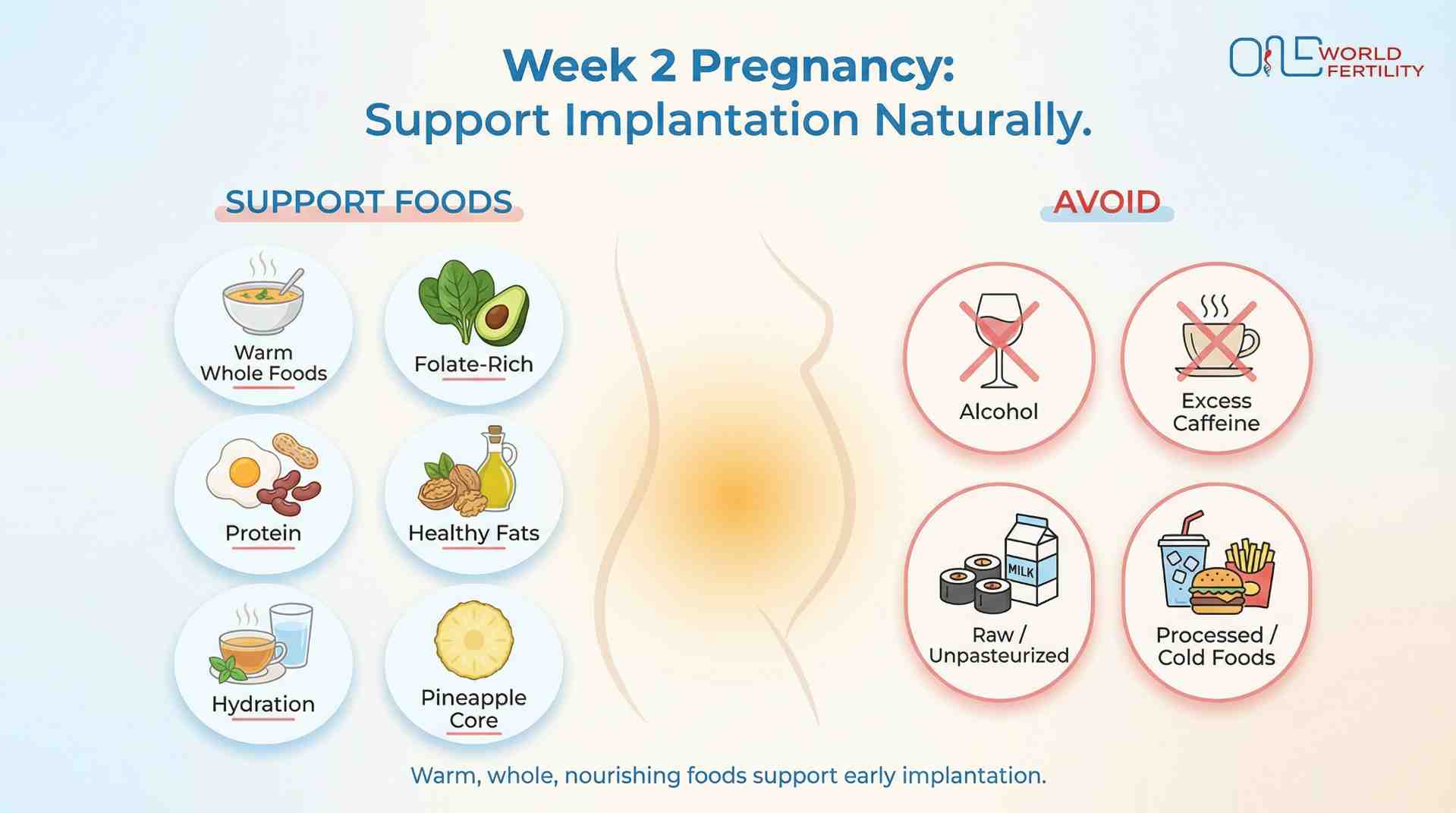
What Not to Eat During Week 2 of Pregnancy -
-
No alcohol at all when you're two weeks pregnant.
- Too much caffeine, only one cup during the second week of pregnancy.
- Eating raw fish and unpasteurized meals can make you sick in the first two weeks of pregnancy.
- Processed and inflammatory foods go against the goals of an implantation diet for IVF.
- No Cold and iced drinks. Warmth is your best friend during week 2 of pregnancy
Tip: There is no single food that will trigger implantation. But taking care of yourself well during the second week of pregnancy gives your body every possible edge, and that's always a good idea.
Week 2 of Pregnancy - Complete Do's and Don'ts Guide
| Category |
Do |
Don't |
Why It Matters |
| Exercise |
Light walking, restorative yoga |
Running, HIIT, heavy lifting |
Protects uterine blood flow |
| Yoga |
Gentle restorative poses, breathwork |
Hot yoga, inversions, power yoga |
Temperature and pressure risks |
| Diet |
Warm wholesome foods, folate, protein |
Alcohol, caffeine, raw fish |
Supports implantation directly |
| Stress |
Meditation, journaling, counselling |
Excessive Googling, symptom comparison |
Cortisol disrupts implantation |
| Sex |
Only with doctor or clinic approval |
Without medical clearance |
Protocol varies per patient |
| Medications |
Take every dose on time |
Skip or delay progesterone |
Critical for pregnancy support |
| Pregnancy Testing |
Wait for official OTD blood test |
Home testing before OTD |
Avoids false results and distress |
| Bathing |
Comfortable warm showers |
Hot baths, saunas, jacuzzis |
High temperature risks embryo |
| Travel |
Short comfortable local trips |
Long-haul flights without approval |
Causes fatigue and dehydration |
| Mental Health |
Lean on support, talk to a counsellor |
Isolate or spiral into anxiety |
Emotional health impacts outcomes |
| Sleep |
7 to 9 hours of restful sleep |
Late nights, irregular sleep |
Regulates pregnancy hormones |
Red Flags - When to Call OneWorld Fertility During IVF Week 2
During the second week of IVF, much of what you feel is very normal. But your body does have a few ways of saying, "Something needs attention right now." Knowing the difference between typical discomfort and a real IVF week 2 warning sign could be more important than you think.
This isn't meant to terrify you. It is here to make sure you always know when to answer the phone.
Red Flag Symptoms That Need Immediate Medical Attention
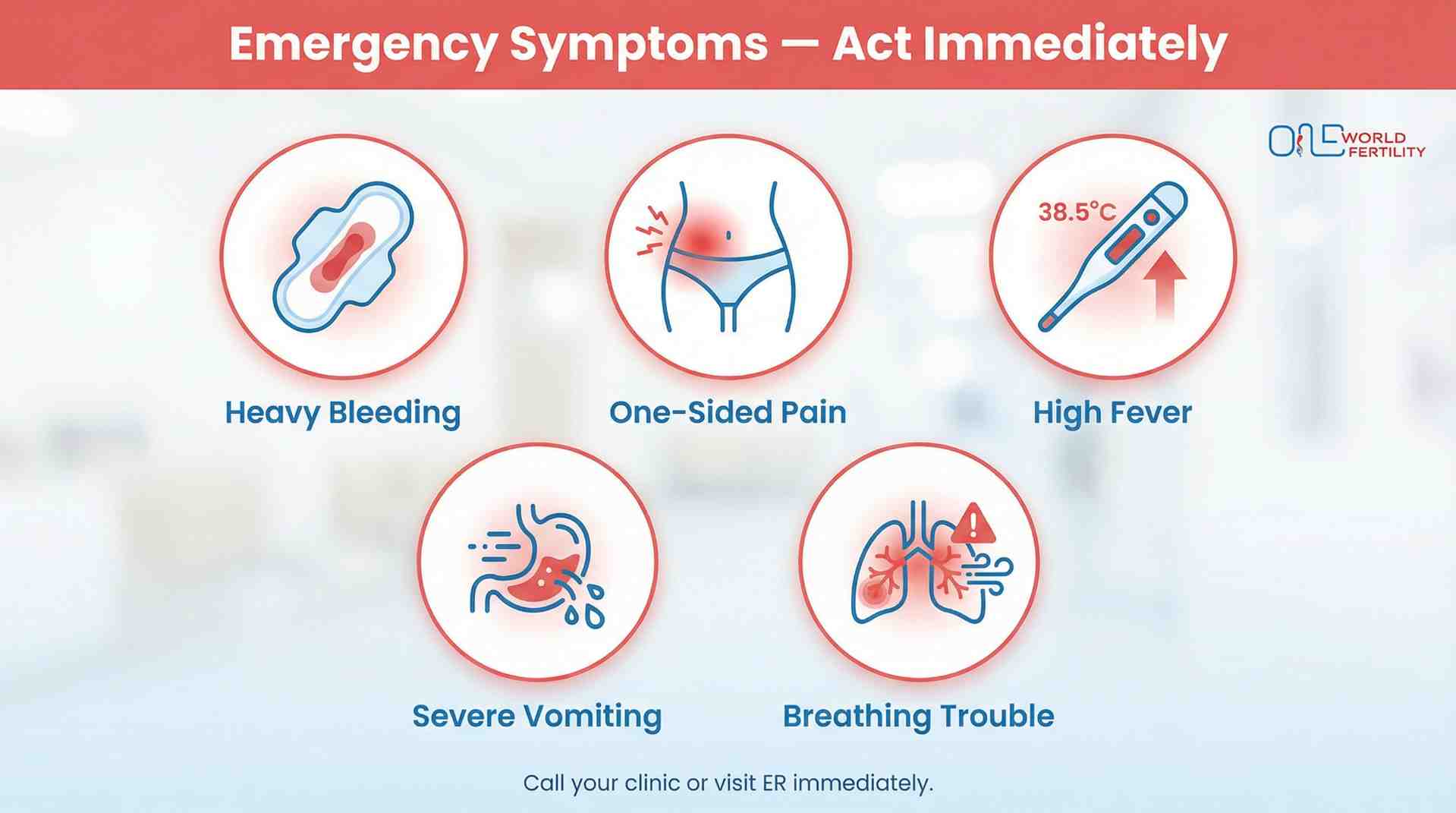
If you have any of the following, don't wait. Call us or go to the emergency room right away.
These are the IVF pregnancy emergency signs at week 2 that are worse than regular TWW pain:
- Heavy bright red bleeding - Light spotting is usual. Bleeding that soaks a pad is not normal. This is not the same as implantation bleeding after IVF and has to be looked at right away.
- One-sided sharp pelvic pain - One of the most crucial symptoms of an emergency after embryo transfer. If you have sharp, one-sided discomfort after an IVF transfer, it could be a sign of an ectopic pregnancy, which is a rare but significant problem that has to be looked at right away.
- High fever with unusual discharge - A fever above 38°C combined with yellow, green or foul-smelling discharge is a sign of possible infection. Call your clinic immediately.
- Severe vomiting - It's typical for a woman who is two weeks pregnant with IVF to feel sick sometimes. Not being able to keep any fluids down is not normal and could mean you have severe OHSS or another problem.
- Extreme shortness of breath - This is a critical OHSS symptom at week 2 of IVF that needs immediate medical attention.
OHSS vs. Normal Bloating - Know the Difference
Most people who are going through IVF week 2 feel bloated. But OHSS ( Ovarian Hyperstimulation Syndrome) feels different, stronger, faster, and harder to ignore.
- Mild OHSS - Extra bloating, mild nausea, slight weight gain. Manageable at home, mention it at your next contact.
- Moderate OHSS - Significant tightness, reduced urination, persistent nausea. Call OneWorld Fertility the same day.
- Severe OHSS - Extreme swelling, difficulty breathing, very little urination. Go directly to the emergency.
At OneWorld Fertility, high-risk patients are proactively monitored throughout the IVF two week wait, because catching ovarian hyperstimulation syndrome after IVF early always leads to better outcomes.
No Symptoms at 2 Weeks After IVF - Should You Worry?
Do you feel nothing, and are you scared? This is yours.
A symptom-free TWW after IVF is completely normal. A lot of women who have no symptoms end up with a fully positive beta result. If you don't feel anything, it just means your body is processing progesterone quietly and effectively, which isn't a failure.
The only thing that tells the real tale is your beta-hCG blood test. Not your symptoms. Not being without them. Just the test of your blood.
You Are Not Alone in This Wait
The IVF week 2 pregnancy journey is unlike anything else. Everybody responds differently; some feel everything, some feel nothing. Both are completely valid. Both are completely normal.
The symptoms, the bloating, and the silence you are feeling right now don't mean anything about what will happen. Only one thing can. Your beta hCG score. OneWorld Fertility will be there for you when that time comes, going over every figure, answering every question, and guiding you through every stage.
You have made it through the hardest wait. That requires more strength than most people would ever know.
Want to know everything about your journey?
Check out our full week-by-week guide:
- What to Expect in Week 1 of IVF Pregnancy
- What to Look Forward to in Week 3 of IVF Pregnancy
Are you ready to move on? You deserve IVF help that feels as personal as your journey. Call OneWorld Fertility today to set up a consultation.
Frequently Asked Questions
It is usually best to stay away from hard lifting, intense workouts, alcohol, and smoking during the second week after embryo transfer. Most of the time, light walking and doing your typical daily tasks are safe. Most crucial, keep taking all of your prescribed drugs, especially progesterone, unless your doctor tells you to stop.
A low initial beta hCG level doesn't signify that the IVF cycle has failed right away. Doctors normally do the blood test again after 48 hours to see if the level is going up as it should. If the hormone level increases at a healthy rate, the pregnancy may still progress normally.
Some symptoms, like moderate cramps and light spotting, are typical, but others need medical treatment. You should call your doctor right away if you have heavy bleeding, severe abdominal pain, intense pelvic discomfort on one side, dizziness, fainting, or a fever.
Some patients choose to take a home pregnancy test in the second week, however testing too soon can give wrong results. There may still be hCG in your system from a trigger shot, which might give a false positive. If you test too soon, on the other side, you can get a false negative since your hormone levels aren't high enough yet. It is usually best to wait for the planned beta blood test.
Depending on whether a Day 3 or Day 5 embryo was transferred, the beta hCG blood test is usually done 9 to 14 days after the transfer. This blood test is more accurate than a home pregnancy test since it tells you exactly how much hCG is in your body.
During the second week, you might see light spotting, especially if it's pink or brown. This could be a sign that the egg has implanted. However, spotting is also prevalent when using vaginal progesterone or when the cervix is sensitive. It's usual to have little spotting, but if you have heavy bleeding like a period, you should talk to your reproductive doctor.
Some people may feel mild cramps in the second week following embryo transfer, although this is not a sure sign of implantation. The uterus naturally reacts to changes in hormones, and progesterone can also make you feel like you're having your period. Most of the time, minor cramps without substantial bleeding are nothing to worry about.
It is perfectly typical to not have any symptoms during the second week following IVF. A lot of women who go on to have healthy pregnancies say they don't feel anything strange during this time. Not having any symptoms doesn't indicate the cycle has failed. Every body reacts differently, and the first few weeks of pregnancy might be extremely small.
Some women have slight cramps, light spotting, sore breasts, tiredness, bloating, or more vaginal discharge in the second week following IVF. But it's vital to know that many of these symptoms are caused by progesterone medicine and not by being pregnant.
The embryo is either implanting into the uterine lining or has already implanted during the second week after the IVF embryo transfer. You might start making hCG (human chorionic gonadotropin), the hormone that shows up in a blood test for pregnancy. Most clinics do the beta hCG test 9 to 14 days after the transfer to make sure the woman is pregnant.