
Why do fertility myths create unnecessary fear
 Written by
One World Fertility
Jan 6, 2026 18 min read
Written by
One World Fertility
Jan 6, 2026 18 min read
Why do fertility myths create unnecessary fear? Learn the facts behind common fertility misconceptions and make informed decisions without panic.

We've all heard them- those whispered "facts" about getting pregnant that sound true but aren't. Myths about fertility can make us worry when we need hope the most.
Here's the problem: hearing that you can't get pregnant after 35 or that worry alone makes it impossible to conceive makes you afraid for no reason. Not only do these myths about infertility spread false information, but they also affect the choices you make about your health and future. There are a lot of pregnancy myths that aren't true that we've held for years. Many common beliefs about pregnancy may complicate the journey instead of supporting it.
We might not get help or lose hope when there's no reason to, when we trust myths more than facts. We could blame ourselves for things that were completely out of our hands. The good news? Getting to the bottom of what's real can help you feel better. What you know not only helps you make better decisions, but it also gives you back the hope that myths try to take away.
What's true and what's just been said so many times that it sounds like it's true?
Understanding Fertility Myths and Misconceptions
To clear up the mess, we must first figure out where it comes from. We'll talk about what pregnancy myths are and how they get so popular, even though they're not true at all.
What Are Fertility Myths and Why Do They Exist?
Fertility myths are those "facts" that everyone says, but they're not really true. They are stories that have been told for generations or that come from old sources. They sound true, but they aren't based in science.Why do they stay? A lot of the time, they come from old wives' tales, generalisations based on a single person's experience, or oversimplified versions of complex medical facts.
The difference between pregnancy myths and facts is obvious when you put them next to each other. It's said, "just relax and it'll happen, and "fertility ends at 30." The truth is that getting older doesn't happen all at once, and relaxing won't fix health problems on its own.
It's easier to deal with fear when you know the truth about myths about infertility and pregnancy. Myth says that women are always to blame for infertility, but the truth is that male and female factors are almost equal. Myths say that eating certain foods will make you pregnant, but the truth is that conception is much more complicated than that.
People have these false beliefs about fertility because it seems strange, and we like to fill in blanks with stories. But those stories hurt more often than they help.
How Misinformation About Fertility Spreads
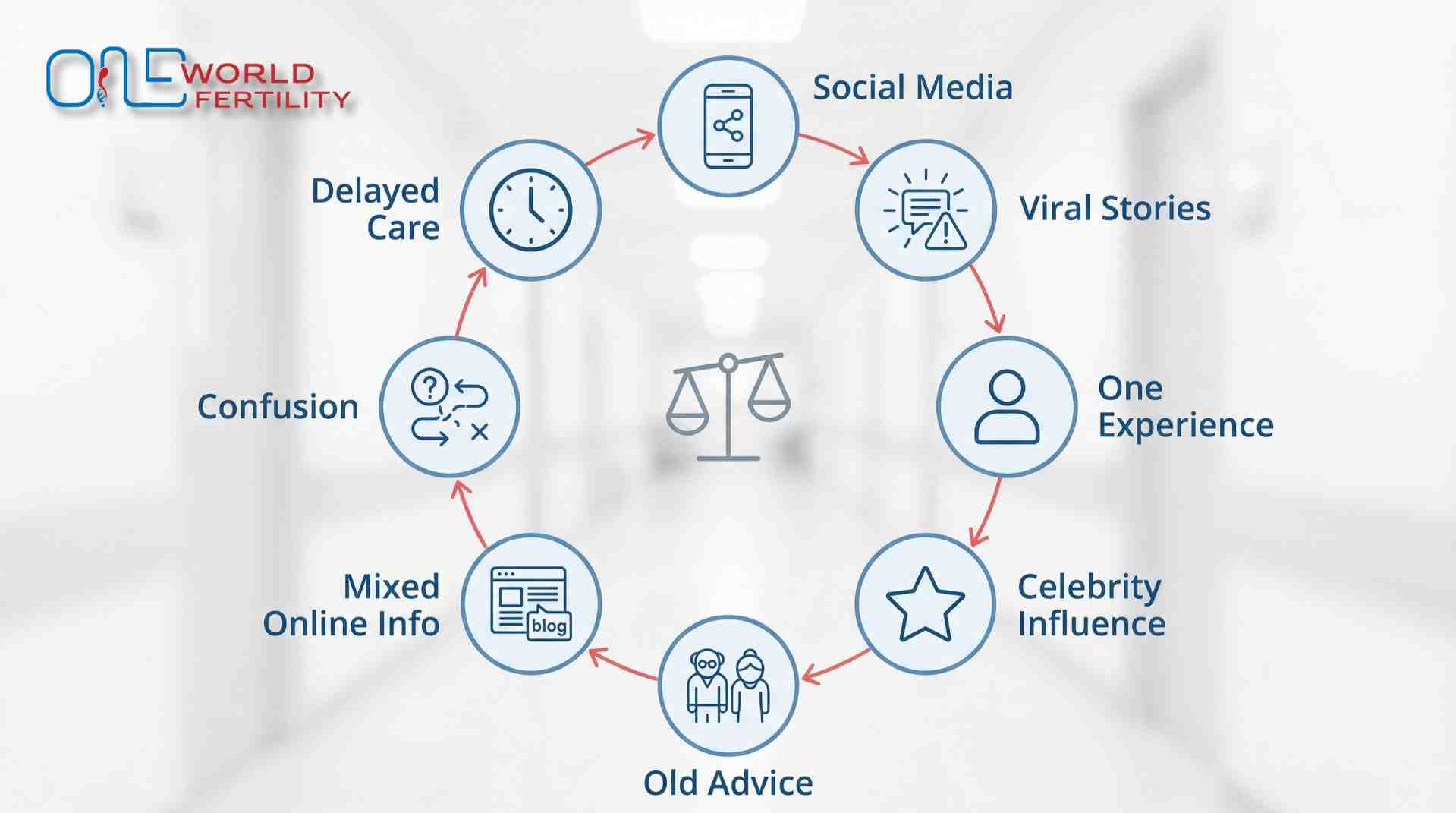
Why lies spread so quickly:
- A scary story is shared thousands of times on social media before anyone checks whether it's true.
- If one person has success with a product or method, it becomes "the answer" for everyone, even if there is no medical proof.
- When famous people talk about their struggles with fertility, other people think that's the only way to get pregnant.
- Relatives keep saying things they heard decades ago, even though science has changed a lot since then.
- There is a lot of mixed messaging online. Blog posts mix facts and myths so that it is hard to tell which is which.
Why this is important:
- Fertility awareness should mean knowing your body, but false information passed off as advice makes it hard to see the big picture.
- People put off seeing a doctor about their infertility because they think they have to try for years before they can get help. This means they miss their best treatment window.
- People who share what worked for them don't realise that it doesn't work for everyone; having good intentions doesn't make false information less hurtful.
How to solve it? If something sounds too easy for something as complicated as conception, you should question it. Just trust medical sources and ask professionals.
Note: This information is only meant to teach you, and it shouldn't be used instead of professional medical advice. There is no one way to get pregnant. If you are worried about getting pregnant or staying pregnant, our experts at One World Fertility can look at your specific situation and give you advice that is specific to your needs.
How Fertility Myths Create Fear and Delay Treatment
People get mad at myths, and they also change how and when they ask for help. Check out how these bad ideas hurt mental health and health in general.
Emotional Impact of Infertility Myths
Some myths about pregnancy are not only false, but they are also bad for your mental health. When someone says you failed as a person because you waited "too long" or didn't stay calm enough, the problem sounds less like a medical one and more like a personal one. People who think these things are to blame for things they can't change. Things are already hard for them, and this could make their mental health worse.
The idea that worry alone keeps people from having children is one of the worst ideas. You're told to stay away from worry, but just thinking about it makes you feel worse. This myth doesn't help you feel better; instead, it makes you feel stressed and guilty, which makes normal emotional reactions think wrong. People who can't have children are also often made fun of or thought to be very strange, which makes them suffer alone. When people have problems, they often don't get help, let alone medical help. This wastes their time and keeps them from getting the mental relief they need.
How Delayed Diagnosis Affects Fertility Outcomes
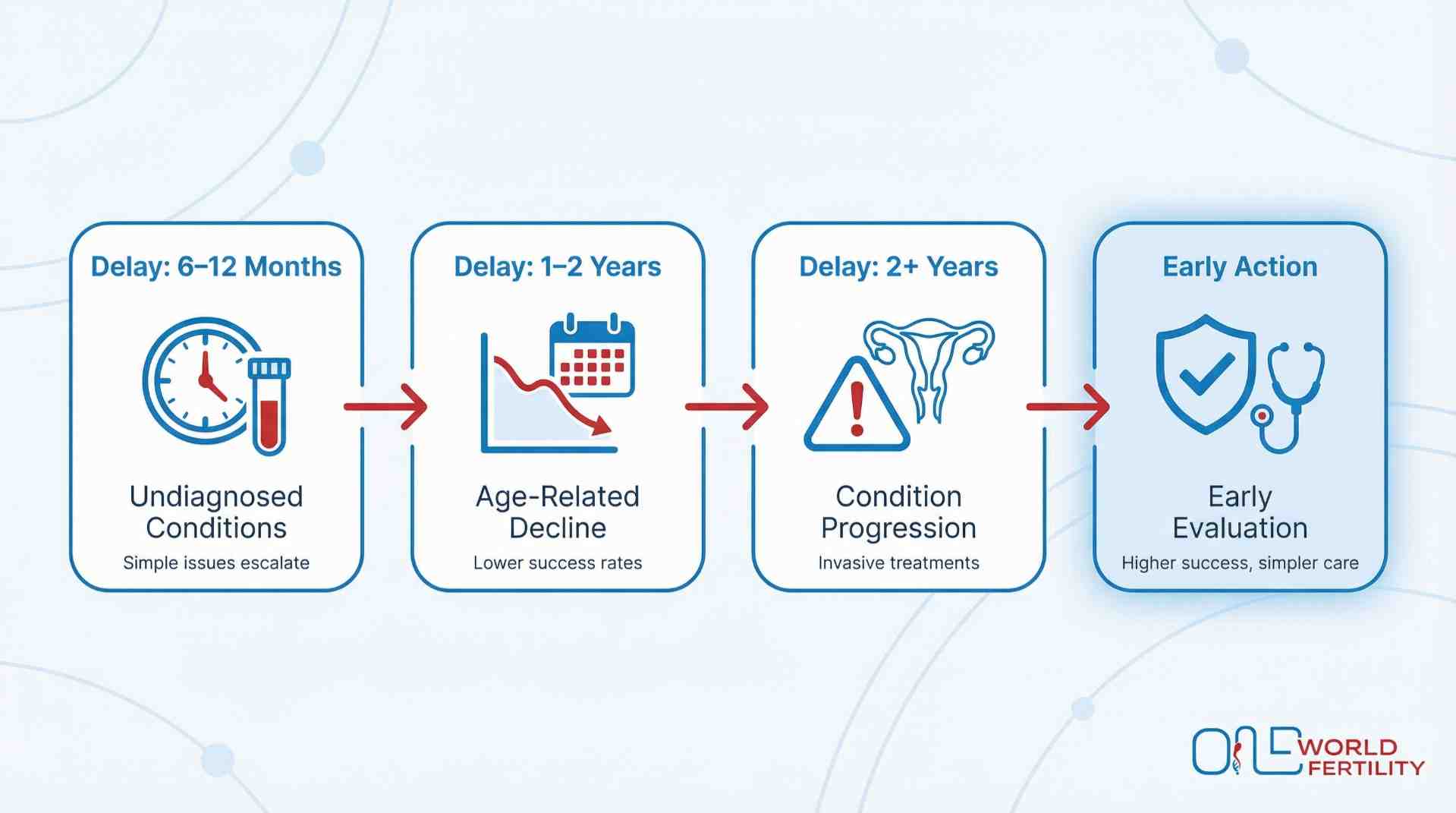
The worst thing about pregnancy myths? They try to get you to wait when you need help right away. You might hear that you should wait years before going to the doctor, but if you're under 35 and it's been a year or over 35 and it's been six months, it's time to get help. No amount of googling signs will help you figure out what causes infertility. You can't find or fix any of these problems on your own. It could be hormonal changes, structural issues, problems with the male factor, or a dozen other things.
It hurts to wait because time is important. Real changes happen with age, and some diseases, like endometriosis, don't just stop getting worse. People who have been stuck in infertility for years and finally decide to get help often find things to be worse than if they had started treatment sooner. There is good news, though. See an expert as soon as possible. They can figure out what's going on and make a plan that works for you. There is a door to answers; you just need to walk through it before myths stop you.
| Delay Period |
What Happens |
Impact |
| 6-12 months |
Treatable conditions undiagnosed |
Simple fixes become complex |
| 1-2 years |
Age-related decline continues |
Lower treatment success rates |
| 2+ years |
Conditions like endometriosis worsen |
More invasive treatments needed |
| Early action |
Quick identification of causes |
Higher success with simpler solutions |
Top 3 Fertility Myths That Create Unnecessary Fear
Let's tackle the biggest myths head-on, the ones that cause the most worry and keep people from understanding what's really happening.
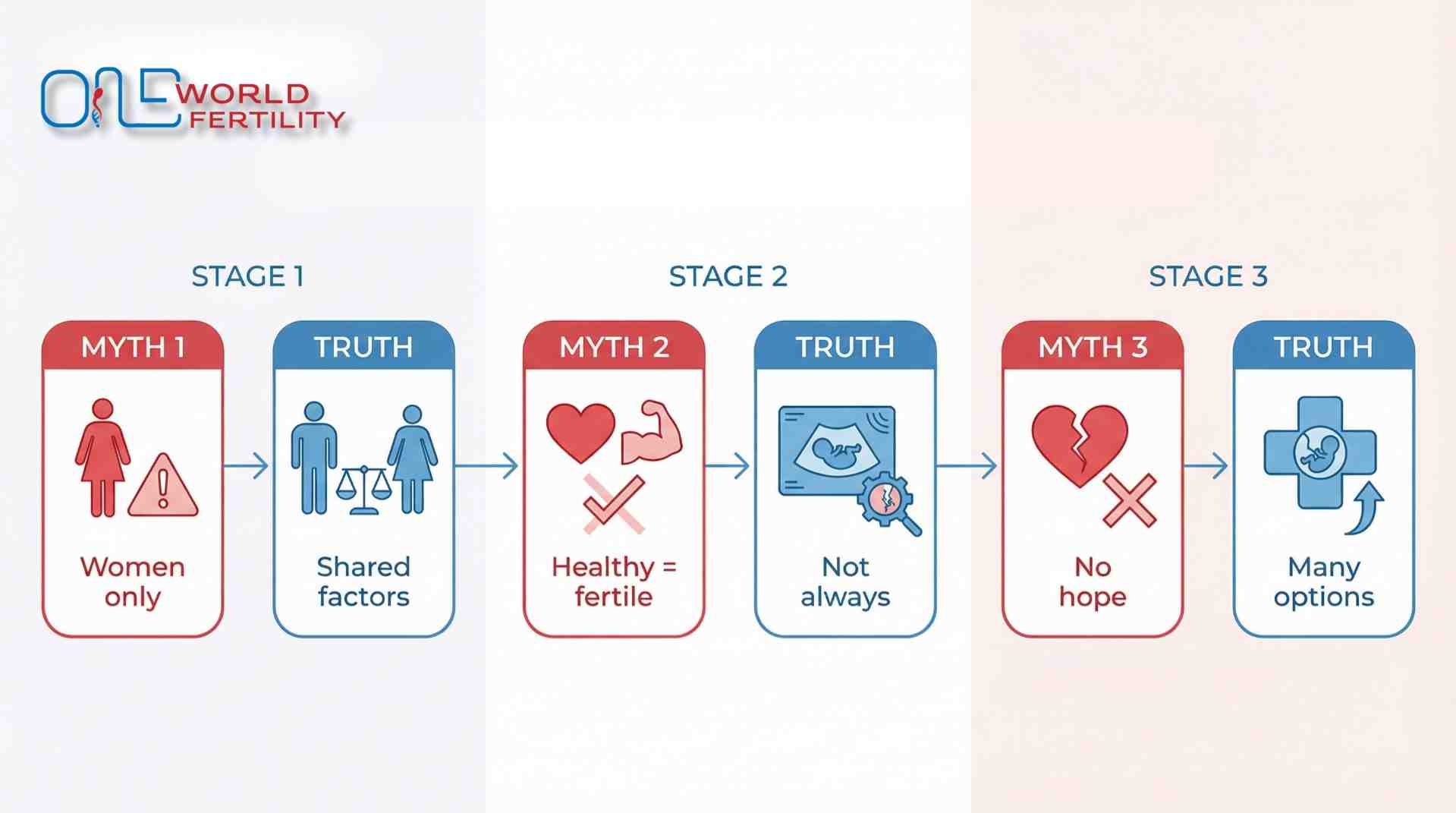
Myth 1 - Infertility Is Always a Woman's Problem
This is totally wrong and very bad for you. Almost the same number of men and women can't have children. About one-third of cases are caused by male factors, one-third by female factors, and one-third by both or factors that can't be explained. But most of the blame is still put on women.
Sperm count and movement problems are common in men who can't have children. Either there aren't enough sperm, or they don't swim well. Infertility caused by DNA damage in sperm can sometimes stop healthy fertilisation. This myth slows down diagnosis because couples don't test their male partners, so they miss treatable diseases. As a medical condition that can cause trouble for anyone, infertility should be checked out by both partners right away.
Myth 2 – Being Healthy Means You'll Conceive Easily
You eat well, work out, and deal with your stress, so being pregnant should be easy, right? Not all the time. Healthy habits can help, but they don't ensure that you will get pregnant. When healthy people have problems, this myth makes them feel like they failed.
Unexplained infertility affects 10-15% of couples; all tests are normal, yet no pregnancy. You could be perfectly healthy and still have blocked fallopian tubes from an old infection or hormonal imbalance, and infertility like PCOS or thyroid issues. Many fertility problems are invisible and have nothing to do with your lifestyle. If you're healthy and struggling, you're not doing anything wrong-you just need medical help to find what's hiding.
Myth 3 – Infertility Means You Can Never Have a Child
This is the scariest myth, and thankfully, it's false. An infertility diagnosis doesn't mean your dream is over-it means you need help getting there. Modern infertility treatment, fertility treatment, and assisted reproductive technology have helped millions of people become parents.
Options range from simple medication to advanced techniques like IVF, donor options, and more. Many people with infertility diagnoses go on to have children, often with less complicated treatment than they feared. An infertility diagnosis is the beginning of finding answers, not the end of hope.
Myth vs Medical Reality
| Myth |
Medical Reality |
| Infertility is the woman's fault |
1/3 male factors, 1/3 female factors, 1/3 both or unexplained |
| Healthy = easy conception |
Hidden conditions affect even healthy people |
| Stress alone causes infertility |
Medical conditions need proper diagnosis, not just stress management |
| Try for years before seeing a doctor |
Get help after 12 months (under 35) or 6 months (over 35) |
| Infertility = no children ever |
Modern treatments help millions with diagnoses become parents |
| Fertility ends at 35 |
Fertility declines gradually; many conceive naturally in late 30s/40s |
Infertility Is Not Just a Woman's Problem
The biggest myth? Infertility is always about the woman. The truth is far more balanced; male and female factors contribute equally to conception challenges.
Female Fertility Issues Explained
Female fertility issues come in many forms. Blocked fallopian tubes are common, caused by past infections, endometriosis, or scar tissue.The frustrating part? You can't feel them, so testing is the only way to know. Hormonal imbalance and infertility go hand in hand. Hormones that cause ovulation and get your body ready for pregnancy can be thrown off by PCOS, thyroid diseases, or cycles that don't go as planned. Even if everything else seems fine, it can be hard to get pregnant when hormones are out of whack.
Other issues include endometriosis, ovulation disorders, uterine abnormalities, or age-related egg quality decline. Each needs a different approach, which is why proper diagnosis matters.
Male Infertility and Sperm Health
About one-third of all cases of infertility are male, but it's talked about a lot less. Sperm count and movement are very important; you need a lot of swimmers who can move quickly. Varicoceles, hormonal imbalances, infections, or changes in living can all cause a low count or trouble moving.
Even if the numbers look fine, sperm DNA damage can make it impossible to get pregnant. The genetic material in sperm could be broken up, which could make fertilization or embryo growth more difficult. Most tests don't always find this.
Male infertility can be treated by making changes to the way a man lives, taking medicine, having surgery, using hormone therapy, or using more advanced methods like ICSI, which can work even with very low sperm counts. A quick test can help you start treatment before time becomes a bigger problem.
Causes of Infertility in Men and Women
| Female Factors |
Male Factors |
| Hormonal imbalances (PCOS, thyroid) |
Poor sperm motility |
| Endometriosis |
Sperm DNA damage |
| Ovulation disorders |
Varicoceles (enlarged veins) |
| Uterine abnormalities |
Hormonal imbalances |
| Age-related egg decline |
Infections or blockages |
Combined/Unexplained: 30-40% involve both partners or remain unexplained
Age and Fertility – Myths vs Medical Facts
Age is one of the most talked-about fertility factors, but also one of the most misunderstood. Let's separate myths from reality.
How Age Affects Women's Fertility
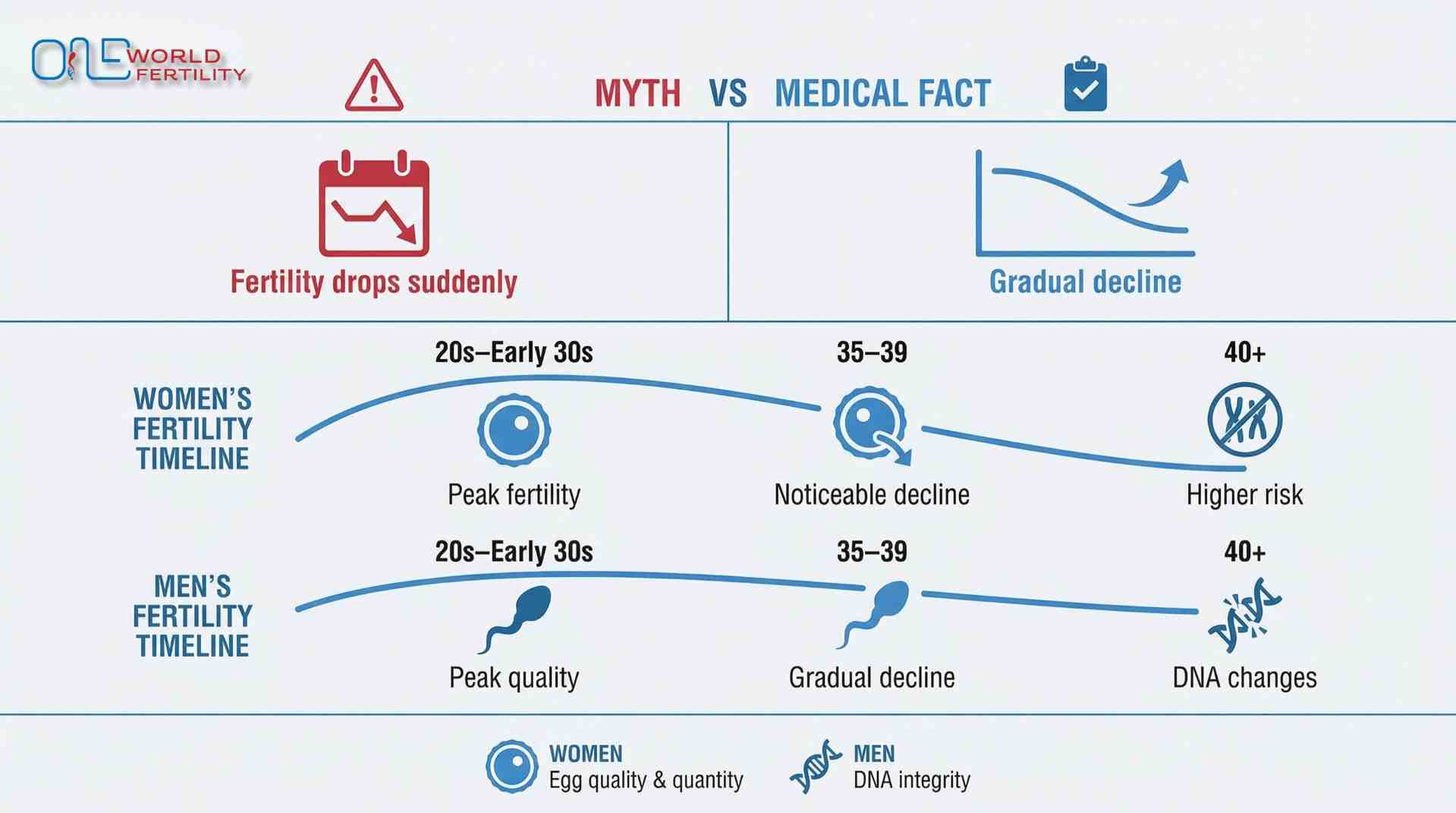
The myth says fertility drops off a cliff at 30 or 35. What is real? Fertility slowly decreases with age, not suddenly.
What really happens as people age and become fertile:
- You are born with all the eggs you will ever have. Over time, both the number and quality of your eggs normally decrease.
- When you're in your 20s or early 30s, you have the best chances of getting pregnant and having healthy eggs.
- The drop is more obvious after age 35, not because age 35 is magical, but because the pace speeds up.
- By age 40, getting pregnant is harder, but many people still get pregnant naturally.
- Older eggs are more likely to have genetic problems, which can make it harder to get pregnant or have a baby.
This doesn't mean that you can't get pregnant; it just changes the odds, and if you're having trouble, you might benefit from getting medical help sooner.
How Age Affects Men's Fertility
The myth: male fertility doesn't decline with age. Wrong. While men produce sperm throughout life, male fertility decline with age is real, just less dramatic than women's.
As men age, sperm count decreases, motility slows, and sperm DNA damage increases, making infertility more common. Some genetic conditions are a little more likely to happen in children whose dads are older. The drop is not as fast as the drop in female fertility, but it is still happening. Men in their 40s and older can have children, but the ages of both partners are important for a pregnancy to succeed.
Age and Fertility Impact
| Age Range |
Women's Fertility |
Men's Fertility |
| 20s-Early 30s |
Peak fertility, highest egg quality |
Peak sperm quality and production |
| 35-39 |
Noticeable decline, lower egg reserve |
Gradual decline, slight DNA damage |
| 40+ |
Significant decline, higher risks |
Continued decline, DNA fragmentation |
| Key Impact |
Egg quantity/quality decrease steadily |
Sperm quality/DNA integrity decline slowly |
Can Healthy People Still Face Infertility?
When you know the truth, you can stop feeling guilty for no reason. Healthy habits and fitness are important, but they don't control every aspect of reproduction. Many fertility challenges exist beneath the surface, completely independent of how well you take care of yourself.
Why Physical Fitness Does Not Guarantee Fertility
Everything you do is "right"- you eat well, work out, and keep a healthy weight. So why aren't you pregnant? The truth is that being fit can help you get pregnant, but it doesn't ensure it. Many pregnancy problems can't be seen and have nothing to do with how you live your life.
Unknown infertility affects 10 to 15 per cent of couples. Even though she has a healthy weight, regular cycles, good sperm, and clear tubes, she still can't get pregnant. This shows that fertility depends on more than just living a good life. An infertility diagnosis often shows problems that aren't obvious, like endometriosis that doesn't cause any symptoms, hormonal imbalances that don't affect daily health but make it hard to get pregnant, or genetic and immune factors that you can't see.
PCOS can happen to people who run marathons. A yoga teacher can have clogged tubes. Hormonal changes can happen even if you eat perfectly. You're not failing if you're healthy and having a hard time. You don't need more push to be "healthier." What you need is a medical exam to find out what's really going on. If you're having a hard time during pregnancy even though you're healthy, don't blame yourself.
IVF and Multiple Pregnancy Myths
Many myths about IVF can make people worry or expect too much. Let's get rid of one of the biggest myths:
Does IVF Always Lead to Twins?
Everyone thinks that having multiples is natural after hearing that someone has twins through IVF. But the IVF multiple pregnancy myth doesn't match up with reality these days, and thinking it can make you feel bad when you're already feeling down.
This used to be somewhat true. Doctors transferred more than one embryo to increase the chances of success, which often resulted in twins or triplets. Things are different now. These days, most people use single-cell transfer because it is safer for both you and your baby.
Quality is more important than quantity in modern IVF. Genetic tests and advanced embryo selection help doctors select the healthiest embryo and transfer only one. This has high success rates without the risks of multiples, like having babies early or with low birth weight, which are problems you'd rather avoid.
IVF: Is it still possible to have twins? If two embryos are moved, or very rarely if one splits on its own, the answer is yes. But it's no longer a sure thing or even the goal. Your doctor will choose based on your age, the health of the egg, and what gives you the best chance of having a healthy baby.
No matter what, the hope is for a healthy baby. That's more valuable than any multiples lie.
When Should Couples Seek Fertility Help?
A question that comes up a lot is "How long should we try before we get help?" The answer is different for each person, but if you wait too long, you might lose valuable time.
How Long to Try Before Infertility Treatment
Some people think you need to struggle for years before seeking medical advice. The truth? How long you should try depends on your age, and delaying help can actually make your situation more challenging to address. What doctors say should be done:
- Under 35: If you have tried for a year and failed, you should get help.
- 35 or more: Six months is too long.
- Over 40: Take a look at coaching after just three to four months.
Why is there a change in age? As people age, their fertility normally decreases, especially after age 35. As you age, each month becomes more important, and problems that can be treated can get harder to handle if they are not taken care of.
When to see a fertility specialist sooner, regardless of how long you've tried:
- Irregular or absent periods - Your cycle isn't predictable or doesn't happen at all
- Known reproductive conditions - Already diagnosed with PCOS, endometriosis, or similar issues
- Past pelvic infections or surgeries - Previous medical history affecting reproductive organs
- Painful periods - Severe menstrual pain that interferes with daily life
- Partner's known fertility concerns - History of low sperm count or testicular issues
- Previous reproductive health problems - Any past diagnosis affecting either partner's fertility
Myths about "giving it more time" should not keep you from getting answers. It's not giving up to get help; it's taking charge. A fertility expert can find problems early, when they're easier to treat, give you answers instead of leaving you guessing for months, and make a plan that works for you. You have more choices if you know what you're up against faster. You can't get back time, so make the most of it.
Why See One Early?
You might feel like you have more time if you wait to get help, but when it comes to pregnancy, acting quickly often leads to better results. It can really help to talk to an expert as soon as possible for these reasons:
- Fertility Drop: Female fertility drops noticeably after age 35, so getting help early makes it more likely that you will be successful.
- Diagnoses: Fertility experts can check your hormone levels, ovarian reserve, and semen to find problems like blocked fallopian tubes or male infertility that you might not be able to see on your own.
- Treatment Options: They can offer solutions tailored to your needs, from simple lifestyle changes to more advanced procedures like IVF. This gives you more ways to move forward.
Final Thoughts: Moving Forward with Facts, Not Fear
Myths about fertility have already taken away too much: time, hope, and peace of mind.That changes when you know the truth. Men and women can both have infertility. Being healthy doesn't always mean it will be easy to get pregnant. Age does matter, but it's not a dead end. A diagnosis is not the end of the trip; it's the start of clarity.
Myths won't tell you when it's "time" to get help. If you've been trying for a while but haven't been successful or just feel nervous, the specialists at One World Fertility are here to help you with their medical knowledge, kindness, and care that is tailored to your needs, not old ideas. You deserve facts, help, and quick action on your path to fertility. Every month is important, and having correct information can open doors that might have closed otherwise.Having trouble getting pregnant doesn't mean you've failed; it means you need help, and you can get it when you're ready.
Disclaimer: This information is only meant to teach and should not be used instead of professional medical advice. There is no one way to get pregnant. Talk to a qualified fertility expert for personalised advice.