
Your Canada IVF Journey: True Costs, Real Success Rates & What to Expect
 Written by
One World Fertility
Sep 8, 2026 19 min read 28 sections
Written by
One World Fertility
Sep 8, 2026 19 min read 28 sections
Discover IVF cost in Canada, provincial funding options, medication expenses, and success rates before starting treatment.
It takes a lot of courage and confidence to take the first step toward IVF. It's easy to feel lost before you even start, given the ups and downs of your emotions and the never-ending questions about money. So many people searching for answers about IVF in Canada run into the same wall: it's hard to understand how much it costs, each province has its own rules, and funding options aren't explained in plain English. In Canada, how much does IVF cost, and does any of it get paid for? - That's what most families really want to know.
Ontario gets money from the government, but what does that mean for you? The truth is that Canada has some of the most reputable fertility clinics in the world. Families from all over the world come to these clinics for care because they are so good. This guide is there to tell you the truth, the whole time. There are different ways to pay for IVF in Canada, success numbers for IVF in Canada based on age, what the process looks like, and how to choose the best fertility clinic in Canada for your stage of life.
IVF Cost in Canada - What You'll Actually Pay
Let's get one thing straight: there is no set price for IVF in Canada. It depends on where you live, if you can get help from the government, and which treatments are part of your plan. That's stressful, so here's a clear breakdown to help you make plans.
Many people pay between $8,000 and $15,000 for a private IVF cycle. That's before the drugs, which cost an extra $3,000 to $6,000. It costs between $2,000 and $4,000 to move a frozen embryo. If you use donor eggs, the price can range from $15,000 to $30,000 or more. If you know ahead of time how much IVF costs in Canada, you can make plans without being surprised by the cost at the last minute.
How much does IVF cost in Canada? Can I really afford it? This is the question that most families quietly ask themselves. - needs a real answer. It is possible to get IVF in Canada at a low cost, especially when you combine government support, tax credits, and insurance benefits. More on that after this.
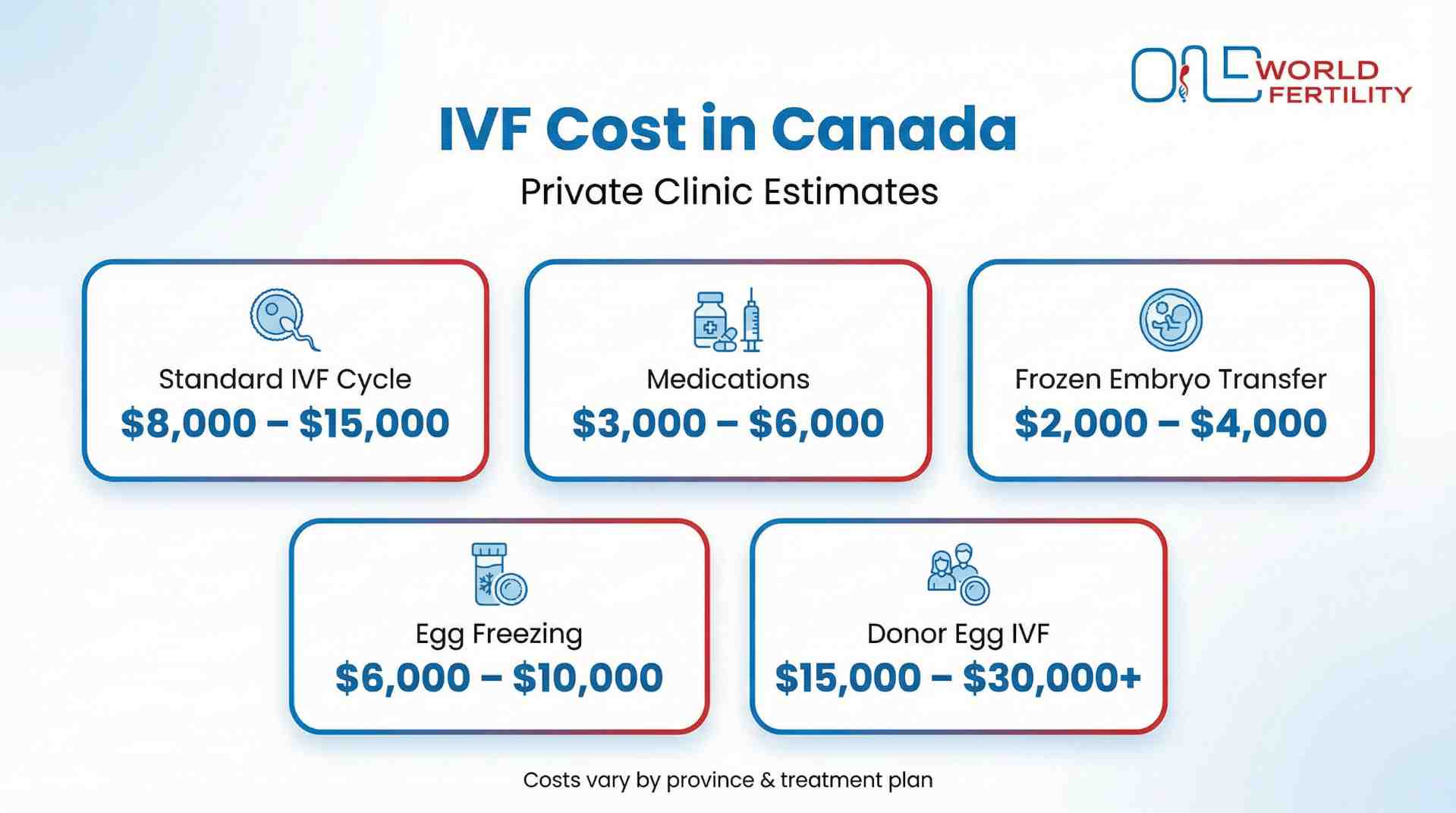
IVF Cost Breakdown in Canada
| Component |
Estimated Cost (Private Clinics) |
| Standard IVF Cycle |
$8,000 – $15,000 |
| IVF Medications |
$3,000 – $6,000 |
| Frozen Embryo Transfer (FET) |
$2,000 – $4,000 |
| Egg Freezing |
$6,000 – $10,000 |
| Donor Egg IVF |
$15,000 – $30,000+ |
Is IVF Covered in Canada?
It's important to clear up this misunderstanding: IVF in Canada is not completely free. There is public funding, but it only covers certain prices in certain provinces, and it's important to read the fine print. Through its fertility program, Ontario pays for one IVF cycle. This means that the process itself is covered, but the medications are still not.
Waitlists can last anywhere from 6 to 18 months, so it's really important to sign up early. Medication costs may be partially covered by private insurance, and Quebec now gives some tax credits to help with the cost.
Government-funded IVF in Canada is a lifeline for many families. But planning for the gaps, especially when it comes to medication costs, will keep you from getting unpleasant shocks during treatment.
British Columbia - Income-Based IVF Grant Program
What BC does is different from what Ontario does. BC doesn't give everyone the same amount of money per cycle; instead, it uses a sliding-scale grant plan, which means you get more help the less you earn. This system is really well thought out, making affordable IVF in Canada feel more accessible for families with limited means.
BC Income-Based IVF Funding Grant
| Combined Household Income (Pre-Tax) |
Government Grant |
| $0 – $100,000 |
$19,000 (Full Coverage) |
| $100,001 – $150,000 |
$14,250 |
| $150,001 – $200,000 |
$9,500 |
| $200,001 – $250,000 |
$4,750 |
| $250,001+ |
Not Eligible |
Eligibility Notes:
- You can't be older than 41 when you transfer the egg.
- Must talk to a doctor who is taking part
- Doesn't cover fees for donor purchases or egg freezing
Ontario - Fertility Program & Tax Credit Breakdown
Over the past few years, Ontario's fertility support has grown significantly. More and more clinics across the state are now participating in the Ontario Fertility Program (OFP). These clinics include Pollin Fertility, Twig Fertility, Tripod Fertility, and Generation Fertility (formerly ReproMed). This makes it easier for families in the GTA and beyond to get help. Every family in Ontario should know about both the funding cycle and the tax credit.
Ontario Fertility Treatment Tax Credit (OFTTC)
| Feature |
Details |
| Refund Rate |
25% of eligible expenses |
| Max Annual Claim |
$20,000 |
| Max Cash Back |
$5,000 |
| Covered Expenses |
IVF, IUI, Medications, Travel (>40 km), Genetic Testing |
This is a refundable credit - meaning even if you owe no taxes, you can still receive the cash back. Keep every medication receipt, and note that travel beyond 40km to your clinic is eligible too.
How to Claim
- Form ON428 - Medical Expense Tax Credit
- Form ON479 - Fertility-specific expenses
The Private Insurance Shortcut - Check Your Employee Benefits
Check your workplace benefits before thinking you'll have to pay for everything yourself. You may be eligible for help you didn't know about. A lot of employers, especially in the tech and banking industries, now offer fertility-specific HSA or HRA accounts that can really help you save money on IVF in Canada. Medication coverage is what most plans offer, but some now also cover egg freezing, genetic tests, and embryo storage. A quick call to your HR department or benefits provider could save you a lot of money. That's worth your five minutes.
IVF Success Rates in Canada - Your Real Chances
The most important thing to know right away is that age isn't the only factor that can tell you whether IVF will work. Another important thing to know is that the pregnancy rate (a positive test) and the live birth rate (a baby in your arms) are not the same thing. Always ask centres what their live birth rate is; that's the important number.
Also, one cycle rarely shows the whole story. When you look at Canada's IVF success rates over two to three cycles, which is what most doctors think is a possible path, things look a lot better.
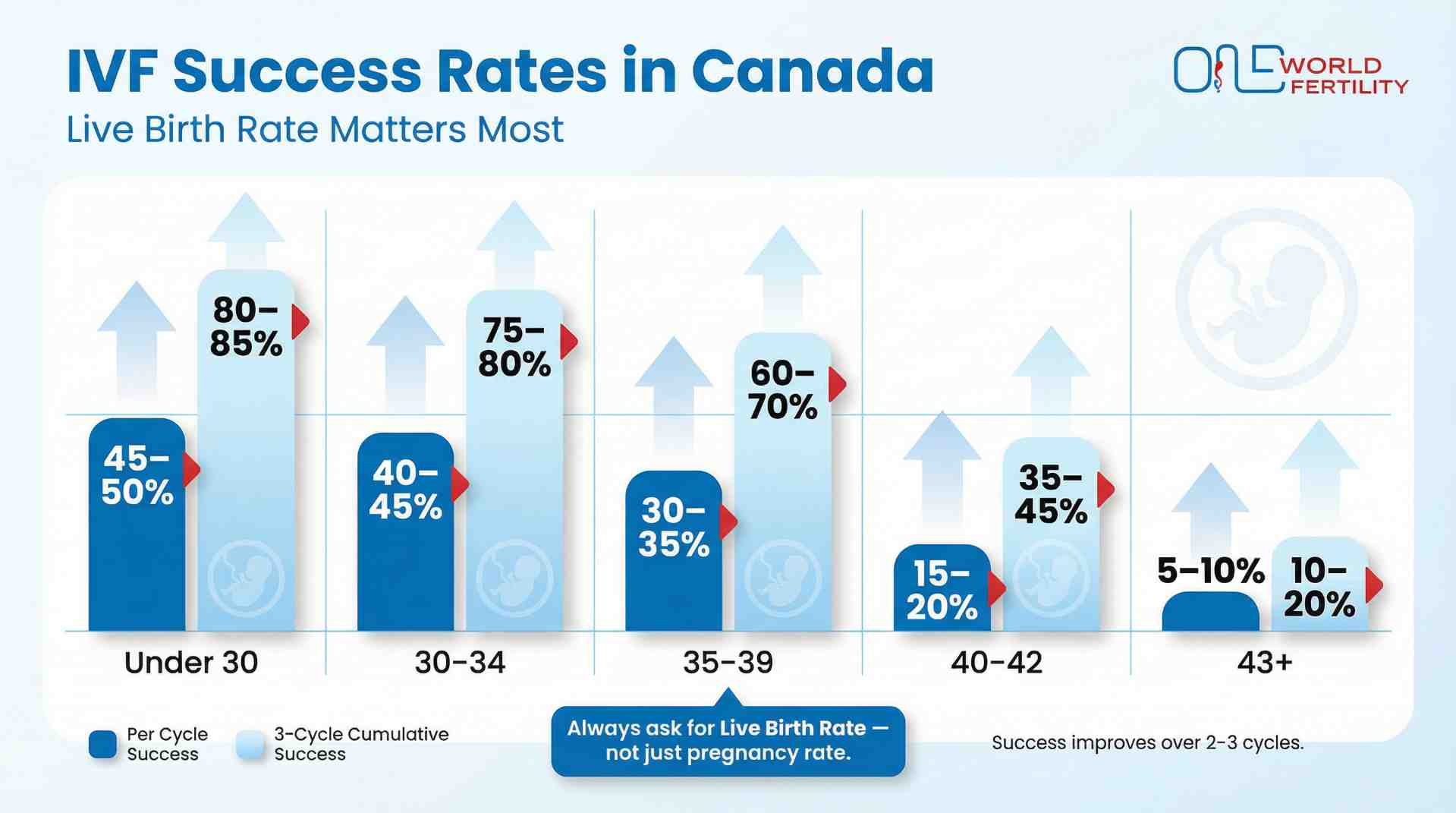
Canada IVF Success Rate by Age
| Age |
Live Birth Per Cycle |
After 3 Cycles (Cumulative) |
| Under 30 |
45–50% |
80–85% |
| 30–34 |
40–45% |
75–80% |
| 35–39 |
30–35% |
60–70% |
| 40–42 |
15–20% |
35–45% |
| 43+ |
5–10% |
10–20% |
If your first cycle doesn't succeed, that is not failure - it's information your doctor will use to do better next time.
What Impacts IVF Success in Canada?
Your result depends on several things, and many of them are things that your care team can help you with:
- Ovarian reserve: determines how many eggs can be retrieved
- Embryo quality: How many of the recovered eggs can be transferred?
- Sperm health: equally important, but not given enough credit
- Uterine health: changes the success of implantation.
- Lifestyle: Sleep, food, worry, and weight all play a small part.
- Lab quality: Canada's strict rules and high standards for fertility labs really make a difference here.
- Previous IVF history: Your doctor can use information from each cycle to develop a better plan for the next cycle.
Medical Disclaimer: The success rates and information shared in this section are based on general population data and publicly available clinical statistics. They are intended for informational purposes only and do not constitute medical advice. Every fertility journey is unique - individual outcomes depend on personal health factors that only your fertility specialist can assess. Please consult a licensed fertility doctor before making any treatment decisions.
Advanced IVF Technology in Canada - What's Changing?
Not only do Canada's fertility clinics meet world standards, but many of them are also changing the way IVF is done today. Right now, when you start your trip, reproductive medicine is really at its most exciting.
AI-Powered Embryo Selection - Cost in Canada
AI-powered embryo selection is one of the most important new technologies, and it's already offered at some of Canada's best fertility clinics. A time-lapse video keeps an eye on the embryo's growth in the incubator without disturbing it, and AI analysis thousands of data points from that footage, such as when cells divide, how they move, and how they grow. The method then predicts implantation potential and ranks embryos much more accurately than just looking at them. This means that your doctor will transfer the embryo that has the best chance of succeeding instead of just guessing.
Couples often ask, "How much does AI embryo selection cost in Canada?" The answer varies by clinic and the technology used, but it usually costs an extra $500 to $1,500 on top of a standard IVF procedure. The extra level of accuracy it brings is thought to be well worth the cost by many families who have had cycles fail.
| Technology |
Estimated Cost (Add-On) |
| AI-Powered Embryo Selection |
$500 – $1,500 |
| Non-Invasive Genetic Testing(niPGT-A) |
$1,500 – $3,000 |
| ICSI |
$1,000 – $1,500 |
| Assisted Hatching |
$500 – $1,500 |
Non-Invasive Genetic Testing (niPGT-A) - Cost in Canada
niPGT-A screens embryo health by analysing the culture fluid the embryo naturally sheds - no biopsy, no physical contact with the embryo itself. That's what makes it different. When families ask "how much does niPGT-A cost in Canada?" - expect to pay between $1,500 and $3,000 depending on the clinic and number of embryos tested. It's typically recommended when:
- There's a history of recurrent miscarriage
- Previous IVF cycles failed without a clear reason
- A chromosomal condition runs in the family
- Older maternal age increases chromosomal risk
- Multiple embryos are available and the strongest transfer candidate needs identifying
niPGT-A adoption is growing steadily across Canadian fertility clinics as evidence builds and availability expands. Most private clinics offer it as an add-on, priced comparably to traditional PGT-A - but with meaningfully less stress on the embryo. For families who've been through failed cycles, that combination of precision and gentleness makes it a conversation well worth having with your specialist before your next transfer.
ICSI (Intracytoplasmic Sperm Injection) - Cost in Canada
What ICSI really means is putting one healthy sperm into each egg. That's it. A normal IVF cycle costs about $1,000 to $1,500 more with ICSI. This is what couples ask when they want to know "how much does ICSI cost in Canada?" ICSI is likely to be needed if:
- There are not many sperm in his body (fewer than 5 million).
- Sperm movement or form isn't right.
- A past IVF cycle did not work or did not result in good fertilisation.
- Using frozen sperm after having a vasectomy or treatment for cancer
- Not many eggs were found, and fertilisation can't just happen by chance.
In Canada, the success rate for ICSI is very similar to that of regular IVF when it is used for the right reasons: 40–50% live birth rate for women under 35, with rates changing with age. Most private fertility clinics in Toronto, Vancouver, and Calgary charge extra for ICSI. However, some deals include it right from the start. Make sure you know what's in your treatment plan before you sign it.
Assisted Hatching - Cost in Canada
Think of assisted hatching as giving your embryo a gentle head start. Before implanting, an embryo needs to break free from its outer shell - but sometimes that shell is too thick, particularly in frozen embryos or older patients. The lab carefully opens it just enough to help. In Canada, this add-on costs between $500 and $1,500, depending on your clinic and province. It's not for everyone - but when it's right for you, it can make a real difference at the most important moment of your entire cycle.
Step-by-Step IVF Process in Canada
When you know what's coming up, the whole journey seems less scary. From your first appointment to your pregnancy test, a normal IVF cycle in Canada lasts 4 to 6 weeks. This is what that looks like.
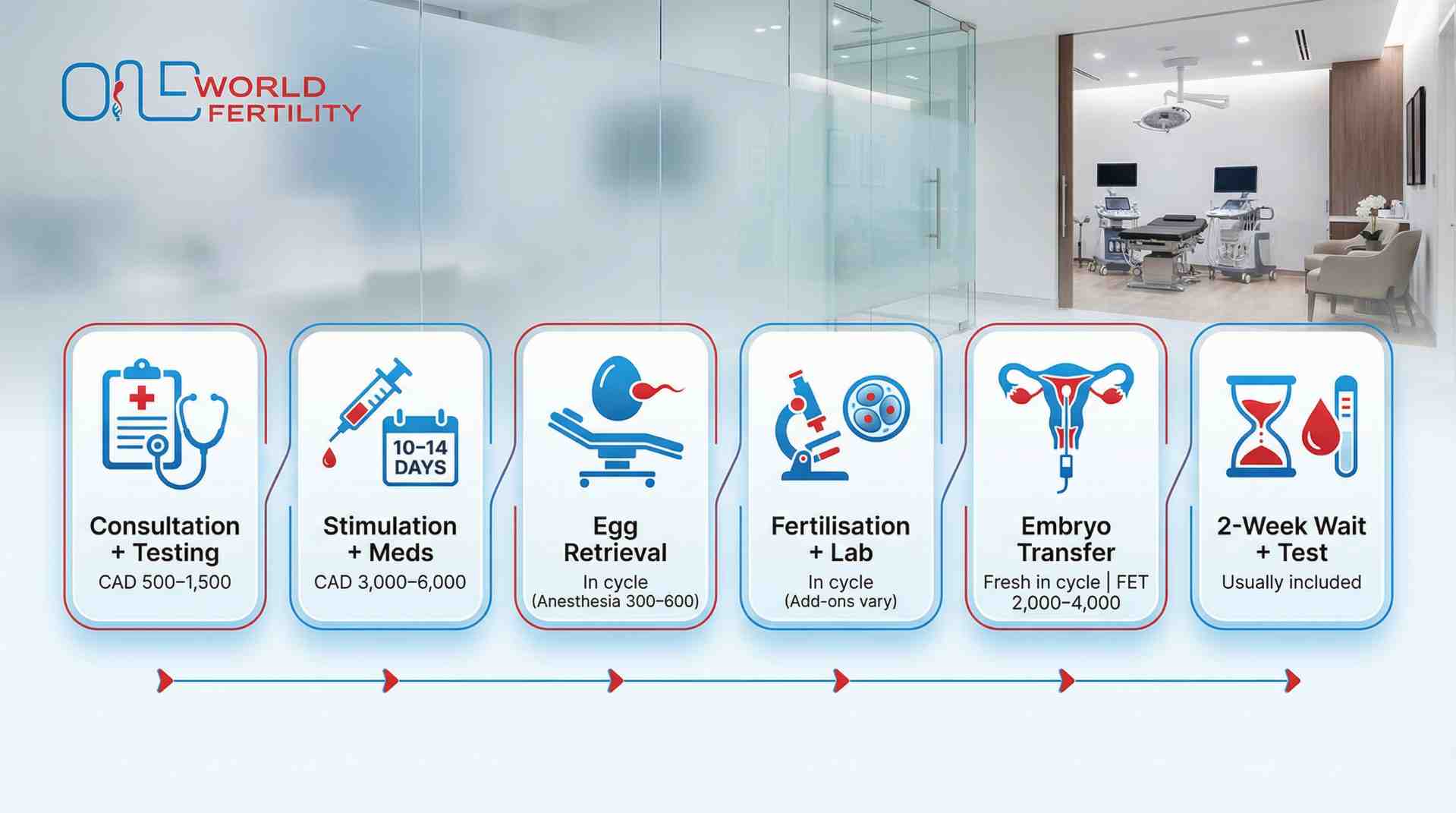
Phase 1 - IVF Consultation & Fertility Testing Cost in Canada
This is the start of everything. Using blood tests, ultrasounds, and a full pregnancy check for both partners, your doctor can make a treatment plan that is just right for you. At private clinics, initial consultations and diagnostic tests usually cost between $500 and $1,500. However, many of these tests are covered by provincial health plans for eligible individuals.
Phase 2 - Ovarian Stimulation & Medication Costs in Canada
Hormone shots every day for 10 to 14 days will help your ovaries make more than one egg, and you will have regular checkups to see how your body is responding. Medications alone cost $3,000 to $6,000 and are not covered by most provincial public funding programs, including Ontario's. This is often the highest out-of-pocket cost in the whole process. It's a good idea to check your private insurance benefits early on to see if they can help in this case.
Phase 3 - Egg Retrieval Procedure Cost in Canada
Egg retrieval is a simple process that can be done during the day with only light sedation. Soon after getting out of the hospital, most people go home and rest for one to two days. In Canada, egg retrieval is usually included in the standard IVF cycle price range of $8,000 to $15,000. However, based on the clinic, anesthesia fees of $300 to $600 may be charged separately.
Phase 4 - Embryo Fertilisation & Lab Culture Cost in Canada
This phase happens entirely in the lab over 5 to 6 days. Your eggs are fertilised - through standard IVF or ICSI - and embryos are carefully monitored as they develop. Lab and culture fees are generally included in your base IVF cycle cost, though add-ons like ICSI ($1,000–$1,500) or embryo freezing ($500-$1,000) will be charged separately if required.
Phase 5 - Embryo Transfer Cost in Canada
Embryo transfer is a simple, quick procedure - no sedation needed for most patients - where the best-quality embryo is placed into the uterus. A fresh embryo transfer is typically included in your cycle cost, while a frozen embryo transfer (FET) runs an additional $2,000 to $4,000 if needed in a later cycle.
Phase 6 - The Two-Week Wait & Pregnancy Test in Canada
Honestly, this is the hardest part of the entire journey - and no amount of preparation makes it easy. A blood test 14 days after transfer confirms whether the cycle has worked. Pregnancy confirmation testing is usually covered within your cycle package, though follow-up monitoring appointments may carry small additional fees depending on your clinic. Most patients need just 1 to 3 days off work across the entire process, with egg retrieval day being the main exception.
IVF Timeline & Commitments in Canada
| Phase |
Duration |
Clinic Visits |
| Testing & Consultation |
1–2 weeks |
1–2 |
| Ovarian Stimulation |
10–14 days |
3–5 |
| Egg Retrieval |
1 day |
1 |
| Embryo Transfer |
1 day |
1 |
| Pregnancy Test |
14 days later |
1 |
Types of IVF Treatment Available in Canada
There are different ways to get pregnant, and different ways to do IVF. What you should do depends on your age, ovarian reserve, and personal situation. Here's what fertility centres in Canada have to offer.
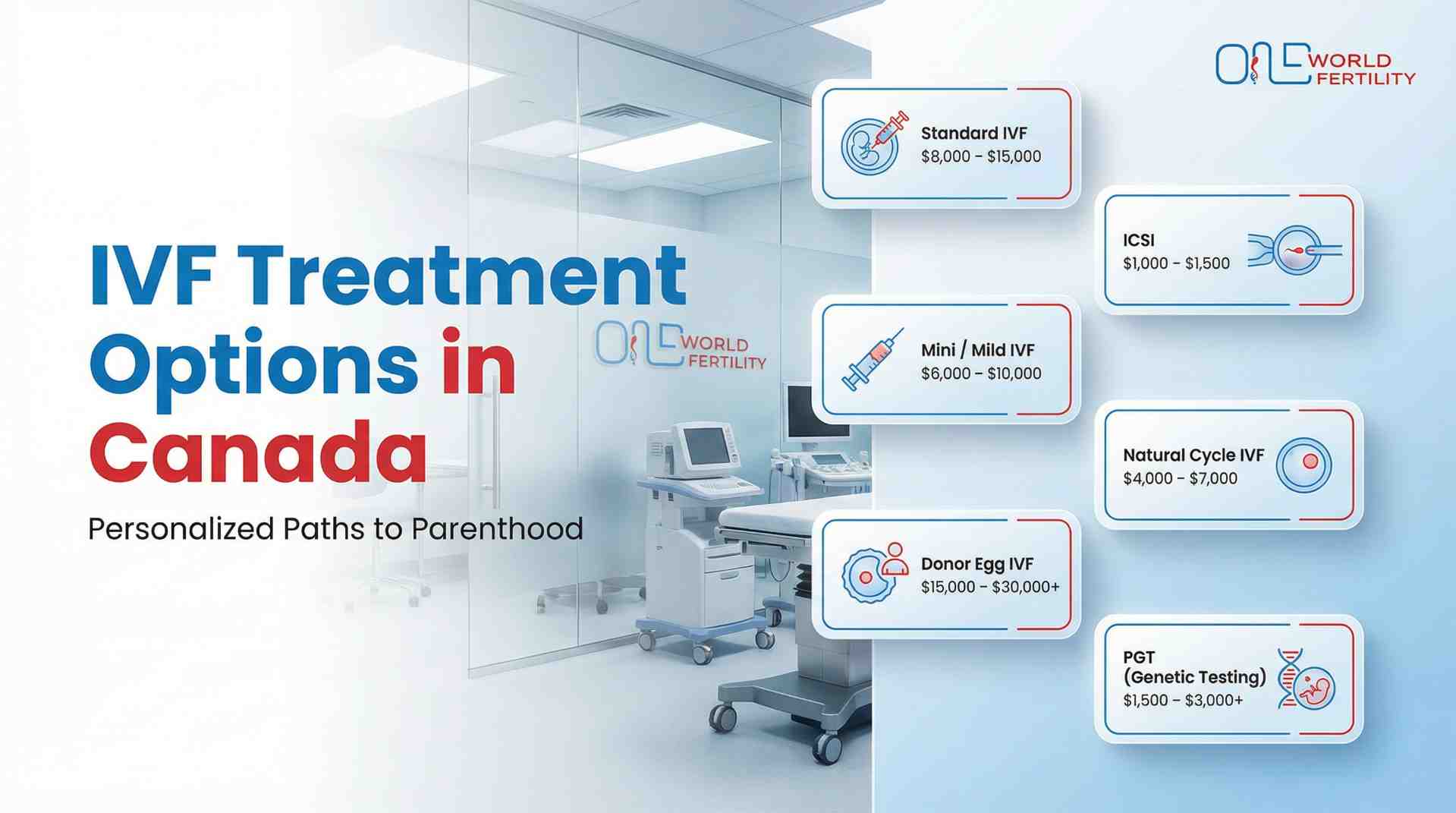
- Standard IVF: The most popular way, which uses hormones to make more eggs that can be fertilized and transferred. The best for most people. $8,000.–$15,000.
- ICSI: Each egg received one healthy sperm, which was directly injected into it. When sperm quality or count is a worry, this test is suggested. ($1,000 to $1,500 extra)
- Mini or Mild IVF: Lower amounts of medicine are better for the body and the wallet. A good fit for women with low ovarian reserve. ($6,000 to $10,000)
- Natural Cycle IVF: It only works with the flow of your body. Little to no medicine, one egg, and the least amount of work of all the choices. ($4,000 to $7,00)
- Donor Egg IVF: This is what women over 43 or with a significantly reduced ovarian reserve should do. $15,000.–$30,000.+
- PGT: Genetic testing of embryos before they are transferred. When chromosomal or inherited diseases are a worry, they can be added to any cycle. ($1,500–$3,000-plus)
IVF Protocol Comparison - Canada
| Type |
Estimated Cost |
Best For |
| Standard IVF |
$8,000 – $15,000 |
Most patients |
| ICSI (Add-On) |
$1,000 – $1,500 |
Male factor infertility |
| Mini IVF |
$6,000 – $10,000 |
Low ovarian reserve |
| Natural Cycle IVF |
$4,000 – $7,000 |
Minimal medication preference |
| Donor Egg IVF |
$15,000 – $30,000+ |
Age 43+, very low reserve |
| PGT (Add-On) |
$1,500 – $3,000 |
Genetic screening needs |
Inclusive IVF in Canada - LGBTQ+ & Single Parents
Canada is one of the most open places in the world when it comes to IVF and other forms of fertility care. And it doesn't matter if you're a same-sex couple, a parent by choice, or building your family in a way that isn't the norm; Canadian fertility clinics are ready and happy to help you along the way. Strong legal protections are in place, and in most provinces, getting public support doesn't depend on your relationship status or sexual orientation.
Reciprocal IVF in Canada
Reciprocal IVF is one of the most important choices for same-sex female couples, and fertility clinics in Canada are seeing a steady rise in demand for it. One partner lays the eggs, which are fertilized by donor sperm, and the other partner is pregnant. There is a deep connection between both partners on the trip, and many couples say it is one of the most connected times of their lives.
What does reciprocal IVF cost in Canada? It ranges from $12,000 to $20,000, based on the cost of donor sperm, clinic fees, and extras like ICSI or PGT. You can get it at most of the big fertility centers in Toronto, Vancouver, Calgary, and Montreal.
Single Parent by Choice (SPBC) - IVF in Canada
It's brave and beautiful to decide to have a child on your own, and Canada's fertility system fully supports that choice. You don't have to be married or in a relationship to use donor sperm IVF or donor egg IVF. You can choose to be a single parent. In Canada, there are no laws that stop single parents from getting fertility care. Costs depend on the route you take. Donor sperm IVF usually costs $8,000 to $15,000 plus $1,000 to $2,000 in fees for the sperm donor. Donor egg IVF costs $15,000 to $30,000 or more. Different provinces may have different rules about who can get public funding, so you should check with your clinic to see if Ontario's supported cycle or British Columbia's grant program applies to your case.
Donor Egg IVF in Canada - Cost & Legal Guidelines
One thing that catches many families off guard - Canada only allows altruistic egg donation. No payment, only expense reimbursement. It comes from a good ethical place, but it does create real-world challenges worth knowing about.
- Paid donation is not legal: Donors are reimbursed for expenses only
- Wait times can be long: Sometimes 12 to 24 months domestically
- Many families go abroad to find donors: Spain, the Czech Republic, and the US all have shorter wait times and larger donor groups.
- The success rate is very good: 50-60% of cycles result in live births.
- Matching, screening, clinic, and other fees: Which always add up to more than $15,000.
Best IVF Clinics in Canada - How to Choose
One of the most important choices you will make on your journey is picking the right fertility clinic. You should do more than just a quick Google search. What really matters is this:
- Age-specific success rates: Never ask for the clinic's overall live birth rate; always ask for the rate for your age group.
- Lab technology: Time-lapse photography, AI embryo selection, and the standard of cryopreservation have a direct effect on your results.
- Transparent pricing: Any centre you can trust will give you a clear estimate of the total cost, including any extras.
- Patient reviews: As important as clinical numbers are, how staff talk to each other during tough times is equally important.
- Location: Consider how easy it is to reach the three to five monitoring visits per cycle.
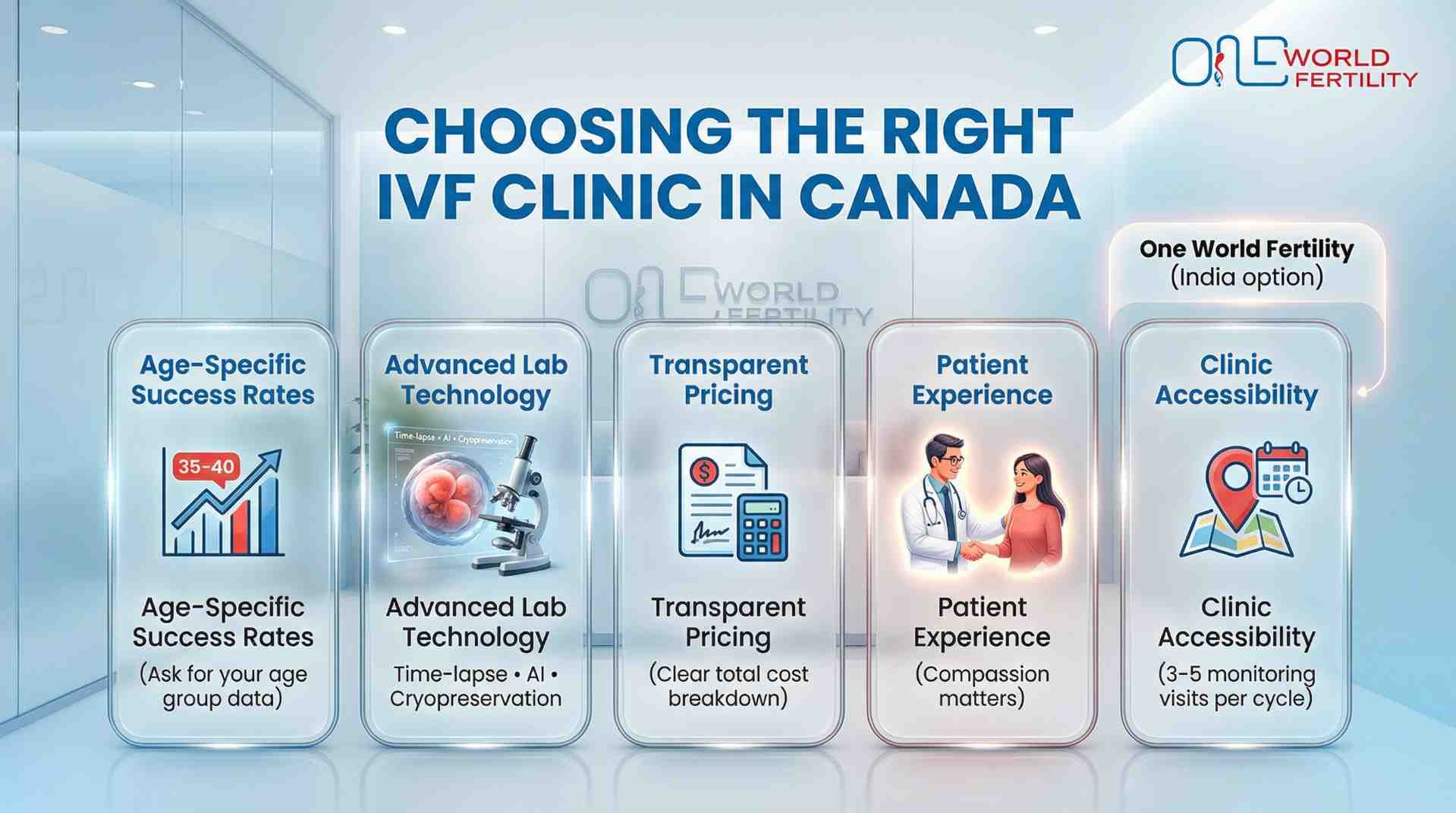
If you're exploring fertility treatment beyond Canada's borders, One World Fertility in India is worth knowing about - a highly advanced clinic offering world-class IVF technology, transparent pricing, and genuine support from first consultation through to treatment completion.
IVF in Toronto vs Vancouver vs Other Provinces
It depends on where you live in Canada, not only on how much IVF costs, but also on how easy it is to get funds. The differences are bigger than most people think.
IVF in Toronto (Ontario)
In terms of making it easy to get IVF in Ontario, it is one of the best states in the country. The Ontario Fertility Program pays for one IVF cycle, which includes the process itself. This can help you a lot with your finances. One important thing to keep in mind is that waitlists usually last 6 to 18 months, so the sooner you sign up, the better. Sign up now, and get ready while you wait. Don't wait until you feel ready.
IVF in Vancouver (British Columbia)
BC has made something really caring for families who want to consider IVF in Vancouver. BC doesn't have a single term that all recipients get. Instead, they offer a sliding-scale grant of up to $19,000 based on your income. This means that the amount of help you get depends on what you actually need. This is a real lifesaver for families with low incomes during a time that is already very hard.
IVF in Other Provinces
In Alberta, IVF is mostly paid for by private patients because the government doesn't pay for it. This is something you should think about when planning your budget early on. Quebec has a tax credit method that helps lower costs through your yearly return, rather than paying for them all at once. No matter where you live, knowing how much money your state has available for clinics could save you a lot of money and stress.
Low-Cost IVF in Canada - Smart Ways to Reduce Expenses
IVF in Canada doesn't have to drain your savings - and it won't, if you plan smart. Here's what actually helps.
- Check your provincial funding first: Ontario covers up to $15,000 in procedure costs. BC's grant goes even higher depending on your income. This is always the first conversation to have.
- Compare clinic packages: prices vary more than you'd expect, even within the same city. Multi-cycle bundles are worth asking about if more than one cycle is on the cards.
- Ask about generic medications: a simple question that could save you $500 to $1,000 per cycle. Many patients never think to ask.
- Check your workplace benefits: fertility drug coverage through employer plans is more common than most people realise. A quick call to HR could genuinely surprise you.
Cost-Saving Strategies in Canada
| Strategy |
Possible Savings |
| Government Funding |
$8,000 – $15,000 |
| Multi-Cycle Package |
$1,000 – $3,000 |
| Generic Medications |
$500 – $1,000 |
| Employer Insurance |
$1,000 – $3,000 |
| Public Waitlist |
Major savings |
Moving Forward with Confidence - Your Canada IVF Journey
You're already doing something important by reading this far: you're getting ready, not just hoping. That's more important than you think. Canada has some of the strictest medical rules in the world, but IVF is safe and well controlled there. It's okay if it takes more than one run. Keep your eyes open. Know how much it really costs. Know your chances of success. Pick a place that makes you feel like they care about you. No matter what, every year in Canada, everyone who gets fertility treatment has a child. You could be one of them.
If you're thinking about getting fertility treatment outside of Canada, you should know about One World Fertility in India. It's a very advanced clinic with world-class IVF technology, clear pricing, and committed support from the consultation all the way through the treatment.